
REVIEW · PRIVATE GUIDED TOURS WITH DRIVER
Kyoto 8hr Private Tour with Government-Licensed Guide
Kyoto rewards travelers who slow down, and this private eight-hour walking tour gives you a guide who can shape the day around your interests. You choose four to six places, then work with your English-speaking, government-licensed guide to build the route.
I like the personal planning and the chance to mix major sights with quieter corners such as Pontocho, Higashiyama, or a small temple in Arashiyama. I also like that the tour can suit a group of six, as it did for one party guided by Karkoo Tanigawa. The main consideration is cost: at $201.46 per person, you still pay for transport, meals, and most entrance fees.
In This Review
- Key points to know before booking
- A flexible Kyoto day, not a checklist
- Fushimi Inari and the southern temples
- Kiyomizu-dera, Higashiyama, and Gion
- Markets, food, and evening streets
- Nijo Castle and the Imperial Palace
- Northern Kyoto: Kinkakuji, Ryoanji, and Ninna-ji
- Arashiyama’s bamboo and quieter temple paths
- Eastern hills and northern mountain escapes
- What the $201.46 price really buys
- Guide style and practical planning
- Who should book this Kyoto tour?
- FAQ
- How long is the Kyoto private tour?
- How many sites can I choose?
- Is transportation included?
- Are temple and castle admission fees included?
- Is this a private tour?
- What is the cancellation policy?
- Should you book it?
Key points to know before booking
- You choose four to six sites: The long list of possible stops is a menu, not a promise that you will see them all.
- Your guide helps shape the route: After booking, the guide contacts you to plan around history, architecture, food, gardens, or another interest.
- It is a walking tour: Meet and finish on foot within the designated Kyoto area. There is no private vehicle.
- Major sights cost extra: Kiyomizu-dera, Nijo Castle, Kinkakuji, and most temples listed require separate admission payments.
- Private means private: Only your group participates, and groups cannot be combined.
- Plan ahead: Booking at least two weeks in advance is requested, while the average booking point is about 69 days before the tour.
A flexible Kyoto day, not a checklist
Kyoto has too many worthwhile places for one sensible eight-hour outing. That is why the tour’s best feature is not the enormous stop list. It is the ability to narrow that list to a day that fits your pace.
You can choose four to six sites before the tour. If you already know Kyoto, send the guide your priorities. If you do not, ask for a suggested route based on your interests. A history-focused day might pair Nijo Castle, the Imperial Palace, and major temples. A first visit might work better with Fushimi Inari, Kiyomizu-dera, Gion, and Nishiki Market.
I would not try to force Fushimi Inari, Arashiyama, Kinkakuji, Ginkakuji, and southern Kyoto into one day. Kyoto is spread out, and each major sight needs time on foot. The guide can help you avoid building a route that looks impressive on paper but leaves you watching the clock.
The supplied duration notes show short sample stops, from 10 to 30 minutes. Treat those figures as planning markers, not a promise of a full visit at every place. For major temples and districts, you will want to agree in advance on how much time goes to entering, walking, taking pictures, and hearing the explanation.
More Private Guided Tours with Driver in Kyoto
- Kyoto 6hr Private Tour with Government-Licensed Guide
★ 5.0 · 1,369 reviews - Kyoto 4hr Private Tour with Government-Licensed Guide
★ 5.0 · 629 reviews - Kyoto: Private Tour with Local Licensed Guide
★ 4.8 · 463 reviews
Fushimi Inari and the southern temples
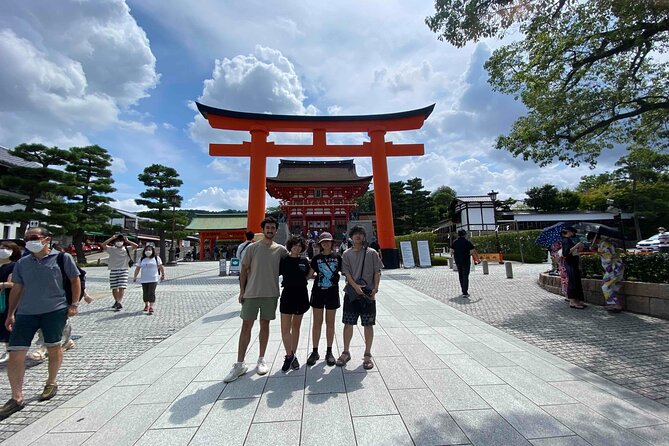
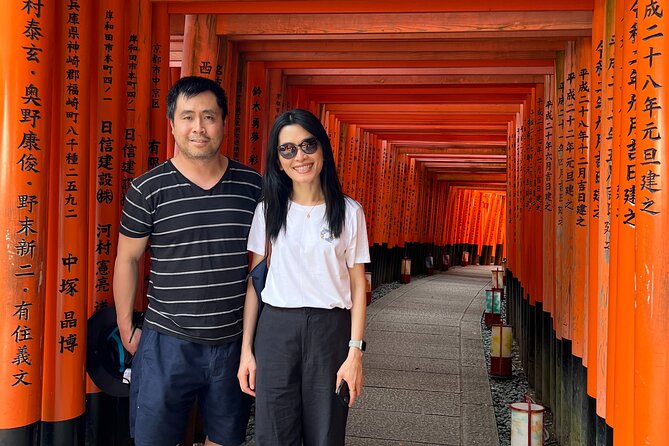
Fushimi Inari-taisha is one of Kyoto’s essential shrines, famous for its long rows of orange torii gates. It can be a strong opening stop because it gives you a clear sense of Shinto practice and Kyoto’s wooded eastern hills.
The important planning question is how far you want to walk. A quick visit near the lower shrine grounds is very different from walking farther up the mountain. Ask your guide to set the right expectation for your group, especially if you want to reach quieter sections rather than simply photograph the first gates.
Nearby Tofuku-ji offers a different mood. This large Zen temple is especially known for autumn color, and its broad grounds give you more room to walk than the tight lanes around some central sights. Admission is extra.
Toji, Kyoto’s East Temple, connects the city to the early Heian period, when Kyoto became the imperial capital. Its grounds and history make it a useful choice for visitors who want an important temple without committing the whole day to the northern or western parts of town. Entrance arrangements and fees should be confirmed with the guide.
Sanjusangendo is another strong choice for art and religious history. Its main attraction is a hall containing 1,001 statues of Kannon, the Buddhist figure associated with mercy. The listed visit time is 30 minutes, but admission is not included, so ask about timing and cost before adding it.
Kiyomizu-dera, Higashiyama, and Gion
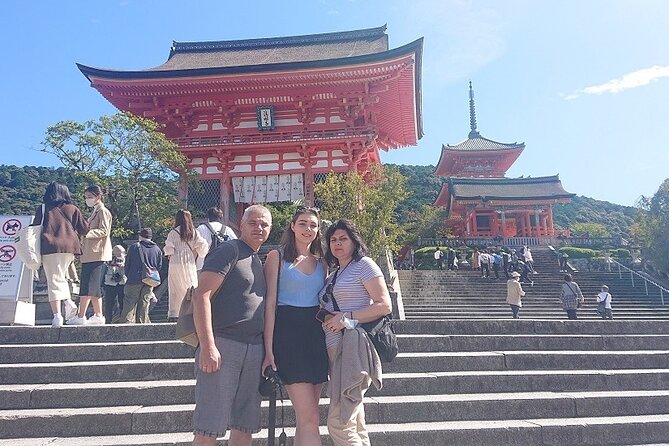
Kiyomizu-dera is one of the easiest places to understand why Kyoto feels unlike a modern Japanese city. The temple rises above the historic Higashiyama area, and the approach leads through old-style streets where walking itself becomes part of the visit.
The temple admission is not included. The approach and temple grounds can also make this a tiring stop if you are already carrying shopping bags or have mobility concerns, so tell the guide how fast your group wants to move.
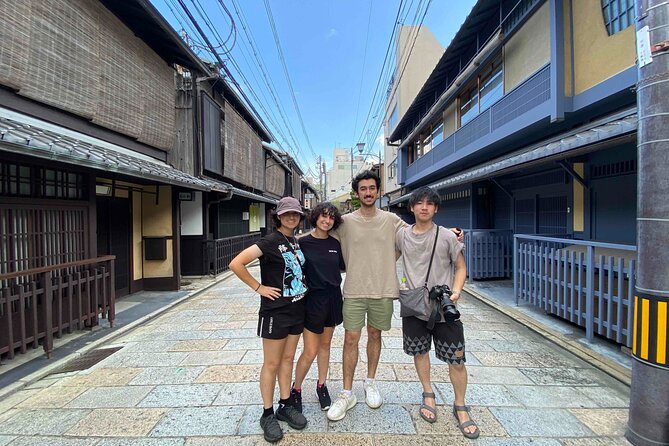
Higashiyama is a natural partner for Kiyomizu-dera. This preserved district along the lower eastern mountains is best enjoyed on foot, with time for the streets, wooden buildings, and small details between major sights. It is not one single attraction with a quick entrance and exit. It rewards a slower pace.
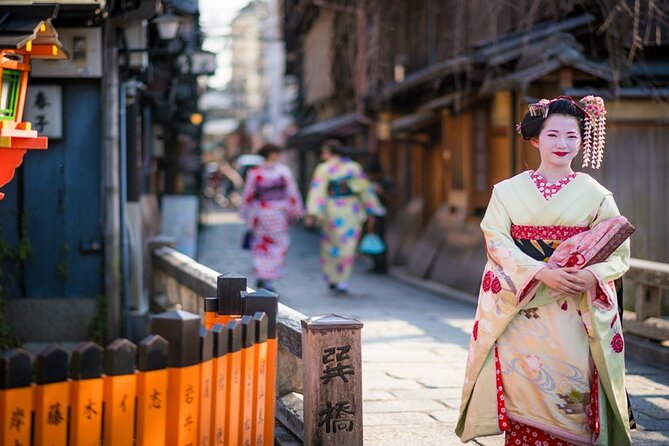
Gion gives the day a different focus. The district is known for geisha traditions, narrow lanes, and old Kyoto architecture. A guide is useful here because the streets can be confusing, and because the value comes from understanding the setting rather than simply passing through it.
Kennin-ji is close to Hanamikoji and Shijo streets, but its temple grounds offer a break from the surrounding city. Its dry gardens make it a good pick for visitors interested in Zen design. The listed sample stop is only one minute, which is clearly too brief for anyone hoping to see the temple properly, so request enough time if you choose it.
Markets, food, and evening streets
Nishiki Market is Kyoto’s Kitchen, a narrow shopping street running for about five blocks and lined with more than 100 shops and restaurants. It is a practical stop for seeing local food culture, browsing ingredients, and fitting a snack into a temple-heavy day.
The market works well for people who want a little variety. You can look at it as a cultural stop, not just a place to eat. Still, the tour does not include lunch or personal purchases, and the guide cannot make those costs disappear. If food matters to you, say so while planning the itinerary.
Pontocho is another compact district with a very different feel. The narrow alley runs between Shijo-dori and Sanjo-dori, close to the Kamogawa River, and is lined with restaurants. It is a good evening-oriented addition, though the tour’s eight-hour format means you should discuss when you want to visit it.
The guide can help connect these central stops into a coherent walk. That is more useful than simply collecting names. Nishiki Market, Gion, Pontocho, and Higashiyama all touch different parts of old Kyoto, but the day can become repetitive if you choose too many similar lanes and shopping areas.
Same city, a completely different kind of day:
- PERFECT KYOTO 1-Day Bus Tour
★ 5.0 · 13,518 reviews - Kyoto: Fushimi Inari, Kinkakuji, Bamboo Grove 1 Day Bus Tour
★ 4.8 · 4,316 reviews - Kyoto: Tea Ceremony in a Traditional Tea House in Kiyomizu
★ 4.9 · 3,519 reviews - Kyoto Geisha Walking Tour: Gion District & Hidden Gems
★ 4.7 · 3,273 reviews
Nijo Castle and the Imperial Palace
Nijo Castle offers a direct connection to political history. Tokugawa Ieyasu built it in 1603 as his Kyoto residence, at the start of the Edo period. The site helps explain the power structure of early modern Japan and gives your guide a solid base for discussing shoguns and the imperial court.
Admission is extra. Nijo Castle is a better choice for you if history matters more than simply seeing another beautiful temple. It also gives the day some variety after repeated shrine and Zen temple visits.
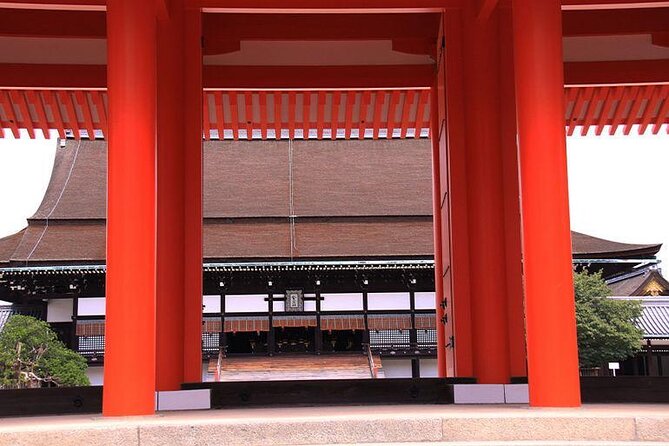
The Kyoto Imperial Palace served as the Imperial Family’s residence until 1868, when the emperor and capital moved to Tokyo. It sits within spacious Kyoto Gyoen, so this stop feels more open than Gion’s alleys or the narrow market street.
The Palace is not simply another old building to photograph. Its importance comes from Kyoto’s long role as Japan’s political and ceremonial center. Admission is listed as not included, and the tour description does not promise special access, so ask your guide what areas and timing apply to your visit.
Northern Kyoto: Kinkakuji, Ryoanji, and Ninna-ji
Kinkakuji, the Golden Pavilion, is one of Kyoto’s most recognizable sights. Its top two floors are covered in gold leaf, and the pavilion is set beside a pond in a formal garden. Admission is extra, and the stop can be brief if you are trying to fit several distant places into one day.
Ryoanji is the right choice if you want a quieter lesson in Zen garden design. Its famous rock garden is one of Japan’s best known, but the visit is not only about counting stones or taking a picture. A guide can give the setting context and point out how the temple’s former life as an aristocratic villa shaped the site.
Ninna-ji, founded in 888, is a World Heritage temple and the head temple of the Omuro school of Shingon Buddhism. It adds age and religious variety to a northern Kyoto route. Like most temples on this list, admission is separate.
These three sites can make a sensible northern day, but they are not a quick central stroll. If you combine them with Fushimi Inari or Arashiyama, transport time becomes important. Since transportation is not included, decide if the convenience of a guide is worth the added train, bus, or taxi costs for your group.
Arashiyama’s bamboo and quieter temple paths
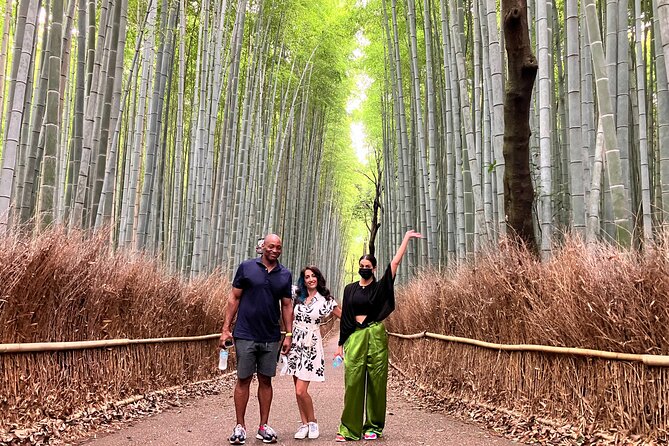
Arashiyama is a popular western Kyoto district known for its wooded hills, temples, river views, and bamboo paths. The Togetsukyo Bridge is its best-known landmark, and the nearby bamboo groves offer an easy walk.
The bamboo paths are free, but Arashiyama is not a single short stop. Ten minutes may be enough for a quick photo, not for a relaxed visit. If you want the district to be a major part of the day, choose fewer additional sites.
Tenryu-ji is the area’s most important temple and a World Heritage site. It was ranked first among Kyoto’s five great Zen temples. Okochi Sanso Garden, the former villa of actor Okochi Denjiro, adds carefully arranged gardens and buildings at the back of the bamboo groves, though admission is extra.
For a quieter Arashiyama route, consider Jojakko-ji, Nisonin, Gio-ji, Adashino Nenbutsu-ji, and Otagi Nenbutsu-ji. Jojakko-ji and Nisonin sit on the hillside, while Gio-ji is known for its moss garden and thatched structures.
Otagi Nenbutsu-ji is especially distinctive for its 1,200 stone rakan statues, each with a different face. Adashino Nenbutsu-ji sits at the end of the preserved Saga-Toriimoto street and is linked to memorial stone figures placed for the dead.
All these stops have admission fees listed as not included, and several are a ten-minute sample visit. I would choose one or two, not all of them, unless your group wants a full temple day and is comfortable with plenty of walking.
Eastern hills and northern mountain escapes
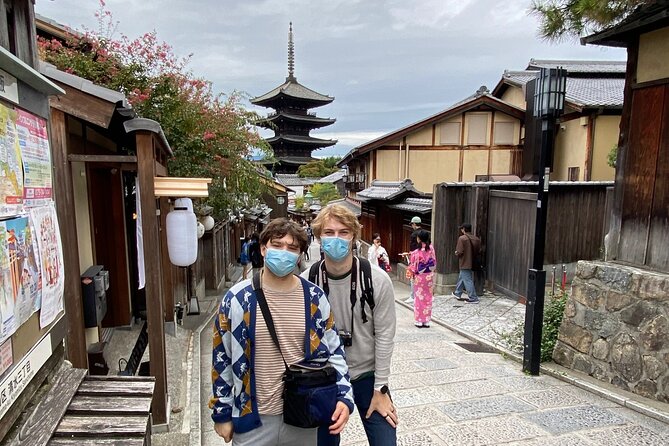
Ginkakuji, the Silver Pavilion, was built in 1482 as the retirement villa of shogun Ashikaga Yoshimasa. Despite its name, it is not covered in silver. Its appeal comes from its Zen setting, gardens, and the story of how a shogun’s retreat became a temple.
Nanzenji is one of Kyoto’s major Zen temples, with spacious grounds at the foot of the Higashiyama mountains. Nanzenji Suirokaku, the brick aqueduct, adds an unusual piece of engineering to the temple visit. Eikando, north of Nanzenji, is especially noted for autumn color and evening illumination, with a listed sample visit of 30 minutes.
Shugakuin Imperial Villa offers a more formal garden and imperial setting. It was built in the 17th century by Emperor Gomizuno and is managed by the Imperial Household Agency. Katsura Imperial Villa is another high-value choice for architecture and garden design, with its present form completed in 1645.
The northern mountain options, Kibune River and Kurama-dera, change the character of the day again. Kibune developed around Kifune Shrine, while Kurama is known for Kurama-dera and its hot spring. These places are less suited to a packed city sightseeing route. Choose them if you want forest, mountain air, and a slower outing rather than a greatest-hits day.
What the $201.46 price really buys
At $201.46 per person, this is not a budget walking tour. The price is easier to justify for a private group that wants planning help, English explanations, and a day built around personal interests.
You are paying for a licensed local guide and a private activity, not a private car. Transportation, lunch, entrance fees, and other personal expenses are extra. Guide entry fees are covered only for sights listed in the tour’s expected selection, so confirm the details if you choose an unusual combination.
The value improves when several people share the planning and guiding service. A group of six can spread the cost across a full day, while a solo visitor may find the per-person price harder to defend.
The guide can also save you from wasting time on a poor route. That matters in Kyoto, where a day can disappear between distant districts. Still, the tour cannot remove every cost or make four far-flung areas feel close together.
Guide style and practical planning
The tour uses government-licensed, English-speaking guides. Names connected with the experience include Karkoo Tanigawa, Ichiro, and Shu. Your assigned guide may be different, so ask who will lead your day once the planning contact is made.
One useful tip is to have Japanese yen and transportation cards ready. That allowed a six-adult group to start moving right away, rather than losing time at the first ticket or transit machine. Since fares are not included, this small bit of preparation matters.
Pickup and drop-off are on foot within a designated Kyoto area. The tour is near public transportation, and most people can participate, but you should be clear that this is not a vehicle tour. Service animals are allowed.
You can cancel for a full refund up to 24 hours before the local start time. Changes made inside that 24-hour window are not accepted, and booking at least two weeks ahead is requested.
Who should book this Kyoto tour?
I would choose this tour if you want a private day and have a clear idea of what Kyoto means to you. It suits families, couples, and small groups who prefer asking questions and setting their own pace rather than joining a fixed bus route.
It is also a good fit for a first visit if you do not know how to connect the city’s major sights. Ask for a route that limits backtracking and includes a mix of temples, food, and historic streets.
I would skip it if you want an inexpensive group outing, a private vehicle, or a guide-led visit to every place on the long stop list. The tour works best when you choose four to six sites carefully, not when you try to see all of Kyoto in one day.
FAQ
How long is the Kyoto private tour?
The tour lasts approximately eight hours.
How many sites can I choose?
You can customize the day around four to six sites from the available selection.
Is transportation included?
No. Transportation fees are not included, and the tour does not provide a private vehicle. You meet and finish with the guide on foot within the designated Kyoto area.
Are temple and castle admission fees included?
Most entrance fees are not included. The tour states that guide entry fees are covered only for sights listed in the expected selection.
Is this a private tour?
Yes. Only your group participates, and multiple tour groups cannot be combined.
What is the cancellation policy?
You can cancel at least 24 hours before the local start time for a full refund. Cancellations or changes made less than 24 hours before the start are not accepted for a refund.
Should you book it?
Book this tour if you want Kyoto explained by a licensed local guide and prefer a private day shaped around your group. Prepare transportation cards and local currency, choose four to six sites that fit together, and tell the guide if your priority is temples, food, gardens, architecture, or history.
The best value comes from using the guide to make smart choices. Pick a focused route, allow time for walking, and treat Arashiyama, the northern temples, and the southern shrines as separate possibilities. Done that way, the eight-hour format can give you a thoughtful first look at Kyoto instead of a hurried collection of photographs.
Just added around Kyoto
- Private Guided Traditional Buddhist Cooking in Japan★ 5.0 · 16 reviews
- Kyoto: Gion Geisha District & Sake-in-Hand Walking Tour★ 5.0 · 37 reviews
- Your Private Vacation Photography Session In Kyoto★ 5.0 · 110 reviews
- Kyoto: Zen Meditation at a Private Temple with a Monk★ 5.0 · 25 reviews
- Traditional Japanese Washi Papermaking- Kyoto morning★ 5.0 · 77 reviews
- Kyoto Wagashi(Japanese sweets) Cooking Class near Fushimiinari★ 5.0 · 60 reviews
- Private Pewter Sake Cup Experience with a Kyoto Artisan★ 5.0 · 31 reviews
- Private Cooking Class Udon in Kyoto Japan★ 5.0 · 23 reviews
Private Guided Tours with Driver, compared.
Tokyo 4hr Private Tour with Government-Licensed Guide
Read our review →
Kyoto 6hr Private Tour with Government-Licensed Guide
Read our review →
Hiroshima / Miyajima Full-day Private Tour with Government Licensed Guide
Read our review →
Kyoto 4hr Private Tour with Government-Licensed Guide
Read our review →
Mt. Fuji Day Trip from Tokyo with English Speaking Driver Guide
Read our review →
Hiroshima City 4hr Private Walking Tour with Licensed Guide
Read our review →Browse the lists this tour appears in