
REVIEW · MIYAJIMA ISLAND TOURS
Kimono and Tea Ceremony in Miyajima
The best part of this Miyajima activity is the setting: you leave the island’s busy shopping streets and spend an hour at Tokuju-ji Temple, learning matcha manners in a calm temple space. You choose from more than 100 kimonos, receive careful help dressing, then watch a tea master before making tea yourself.
I like the small-group format, which gives you time to ask questions and take pictures without feeling rushed. I also like that you do not merely watch a ceremony: you whisk and taste your own matcha, with a sweet served alongside it. The main consideration is time. One hour passes quickly, and the tea ceremony uses a table-style setup rather than the floor seating some people expect.
In This Review
- Key points to know before booking
- Tokuju-ji Temple gives the hour a peaceful setting
- Choosing a kimono is more than a quick costume change
- The ceremony begins with watching closely
- Making your own matcha is the hands-on highlight
- Photos turn the kimono session into a souvenir
- Table seating is practical, but not the classic floor setup
- Is $85.89 fair for one hour?
- Who should book this Miyajima activity?
- Should you book the kimono and tea ceremony?
- FAQ
- Where does the kimono and tea ceremony take place?
- How long does the activity last?
- How many people can join?
- What age can participate?
- Are kimonos provided?
- Do I make my own matcha?
- Is cancellation free?
Key points to know before booking
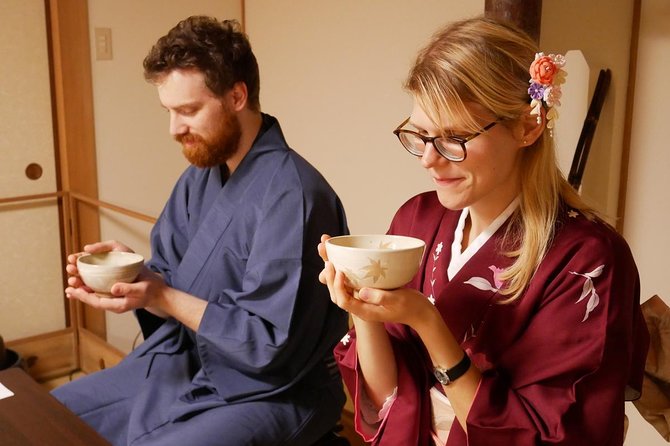
- Choose from more than 100 kimonos: Staff help you select and fit traditional clothing, with options for men, women, and children.
- A quiet temple setting: Tokuju-ji is close to the ferry port but away from Miyajima’s busiest business streets.
- Watch, then make matcha: A tea master demonstrates the ceremony before you prepare your own tea.
- Photos are part of the fun: Staff take pictures during the lesson, and you can receive them after answering a questionnaire.
- Small and personal: The activity is presented as an intimate group experience, with a stated maximum of 10 people.
- Good for families: Children age 6 and older can join, and several families have used the experience as a cultural activity.
Tokuju-ji Temple gives the hour a peaceful setting
Miyajima is famous for the large torii gate, Itsukushima Shrine, deer, and busy lanes lined with oysters and sweets. Those are worthwhile, but the island can feel crowded, especially when ferry arrivals fill the main streets.
This activity takes you to Tokuju-ji Temple, at 741-1 Miyajimachō. The meeting point is near the ferry port and public transportation, so you can reach it without arranging a separate ride. The activity ends where it begins, which makes it easy to continue sightseeing afterward.
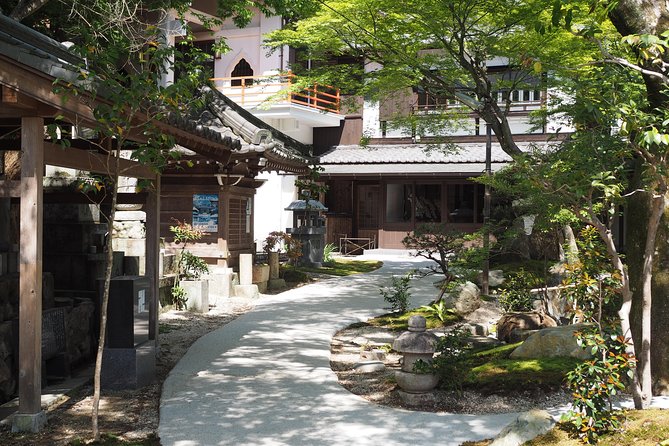
The temple setting matters. Tea ceremony is built around attention, quiet, and courtesy, and the grounds provide a better backdrop than a busy commercial room. You may have time for pictures in the garden and around the temple grounds after dressing. The location also gives you a short break from Miyajima’s main tourist flow without taking you far from the ferry.
Do allow a little extra time to find Tokuju-ji. The meeting address is supplied in Japanese as well as English, and the activity begins near a working temple rather than at a large attraction with a prominent tour desk. A mobile ticket is provided, and your booking confirmation arrives at the time of booking.
More tea ceremony experiences in Hiroshima:
- Hiroshima Local guided Hiking Tour&Open-air Tea Ceremony
★ 5.0 · 213 reviews - An Amazing set of Cultural experience: Kimono, Tea Ceremony and Calligraphy
★ 5.0 · 69 reviews - Hiroshima: Morning Hiking Tour with Open-air Tea Ceremony
★ 4.8 · 58 reviews
Choosing a kimono is more than a quick costume change
The activity begins with dressing. You choose a favorite kimono from a collection of more than 100, then staff provide the other clothing and accessories needed for the outfit. The fitting is done with care, and staff help with the layers and adjustments.
That personal attention is one of the strongest reasons to choose this activity over a simple kimono rental. You are not just picking up an outfit and heading into town on your own. The staff dress you for the ceremony and help you look appropriate for the setting.
The selection includes kimono for men and women, and the activity is suitable for children from age 6. One useful point from the experience is that the staff have been able to accommodate a range of body sizes, including a taller person wearing a larger size. Still, the supplied information does not promise a specific size range, so if fit is a concern, contact the operator before booking.
Dressing takes a meaningful portion of the one-hour schedule. That is not wasted time, but you should understand the tradeoff. You will not spend a long afternoon in kimono, strolling all over Miyajima. You will have a focused dressing, tea, and photography session.
The careful fitting also adds cultural context. Traditional clothing is not simply pulled on like a jacket. The staff show you the proper way to wear it, and the process helps you appreciate the care that goes into formal Japanese presentation.
The ceremony begins with watching closely
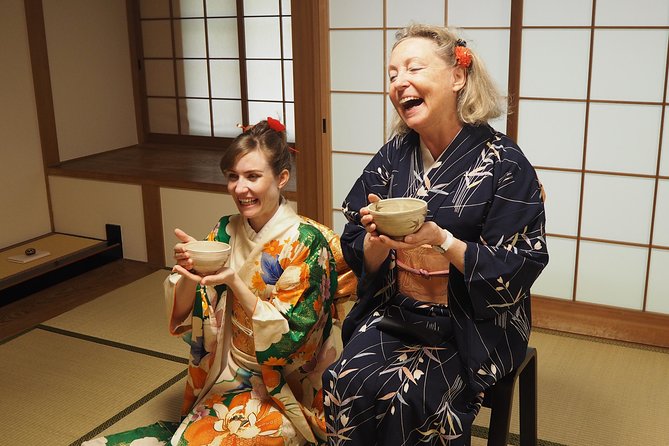
Once everyone is dressed, you watch a tea ceremony conducted by a tea master. The demonstration shows how the tea is prepared, served, and received, along with the manners expected during the ceremony.
You will learn how to drink matcha in the proper manner. This may include details that are easy to miss if you only attend a formal demonstration, such as how to handle the bowl and how to approach the sweet served with the tea. The explanation also connects tea preparation with the four principles associated with the tradition: harmony, respect, purity, and tranquility.
The staff are used to explaining the ceremony to international visitors, and English-language assistance is available. That is important because the actions can seem mysterious when you do not know why each movement matters. Here, the ceremony is taught step by step rather than presented as a silent performance.
The atmosphere is formal, but the tone is friendly. You can ask questions, and the staff make an effort to keep participants comfortable. That balance works well for first-time visitors. You receive a real introduction to the custom without needing prior knowledge of Japanese tea culture.
The tea ceremony is still a structured ritual, not a casual matcha café tasting. If you want a quick cup of green tea, this is more time and instruction than you need. If you want to understand the etiquette behind the drink, the format is much more rewarding.
Making your own matcha is the hands-on highlight
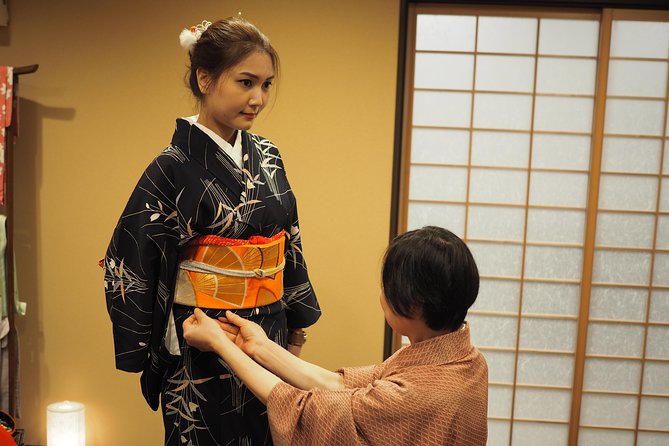
After watching the tea master, you learn to make matcha yourself. You prepare and whisk the tea, then taste what you have made. This turns the session from a demonstration into a practical lesson you can repeat at home.
The instructions are designed for beginners. You do not need to know how to use a bamboo whisk before arriving. The staff guide you through the process and explain the manners around serving and drinking the tea.
A sweet is served with the matcha. This is not just a treat on the side. Japanese tea ceremony traditionally pairs bitter tea with a small sweet, creating a useful contrast in taste. Local Miyajima chocolate may also be included, and it has become a memorable part of the welcome for many participants.
You can take the lesson home in a simple way. After returning from Japan, you can buy matcha and try the method with friends. It will not reproduce every formal detail of the ceremony, but you will understand the basic rhythm and purpose of the preparation.
The one-hour length means the lesson is introductory. You will not become a tea master in one visit, and the activity does not claim to offer advanced training. Its value is giving you a clear, respectful first look at the practice, along with the chance to perform the essential steps yourself.
More kimono & culture experiences in Hiroshima:
- Cultural Activities :Kimono, tea ceremony, Calligraphy and Amulet
★ 5.0 · 44 reviews - Calligraphy Workshop at Traditional Folk Craft Shop in Hiroshima
★ 5.0 · 26 reviews - Kimono and Calligraphy Experience in Miyajima
★ 5.0 · 16 reviews - Private Hiroshima Calligraphy: Create Your Own Kanji Art Souvenir
★ 5.0 · 12 reviews
Photos turn the kimono session into a souvenir
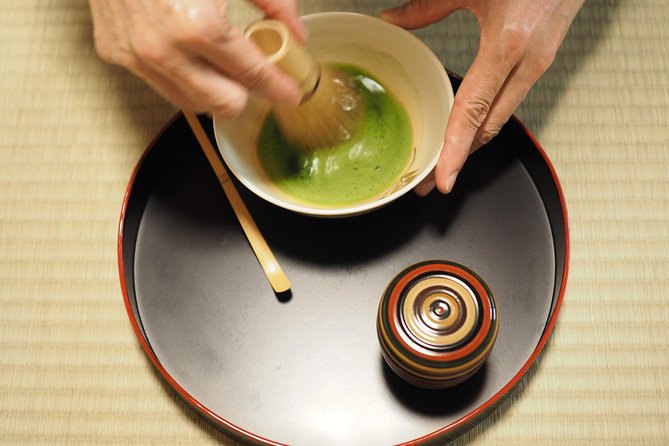
Staff take pictures during the dressing and tea lesson. You may receive the images after answering a questionnaire, so you should expect a small follow-up step rather than an automatic photo package at the end.
You can also take your own pictures, including in the garden and temple grounds. The setting gives you more visual variety than a plain indoor studio, and the kimono makes the photographs feel tied to Miyajima rather than simply being a dress-up portrait.
This is particularly useful if you are visiting with family or friends. Staff can help record the ceremony, and one solo participant had the tea-making process filmed and sent through Instagram. The exact delivery method may vary, but it is worth asking how you will receive the images before you leave.
You should also keep the schedule in mind. The pictures are a pleasant part of the activity, but the main purpose remains dressing and tea ceremony. If you want an extended photo shoot with many locations and elaborate poses, a dedicated kimono photography session would suit you better.
Table seating is practical, but not the classic floor setup
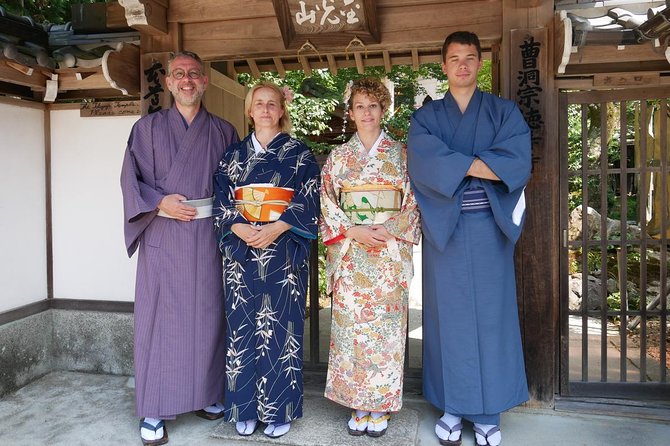
Some people picture tea ceremony as sitting formally on tatami mats with knees folded beneath them. This activity uses tables for tourists and other participants. That can feel less traditional if floor seating is what you hoped to experience.
There is a sensible reason for the arrangement. Sitting on the floor for a formal ceremony can be difficult, even for many Japanese people, and table-style tea practice has been used in Japan for more than a century. The table setup lets more people participate comfortably and keeps attention on the tea rather than on aching knees.
If you have limited mobility or simply dislike floor seating, this is likely a benefit. If the visual detail matters greatly to you, ask about the seating before booking so you arrive with the right expectations.
The ceremony can still feel formal at a table. Clothing, gestures, sweets, tea bowls, and the quiet temple surroundings carry much of the atmosphere. The experience is not made inauthentic by the furniture, but it is different from the image many visitors bring with them.
Is $85.89 fair for one hour?
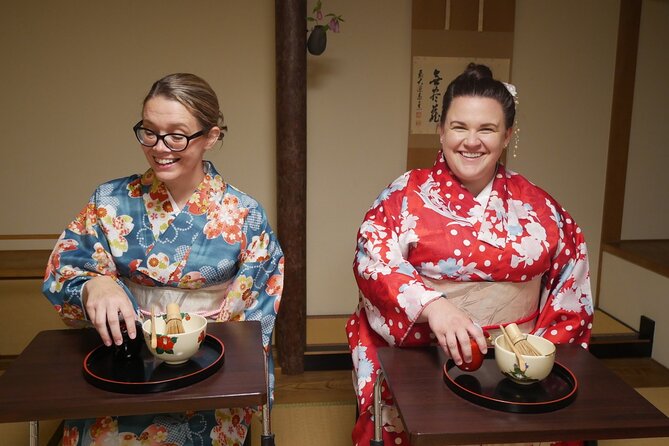
At $85.89 per person, this is not a cheap way to drink matcha. You are paying for a bundled cultural activity: kimono selection and fitting, use of the temple setting, a guided demonstration, your own tea preparation, sweets, and staff-taken photographs. The value is strongest if you would otherwise pay separately for kimono rental and a tea ceremony.
The small group also matters. The activity has a stated maximum of 10 people, and its description presents it as a group of about six. Some sessions may include more than one small party, so the exact feel depends on the date. Even so, this is designed to be personal rather than a large, stage-like production.
The price makes most sense for a first visit to Japan, a special family outing, or anyone who wants a cultural activity that produces good photographs as well as instruction. It is less attractive if you are mainly looking for a low-cost local snack or if you already have several kimono and tea activities planned in Kyoto or elsewhere.
Compared with a quick kimono rental, you receive much more guidance. Compared with a long formal tea-school lesson, you receive a shorter and more accessible introduction. I see it as a reasonable splurge during a Miyajima day, especially because the activity fits neatly between ferry arrival and the rest of your island sightseeing.
Who should book this Miyajima activity?
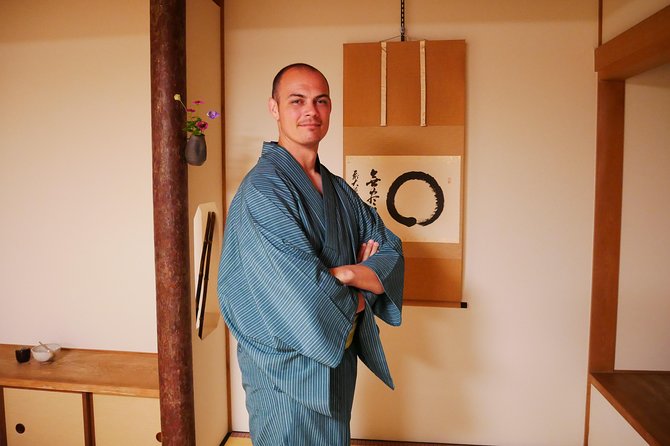
I would recommend it to first-time visitors who want a clear introduction to Japanese customs without committing half a day. The staff provide clothing, instruction, and a setting that does much of the work for you.
It suits couples, friends, and families. Children age 6 and older are welcome, and the patient approach makes it possible for a mixed-age group to participate together. The activity also works for solo visitors because staff can help with pictures and guide you through each step.
It is a good choice if you value quiet places and direct contact with local tradition. The temple location feels separate from the main shopping area, and the ceremony gives you an hour to slow down.
You may want to skip it if you dislike formal manners, do not want to wear layered traditional clothing, or expect to sit on the floor. You should also look elsewhere if your main goal is a long outdoor photo session or a full-day kimono rental.
Cancellation is free up to 24 hours before the start time for a full refund. Changes or cancellations inside that window are not accepted, and poor weather can lead to a new date or a full refund because the activity requires good weather.
Should you book the kimono and tea ceremony?
Yes, if you want an easy, well-structured cultural activity near the Miyajima ferry port. The combination of careful kimono dressing, a temple setting, and hands-on matcha preparation gives you more substance than a basic costume rental.
Book it with realistic expectations. This is a one-hour introduction, not an advanced tea course or a private photo tour. You will use table seating, the exact group size can vary up to the stated limit of 10, and the photo delivery requires answering a questionnaire.
For a quiet pause in a busy Miyajima day, the $85.89 price is defensible. I would especially choose it for families, couples, and first-time visitors who want to take home both photographs and a simple skill: how to prepare and enjoy matcha with respect.
FAQ
Where does the kimono and tea ceremony take place?
It takes place at Tokuju-ji Temple, also written as 徳寿寺, at 741-1 Miyamachō, Hatsukaichi, Hiroshima 739-0513, Japan.
How long does the activity last?
The activity lasts approximately one hour and ends back at the meeting point.
How many people can join?
The activity has a maximum of 10 participants. It is presented as a small-group experience, with an intimate group of about six described in the tour details.
What age can participate?
The minimum age is 6.
Are kimonos provided?
Yes. You can choose from more than 100 kimonos, and staff provide the items needed to dress you for the ceremony.
Do I make my own matcha?
Yes. You first watch a tea master conduct the ceremony, then learn how to make and taste your own matcha tea.
Is cancellation free?
You can cancel at least 24 hours before the local start time for a full refund. Cancellations or changes made less than 24 hours before the start time are not accepted, and bad weather may result in a different date or a full refund.
More Miyajima Island Tours in Hiroshima
- Peaceful Hiroshima & Miyajima UNESCO 1 Day Bus Tour
★ 5.0 · 5,309 reviews - Hiroshima: Hiroshima and Miyajima UNESCO Sites 1-Day Tour
★ 4.9 · 2,330 reviews - Hiroshima / Miyajima Full-day Private Tour with Government Licensed Guide
★ 5.0 · 1,298 reviews - From Hiroshima: Hiroshima & Miyajima 1 Day Tour with Lunch
★ 4.7 · 395 reviews
Just added around Hiroshima
- The Peace Memorial to Miyajima : Icons of Peace and Beauty★ 4.5 · 31 reviews
- Private Full Day Hiroshima Tour★ 4.5 · 29 reviews
- Hiroshima & Miyajima All-Inclusive Tour w/Licensed guide Pancho★ 5.0 · 54 reviews
- Okunoshima Rabbit Island Cycling Tour with Local Guide★ 4.5 · 17 reviews
- Shore Excursion from Hiroshima Port : Private Tour in Hiroshima★ 5.0 · 17 reviews
- Hiroshima Saijo Sake Tasting Tour with visit to 7 Breweries★ 5.0 · 104 reviews
- Miyajima Guided Tour and Fresh Oyster Farm Tour★ 5.0 · 20 reviews
- Hiroshima Country Cycling: Explore Rural Life 1 HR from City★ 5.0 · 22 reviews
Miyajima Island Tours, compared.
Peaceful Hiroshima & Miyajima UNESCO 1 Day Bus Tour
Read our review →
Hiroshima and Miyajima UNESCO Sites 1-Day Tour
Read our review →
Hiroshima / Miyajima Full-day Private Tour with Government Licensed Guide
Read our review →
Osaka/Kyoto: Hiroshima Miyajima Bus Tour & Shinkansen Ticket
Read our review →
Hiroshima and Miyajima Day Trip with Itsukushima Shrine & Ferry
Read our review →
Full Day Hiroshima and Miyajima Bus Tour from Hiroshima
Read our review →
Miyajima Peace Memorial Icons of Peace and Beauty
Read our review →Browse the lists this tour appears in