
REVIEW · CYCLING TOURS
Tokyo: 3-Hour Bike or E-Bike Tour of City’s Hidden Gems
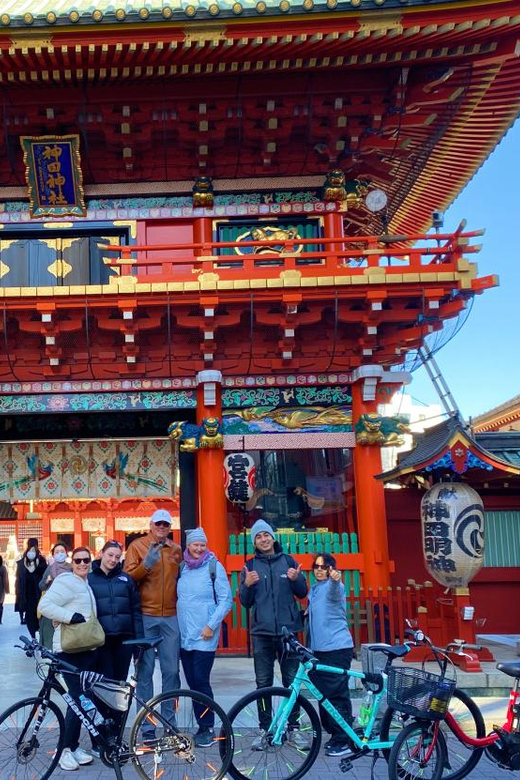
Tokyo makes surprising sense from a bicycle seat. In three hours, you can move from the temple bells of Zojo-ji to the Imperial Palace, Akasaka, Aoyama, Harajuku, and Shibuya without spending your day underground on the metro. The route mixes major sights with quieter streets and short walks off the bike.
I like the quality bikes, especially the Bianchi and Fuji models, and I like having an e-bike choice for Tokyo’s distance and summer heat. Guides such as Shin, Casey, Naoki, Marika, and Nouchi have been praised for clear explanations, flexible routing, photos, and careful riding support. The main drawback is that this is a real cycling outing, not a gentle sightseeing bus ride, and helmets cost an extra ¥1,000 in cash.
In This Review
- Key points before you book
- Why a bike works so well in central Tokyo
- Starting near Commodore Perry in Shiba
- Zojo-ji Temple and the first look at old Tokyo
- The Imperial Palace and Ote-mon Gate
- Akasaka Palace and the National Stadium
- The unmarked neighborhood stop
- Aoyama, Cat Street, and Miyashita Park
- Shibuya Crossing and the Bell of Peace
- What the guide adds to the ride
- Bikes, e-bikes, helmets, and the physical effort
- Small groups, private options, and value at $60
- Who should book this Tokyo bike tour?
- Final verdict: a smart first look at Tokyo
- FAQ
- How long is the Tokyo bicycle tour?
- Where does the tour begin?
- Where does the tour finish?
- Which languages are available?
- Are e-bikes available?
- Are helmets included?
- Is the tour suitable for children?
- Can I cancel for a refund?
Key points before you book
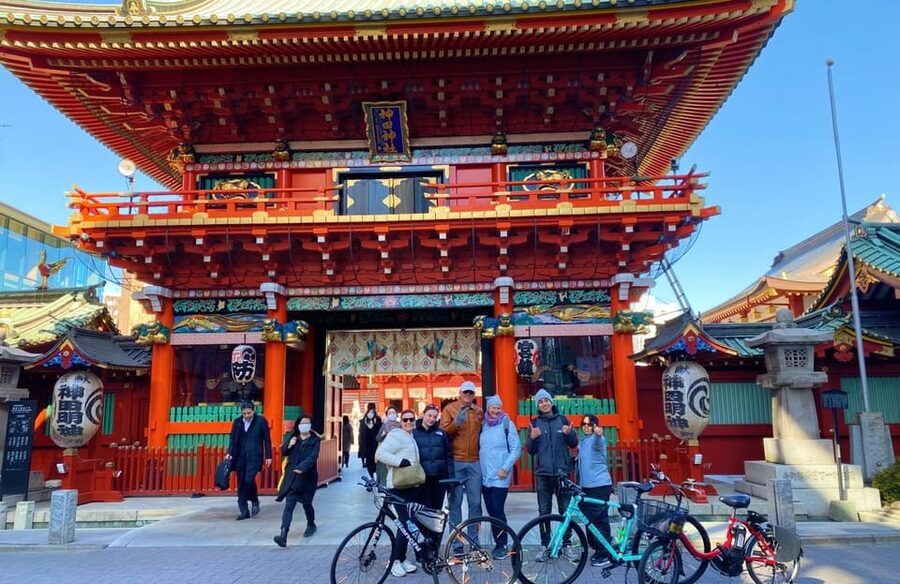
- Three hours connects several far-flung districts: You cover Shiba, the Imperial Palace area, Akasaka, Aoyama, Harajuku, and Shibuya in one outing.
- The bikes are a major part of the value: You ride quality Bianchi or Fuji bicycles, with an e-bike available for riders who lack stamina or do not cycle often.
- The route balances famous sights and local streets: Zojo-ji, the Imperial Palace, the National Stadium, Cat Street, Miyashita Park, and Shibuya Crossing all appear, along with less obvious stops.
- Guiding is personal rather than purely historical: Guides explain temples, shrines, Japanese customs, and modern city life, and some have adjusted the route to match the group’s interests.
- Small groups make city riding easier: A compact group can stop, cross streets, and park bikes with less fuss than a large tour.
- Bring cash for a helmet: Helmets are available for ¥1,000 per person, and the meeting point can take a little finding around the Commodore Perry statue.
Why a bike works so well in central Tokyo
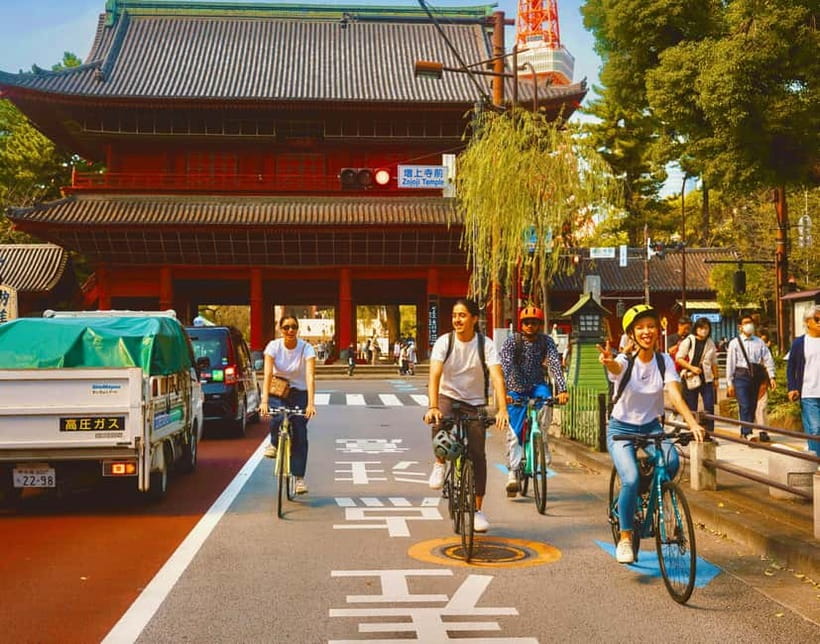
Tokyo is too spread out to understand from a single neighborhood. The train system is superb, but trains whisk you from one station to another without showing how the districts connect. A bicycle fills in that gap.
You see the change from temple grounds to office blocks, from palace walls to fashionable Aoyama streets, and from quiet lanes to the bright spectacle of Shibuya. The pace is quick enough to cover ground but slow enough to notice the city between the headline sights.
This is not a tour built around long interior visits. Most stops are photo breaks or short guided visits. That matters. You should book it to get an informed overview and a feel for Tokyo’s layout, not to spend half an hour inside every temple or museum.
At $60 per person, the price is reasonable if you value transport, a good bicycle, a local guide, and a route that would be difficult to organize on your own. You are paying for access to a ready-to-ride bicycle and for the judgment of someone who knows how to link these districts. The value drops if you already know central Tokyo well or want a slow, detailed temple tour.
More Walking Tours in Tokyo
- Tokyo Tsukiji Fish Market Food and Culture Walking Tour
★ 5.0 · 3,184 reviews - Tokyo: Imperial Palace and Shogun Historical Walking Tour
★ 5.0 · 2,251 reviews - Tokyo: Shinjuku Local Bar and Izakaya Guided Walking Tour
★ 4.9 · 1,794 reviews
Starting near Commodore Perry in Shiba
The meeting point is around the Statue of Commodore Perry, a three-minute walk from Daimon Station’s A6 exit. Allow a few extra minutes to locate the statue and your guide. One rider found the meeting point unclear, so do not leave this to the last second.
This starting point gives the tour an immediate historical frame. Commodore Perry’s arrival in the nineteenth century helped force Japan to open to foreign trade after a long period of restricted outside contact. From here, you begin in the Shiba area, close to Tokyo Tower and Zojo-ji Temple.
The operator provides a small pouch attached to the bike for a phone, wallet, or keys. That is a minor detail, but a useful one. You do not want a loose phone in a pocket while riding or stopping for photographs.
The tour includes bike insurance. The stated equipment includes Bianchi and Fuji bicycles, plus an e-bike option. Comfortable clothes, walking-friendly shoes, and water are the sensible basics. Smoking, alcohol, drugs, and littering are not allowed.
Zojo-ji Temple and the first look at old Tokyo
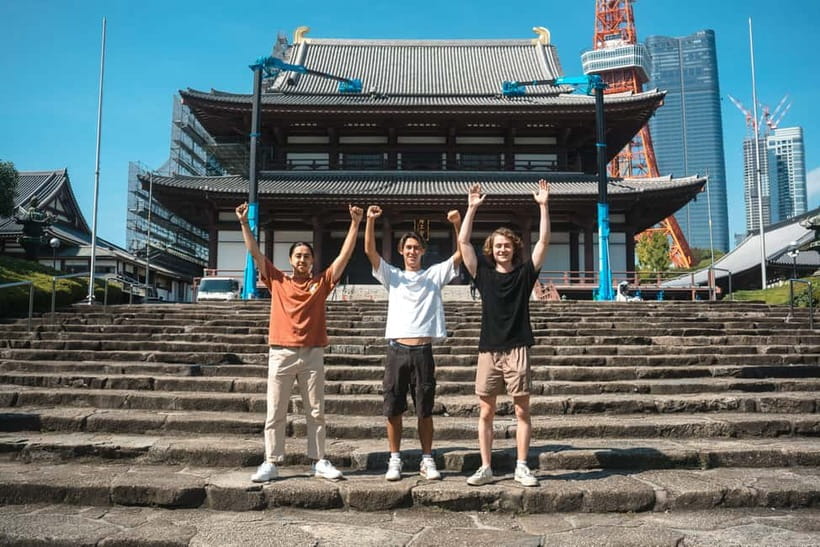
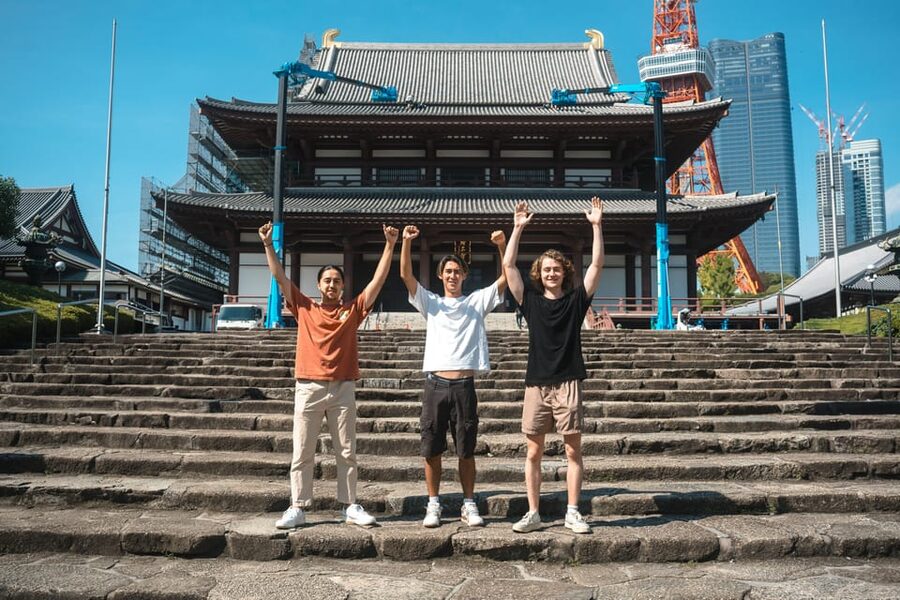
Zojo-ji is the first substantial stop, with about 15 minutes for a guided visit and photographs. Its broad grounds and traditional buildings sit in an unusually dramatic setting, with Tokyo Tower close by. This is one of those places where old and new Tokyo share the same view rather than occupying separate parts of town.
Your guide can help explain the difference between temples and shrines, a point that several riders particularly valued. That context makes the site easier to read. You are not just looking at roofs, gates, and statues; you begin to understand which customs belong to Buddhist temples and which belong to Shinto shrines.
Fifteen minutes is enough for an introduction and a few pictures, but not for a thorough look around the entire complex. If Zojo-ji interests you, return later on foot and give it more time.
The route then heads toward the Imperial Palace. This is where the bike begins to earn its keep. The distance between major central Tokyo sights is manageable on two wheels but can feel tedious if you connect every stop by train and station corridors.
The Imperial Palace and Ote-mon Gate
The Imperial Palace stop lasts about 10 minutes, followed by roughly five minutes at Ote-mon Gate. The palace grounds are associated with the former Edo Castle, so this section gives you a strong sense of Tokyo’s transformation from shogunal capital to modern national capital.
You should expect exterior views and short explanations rather than an extended palace visit. The schedule is designed for orientation. The gate, stonework, broad open areas, and formal surroundings provide good photo opportunities, while your guide supplies the historical background.
One practical advantage of arriving by bike is that you can see the palace area as part of the city rather than as an isolated attraction. The ride shows how close it is to Tokyo’s business districts and how quickly the mood changes once you reach the palace perimeter.
The route does not include Senso-ji in Asakusa. That temple is too far for this three-hour loop, and the tour guides have sensibly treated it as a separate train-and-walking outing. If Senso-ji is high on your list, plan another visit rather than expecting it here.
Same city, a completely different kind of day:
- Mt Fuji and Hakone 1-Day Bus Tour Return by Bullet Train
★ 5.0 · 26,383 reviews - 1-Day Tokyo Bus Tour
★ 5.0 · 14,250 reviews - Tokyo: TOKYO SKYTREE® Admission ticket
★ 4.5 · 11,192 reviews - Tokyo: teamLab Planets TOKYO Digital Art Museum Entry Ticket
★ 4.6 · 9,779 reviews
Akasaka Palace and the National Stadium
The next major photo stop is the State Guest House Akasaka Palace, with about 10 minutes scheduled. Its formal European-style architecture provides a sharp contrast with Zojo-ji’s temple setting and the palace’s Japanese associations.
The stop is mainly visual. You are unlikely to get a detailed interior visit within this tour’s timetable, so think of it as a chance to see another side of Tokyo’s official architecture and to hear a short explanation from the guide.
The ride continues to the New National Stadium, also with about 10 minutes for photographs. The stadium adds a modern layer to the route and helps show how Tokyo has reused and reshaped central districts for large international events.
These stops are useful partly because they break up the cycling. You get off, stretch your legs, take photographs, and listen. The itinerary moves briskly, so keep your camera and water easy to reach.
The unmarked neighborhood stop
The itinerary includes a 15-minute visit to a less obvious local stop. Its exact identity is not fixed in the information provided, which is part of the appeal and part of the uncertainty.
This is the sort of pause that can give the tour more personality than a simple checklist of landmarks. Your guide may use it to show a quieter corner, a neighborhood detail, or a place that fits the day’s route. The guide’s local knowledge matters most here, since the stop is not a standard monument with a clear explanation already printed on every sign.
Do not book this tour expecting every minute to be predictable. The route can respond to the group, weather, traffic, or the guide’s judgment. Shin, in particular, has been praised for adjusting the route to suit riders’ interests. That flexibility is valuable in a private or small group, but the exact experience can vary.
Aoyama, Cat Street, and Miyashita Park
The route then reaches 3 Chome Minamiaoyama, a brief five-minute visit. Aoyama is a good place to notice Tokyo’s polished side, where design, fashion, and everyday urban life share the same streets.
The stop is short, so you will not explore the entire district. Instead, it gives you a glimpse of the neighborhood before moving toward Cat Street. The bicycle is helpful here because the tour can connect areas that feel separate on a subway map but are close enough to link above ground.
Cat Street receives about five minutes. The name suggests a playful lane, but the larger point is the shift toward Harajuku and Shibuya’s fashion-focused streets. Your guide can add useful observations about modern Japanese life and youth culture, subjects that several guides have handled well.
Miyashita Park is an especially quick three-minute stop. Treat it as a brief look rather than a full park visit. The schedule keeps moving, and this section is about showing you the relationship between Harajuku, Aoyama, and Shibuya rather than giving each place a full afternoon.
This is also where you may appreciate the e-bike. Even when the route is not difficult for a regular cyclist, three hours of starts, stops, traffic awareness, and city riding can wear you down. The e-bike option is recommended for people who do not cycle often or are unsure about their stamina.
Shibuya Crossing and the Bell of Peace
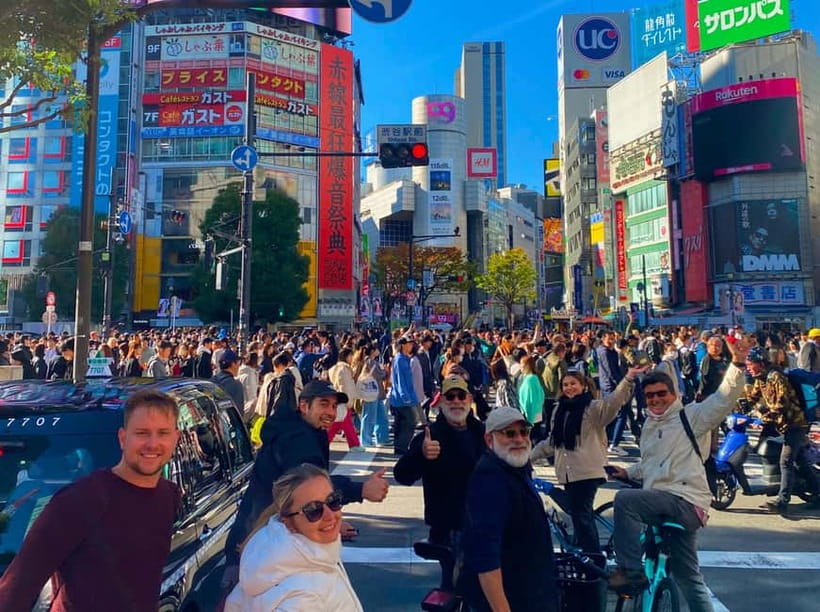
The tour reaches Shibuya Crossing for a five-minute visit and photo stop. You get the classic view of Tokyo’s organized chaos, but the bicycle route has already shown you the quieter neighborhoods that feed into this famous center.
Five minutes is enough to take in the crossing and capture photographs, though it is not enough for a full Shibuya exploration. If you want shopping, department stores, or a long look at the surrounding streets, plan extra time after the tour.
The finish is at the Bell of Peace. This gives the ride a quieter ending after Shibuya’s noise and crowds. It also offers a natural point to continue your own sightseeing, though the supplied details do not specify onward transport or additional arrangements.
One pleasure of this final stretch is the contrast. You have moved from a historic temple and imperial walls to contemporary retail streets in a single morning or afternoon. That range is the strongest reason to choose this route.
What the guide adds to the ride
The best guides on this tour do more than point at buildings. Casey has been praised for explaining history, stopping at useful points, taking photographs, and watching out for riders. Shin has been described as flexible and personable, with the ability to adjust the route for an experienced group.
Naoki, Marika, Nouchi, Georgie, Miguel, and KG have also been singled out for friendly service, humor, cultural explanations, and professional handling of the ride. Guide assignments can change, so you should not book on the assumption that one particular person will lead your group unless the operator confirms it.
The language options are English and Japanese. The English guiding is a major part of the value for visitors who want more than a route map. You can ask about customs, buildings, and daily life as you go, rather than trying to piece together meaning from signs later.
Guides also help with the practical side of riding. They can manage pauses, explain where to stop, and help a group stay together. That support matters more in Tokyo than it would on an empty country lane.
Bikes, e-bikes, helmets, and the physical effort
The bicycles are one of the tour’s strongest features. Bianchi and Fuji are established bicycle brands, and the supplied models are described as high quality road or cross bikes. A good bike makes the ride more pleasant, especially on a route with repeated stops and city traffic.
The e-bike is not a luxury add-on in practical terms. It is the sensible choice if you rarely cycle, do not have much stamina, or are booking during hot weather. One rider completed the tour during an exceptionally hot Tokyo summer, but that should not be taken as proof that the conditions will feel easy.
You need to be able to ride a bicycle confidently. The tour is not suitable for children under 12, pregnant women, people with back problems, or people who cannot ride. The information does not give a precise distance, but several parts of the route involve extended cycling, so prepare for a workout rather than a slow roll.
Helmets are available on site for ¥1,000 each, payable in cash. Since helmet inclusion was not clear to at least one rider during booking, settle this point before you arrive. Bring water, wear comfortable clothing, and choose shoes that work for both pedaling and short walks.
Small groups, private options, and value at $60
Small groups are a good fit for this experience. Tokyo streets demand attention, and a compact party is easier to keep together. You can also ask questions without waiting for a large crowd to quiet down.
Private groups are available. That may be worth considering if your party has mixed cycling ability, a strong interest in temples, or a preference for modern neighborhoods. The guide may have more room to adjust the route when the group is private, though the exact flexibility should be confirmed at booking.
At $60, I would compare this with the cost of several train rides, bicycle rental, and the time needed to plan the route yourself. The tour does not replace a full day at the Imperial Palace area, Zojo-ji, or Shibuya. It does give you a well-connected first look at a wide slice of central Tokyo, with bicycle insurance and a guide included.
The main limitation is the number of short stops. If you dislike moving on just as you begin to settle into a place, use this as an introduction and return to your favorite areas later.
Who should book this Tokyo bike tour?
I would choose it for a first or second visit, especially if you want to understand how central Tokyo fits together. It suits active couples, friends, solo riders joining a small group, and families with children aged 12 or older who already ride comfortably.
It is also useful for people with limited time. One morning or afternoon can cover sights that would otherwise require several separate train trips and a fair amount of walking.
I would think twice if you have back trouble, are pregnant, cannot ride, or want a slow cultural visit with long interior stops. If you are uncertain about stamina, select the e-bike rather than hoping the regular bicycle will be fine.
The cancellation policy allows a full refund when you cancel at least 24 hours ahead, and you can reserve now and pay later. That gives you some useful flexibility, especially when Tokyo weather is unsettled.
Final verdict: a smart first look at Tokyo
Book this tour if you want to cover ground, hear local explanations, and see Tokyo’s old and new sides in one outing. The strong bikes, small-group feel, careful guides, and e-bike option make it more practical than a basic rental.
Skip it if your priority is entering every major sight or spending a long time at one temple. For most active visitors, though, $60 buys a useful orientation, a pleasant ride, and a better sense of Tokyo’s connections than you get from moving station to station.
FAQ
How long is the Tokyo bicycle tour?
The tour lasts three hours.
Where does the tour begin?
You meet the guide near the Statue of Commodore Perry, about a three-minute walk from Daimon Station’s A6 exit.
Where does the tour finish?
The tour finishes at the Bell of Peace.
Which languages are available?
Guiding is available in English and Japanese.
Are e-bikes available?
Yes. An e-bike option is available, and it is recommended for people who do not cycle often or are concerned about stamina.
Are helmets included?
Helmets are not included in the stated inclusions. They are available on site for ¥1,000 per unit, payable in cash.
Is the tour suitable for children?
The tour is not suitable for children under 12 years old.
Can I cancel for a refund?
Yes. You can cancel up to 24 hours in advance for a full refund. You can also reserve now and pay later.
More E-Bikes in Tokyo
- Tokyo: 3-Hour Bike or E-Bike City Highlights Tour
★ 4.8 · 435 reviews - Tokyo: 3-hour Guided E-Bike Tour of the City’s Hidden Gems
★ 4.8 · 251 reviews - Tokyo: 3h Private E-bike Tours, Starting at Your Hotel
★ 5.0 · 36 reviews - Hidden Kyoto E-Biking tour
★ 5.0 · 1,843 reviews
More Cycling Tours in Tokyo
- Tokyo Guided Small-Group Biking Tour
★ 5.0 · 1,250 reviews - Tokyo Great Cycling Tour
★ 5.0 · 811 reviews - Tokyo Top Highlights 3h Guided E-bike Tour
★ 5.0 · 714 reviews - 3h Tokyo E-Bike Tour: Hidden Gems, and Local Life with guide
★ 5.0 · 670 reviews
Just added around Tokyo
- Tokyo: Customizable Private Guided Walking Tour★ 4.5 · 129 reviews
- Private Harajuku Omotesando Architecture Tour★ 4.9 · 18 reviews
- Tokyo: Guided Helicopter Ride★ 4.9 · 24 reviews
- Tokyo: Guided Walking Tour of Tsukiji Market with Lunch★ 4.4 · 24 reviews
- Tokyo: Private Personalized Local Food Tour★ 4.5 · 101 reviews
- Tokyo GINZA: KONPARU Japanese Cabaret Show with Drink★ 4.8 · 38 reviews
- Tokyo: Guided Walking Tour of Tsukiji Market with Breakfast★ 4.4 · 134 reviews
- Tokyo: Gotokuji Cat Temple, Shinjuku Cat Cafe & 3D Cat Tour★ 4.9 · 38 reviews
Cycling Tours, compared.
3h Tokyo E-Bike Tour: Hidden Gems, and Local Life with guide
Read our review →
Arashiyama Bamboo Forest & Hidden Gems Bike Tour (Early Bird)
Read our review →
Hiroshima in a Nutshell: Morning Bike Adventure
Read our review →
5 Top Highlights of Kyoto Full Day Bike Tour (E-bike option)
Read our review →Browse the lists this tour appears in