
REVIEW · PRIVATE GUIDED TOURS WITH DRIVER
Nagasaki Half-Day Private Tour with Government-Licensed Guide
Nagasaki is a city that rewards context. The Peace Park, Dejima, foreign-settlement streets, Chinese temples, and atomic-bomb sites can feel scattered at first. This private four-hour tour gives you a local guide to connect the pieces, while you choose the two or three places that matter most. Guides such as Yoshi, Hiromi, Noriko, and Hiro have helped visitors shape mornings around family needs, cruise schedules, food, and personal interests.
I like the freedom from a fixed route, and I like the chance to use trams, taxis, and your own feet instead of sitting in a tour bus. The main caution is practical: transportation and entrance fees are extra, and this is not a private-car tour. If you expect door-to-door driving, confirm the plan before booking.
In This Review
- Key points at a glance
- Why a flexible Nagasaki tour makes sense
- Meet your guide and shape the morning
- Peace Park, the hypocenter, and the Atomic Bomb Museum
- Dejima and Nagasaki’s international story
- Glover Garden, Oura Church, and Dutch Slope
- Sofukuji and Kofukuji, two Chinese-founded temples
- Deeper Chinese and national stories
- Mount Inasa and the city views
- Meganebashi and the old city center
- The human side of a private guide
- Walking, trams, taxis, and the real cost
- Who should book this Nagasaki morning
- Should you book it?
- FAQ
- How long is the Nagasaki private tour?
- How many attractions can I visit?
- Where does the guide meet me?
- Is a private vehicle included?
- Are admission tickets included?
- Is the tour suitable for families?
- Can I cancel for a full refund?
Key points at a glance
- Choose two or three sites: Build the morning around peace memorials, historic districts, temples, museums, churches, or city views.
- Meet a licensed local guide: English-speaking guides including Yoshi, Hiromi, Noriko, Hiro, and others have offered personal stories and flexible planning.
- Walk and ride public transport: The tour is designed around walking and local transport, with taxis possible at your expense.
- A strong fit for short stays: Four hours can give you a useful first look before an afternoon of independent exploring.
- Plan for extra costs: Admission, trams, buses, taxis, lunch, and other personal expenses are not included.
- Best for focused sightseeing: Two or three carefully chosen stops work better than trying to race through all 16 suggested attractions.
Why a flexible Nagasaki tour makes sense
Nagasaki is not a city you understand by checking off monuments. Its meaning comes from the way several stories overlap: international trade, Christianity, Chinese influence, industrial development, wartime destruction, and postwar recovery.
A fixed half-day route may show you several famous places but leave little time to ask questions. Here, you choose the emphasis. You might spend the morning on the atomic bombing and peace memorials, focus on Nagasaki’s international connections, or mix one major museum with a temple and a viewpoint.
The tour costs $122.20 per person. That is not a budget walking tour, especially once you add admission and public transport. For one or two people, it is a significant expense. For a family or small group, the private format can compare more favorably with a packaged excursion, particularly if you want a guide to adjust the pace or help with children.
The 98 percent recommendation rate and 4.9 rating from 53 reviews point to a consistently strong experience, though the feedback also shows why expectations matter. One unhappy customer found the guide’s English difficult to follow and expected a vehicle. The operator acknowledged confusion about the vehicle arrangement. Read the inclusions carefully, then confirm how you will meet and move around Nagasaki.
More private guided tours with driver in Japan:
- Tokyo 6hr Private Tour with Government-Licensed Guide
★ 5.0 · 3,902 reviews - Tokyo 4hr Private Tour with Government-Licensed Guide
★ 5.0 · 1,394 reviews - Kyoto 6hr Private Tour with Government-Licensed Guide
★ 5.0 · 1,369 reviews
Meet your guide and shape the morning
The guide is scheduled to meet you in the morning at your hotel or another agreed point within the designated Nagasaki area. If you arrive by cruise ship, ask in advance about meeting at the terminal. Koko, for example, met a group at the terminal, while other guides met visitors at Nagasaki Station or their hotel.
The pickup is on foot. That wording matters. You are not being collected in a tour vehicle, and a private vehicle is not included. The basic plan is to walk and use public transportation. Taxis may be arranged, but you pay the fare.
The best use of your pre-tour contact is to state your priorities clearly. Tell the guide if you want the Peace Park, Dejima, a temple, Glover Garden, or the Atomic Bomb Museum. Also give practical information: how much walking suits you, if children are with you, if you need to finish at the port, and if you want lunch suggestions afterward.
Several guide accounts describe useful preparation before meeting. Yoshi contacted a family to ask what they wanted to see. Hiromi warned a group about rain and explained likely taxi costs. Noriko helped with transport questions, suggested places for the rest of a Nagasaki stay, and helped locate vegan dining options.
That kind of contact is valuable because four hours passes quickly. You do not want to spend the first hour deciding between 16 possible stops.
Peace Park, the hypocenter, and the Atomic Bomb Museum
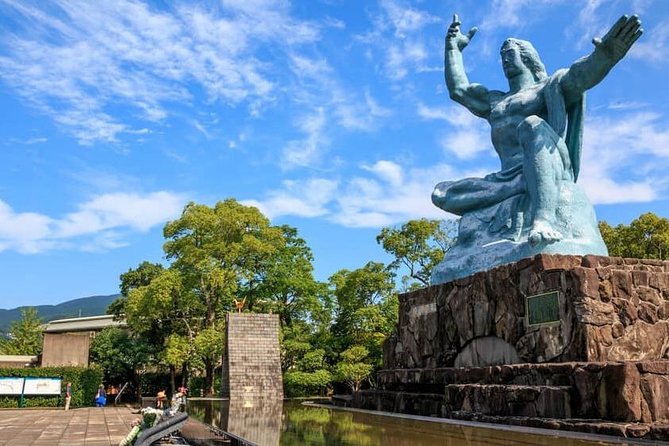
For many people, Nagasaki’s central experience is the group of sites around the 1945 atomic bombing. The Peace Park offers a quiet setting for remembrance, while the nearby hypocenter marks the place directly associated with the blast. The Atomic Bomb Museum adds exhibits and documentary material about the destruction and the city’s recovery.
The supplied route gives only about 15 minutes to some stops, but that should not be read as enough time to properly visit every major site. The museum alone can call for much longer, depending on how closely you read the displays. If this is your main reason for coming to Nagasaki, use most of the four hours here and at the Peace Park rather than trying to add several distant attractions.
A guide can provide context before and after the museum, which is especially helpful because the subject is difficult. Yoshi has shared a personal family connection to the bombing, and another guide, Tasaki Toru, has been described as having survivor ties. You should not assume you will receive a specific guide or personal account, but you can request a guide who can discuss the subject in depth when making arrangements.
This portion suits adults and older children who can handle serious material. One family used the museum, Peace Park, and hypocenter with a guide who also kept younger children engaged, including by teaching origami. Still, the emotional weight is real. Build in quiet time rather than treating the sites as quick photo stops.
Public transport is part of the experience here. One group used the tram to reach the Peace Park, then walked between key locations. That saves money compared with taxis, but you need comfortable shoes and enough time for transfers.
Dejima and Nagasaki’s international story
Dejima explains why Nagasaki became Japan’s main window to the outside world during the period of restricted foreign contact. The original man-made island was built in 1636 to separate Portuguese residents from the Japanese population. Later, Dutch residents used the site.
Today, Dejima functions as a historical attraction with reconstructed buildings and exhibits. It is a good choice if you want to understand trade, foreign settlement, and the daily mechanics of contact between Japan and other countries.
I would pair Dejima with Glover Garden or the Dutch Slope if international Nagasaki interests you. Together, they tell a more complete story than either site alone. The drawback is that each requires time to appreciate, and adding the Atomic Bomb Museum in the same four-hour morning may produce a rushed schedule.
Dejima has an entrance fee, and it is not included. Ask the guide to explain which admissions are needed for your chosen stops. The guide’s own entrance fees are covered only for attractions listed in the expected site selection, not for every possible expense connected with your day.
A few more Japan trips to weigh up
- Kyoto Arashiyama Bamboo forest & Garden Half-Day Walking Tour
★ 5.0 · 413 reviews - Miyajima Half-day Trip Historical Walking Tour
★ 5.0 · 284 reviews - Half-day Tokyo Afternoon Tour by Hato Bus
★ 4.0 · 269 reviews - Naha, Okinawa: Kerama Islands Half-Day Whale Watching Tour
★ 4.4 · 241 reviews
Glover Garden, Oura Church, and Dutch Slope
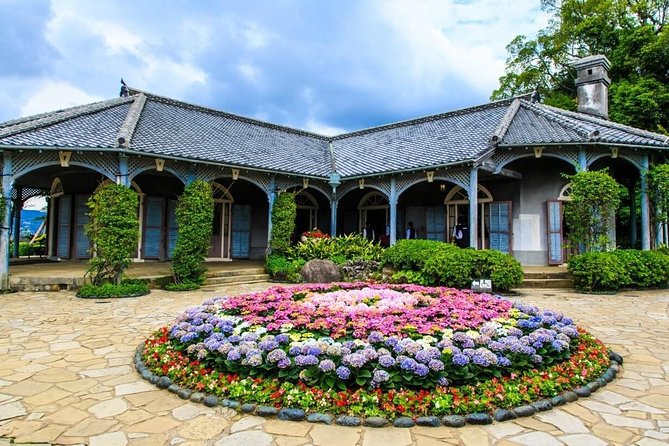
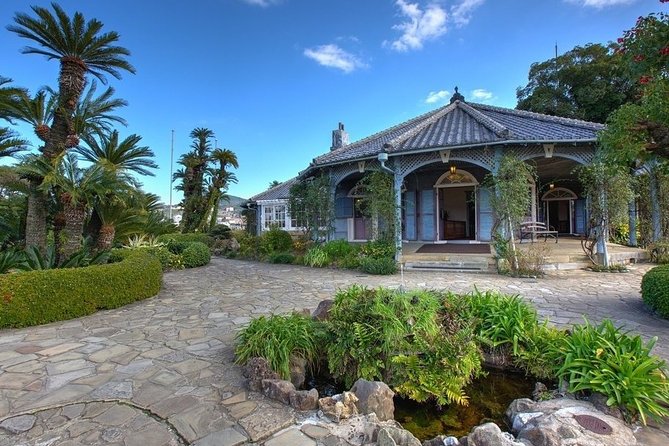
Glover Garden sits on a hillside associated with Western merchants after Nagasaki opened to foreign trade. It is an open-air museum with former foreign residences and related buildings. The hill setting also gives you a sense of how Nagasaki’s port, slopes, and foreign settlement fit together.
The attraction is more than a collection of old houses. It helps you see the social and commercial world that developed around the port. The walking here is uphill, so allow more time than the brief sample stop suggests. If you have limited mobility or dislike slopes, ask about the route before committing to it.
Nearby Oura Church, also called Oura Catholic Church, dates from 1864 and was built for the foreign merchant community by a French missionary. It is a major part of Nagasaki’s Christian story and can be paired naturally with Glover Garden.
The suggested sites list repeats Oura Church, so do not treat those as two separate attractions. You have one church, not an extra stop. Admission is not included.
Dutch Slope is free and offers a simple street-level look at the area where foreign traders lived after the port reopened in 1859. It is less demanding than a museum visit, but the stone-paved incline still calls for sensible footwear. For a short tour, Glover Garden, Oura Church, and Dutch Slope make a coherent cluster, though visiting all three plus a distant site may be too ambitious.
Sofukuji and Kofukuji, two Chinese-founded temples
Sofukuji Temple was built in 1629 for Nagasaki’s Chinese residents and belongs to the Obaku school of Zen Buddhism. Its Chinese architectural style makes it different from many temples you may see elsewhere in Japan.
Kofukuji Temple is older, founded by Chinese residents, and lies in the Teramachi temple district. It is also linked with the beginnings of the Obaku tradition in Japan. Seeing both can give you a clearer idea of the city’s Chinese connections than visiting one in isolation.
These temples are good choices for you if you want architecture, religious history, and quieter streets rather than major wartime sites. Admission fees are extra. The 15-minute sample timing is enough for a quick exterior look and basic explanation, but not for an unhurried visit.
A guide is particularly useful in temple districts because the meaning of gates, halls, courtyards, and symbols may not be obvious from a guidebook. At the same time, the temples are not interchangeable. Tell your guide if you care more about Chinese design, Zen traditions, or the old temple neighborhood.
Deeper Chinese and national stories
The Nagasaki Confucius Shrine includes a Chinese museum and was built in 1893 by Nagasaki’s Chinese community. It is one of the relatively few Confucian shrines in Japan, making it a worthwhile choice if you want a less familiar side of the city.
Nagasaki Gokoku Shrine is dedicated to those who died for the nation. Its role changed after World War II, when such shrines moved from Ministry of the Interior control to new administration. This is a different kind of historical stop from the Peace Park, focused on national memory and commemoration.
The Nagasaki Museum of History and Culture covers the city’s role as a major international trading center. It is a sensible rainy-day choice and a useful introduction if you have not yet decided which parts of Nagasaki to explore independently.
All three sites require trade-offs. They are not a natural fit with a Peace Park and Glover Garden program unless you are using taxis and keeping visits short. The museum in particular deserves more than a hurried quarter hour if exhibitions are your priority.
Mount Inasa and the city views
Mount Inasa rises 333 meters near central Nagasaki. The summit can be reached by ropeway, bus, or car, and the observation deck gives you a broad view over the city.
This is the tour’s best visual counterpoint to museums and memorials. From above, Nagasaki’s hills, port, and compact urban form become easier to understand. You see why walking between districts often means climbing or using a tram.
The itinerary allows 15 minutes at the observation deck, which is enough for a quick look if transportation is already arranged. It is not much time if you want to ride the ropeway, linger over the view, and return to central Nagasaki before your finish time. The famous night view is not a realistic focus for a morning half-day tour, so choose this stop mainly for daytime orientation.
Mount Inasa may be a poor choice if you want a museum-heavy morning or if the weather is poor. Your guide can help decide if visibility makes the trip worthwhile.
Meganebashi and the old city center
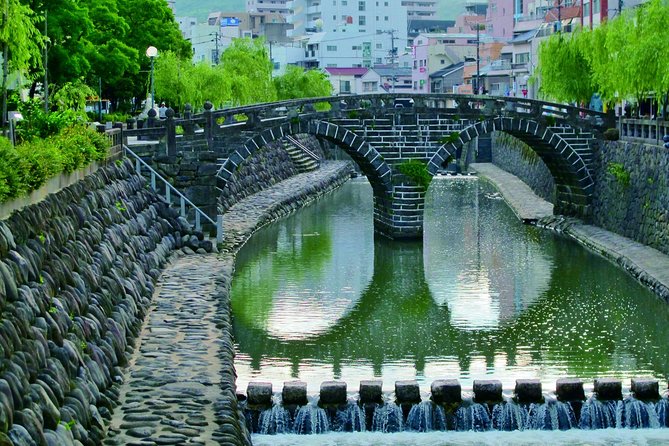
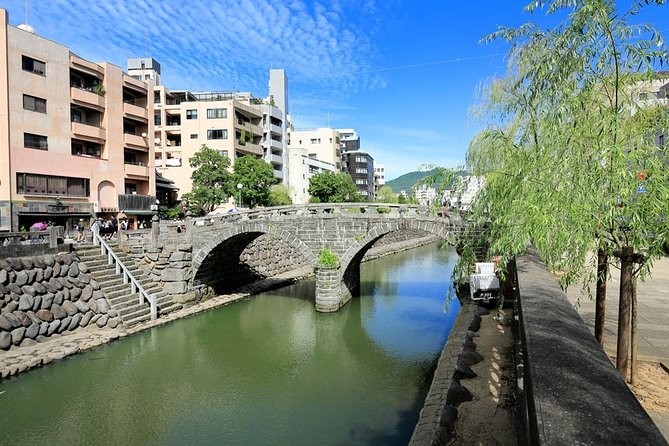
Meganebashi, or Spectacles Bridge, is the best known of the stone bridges over the Nakashima River. Its paired arches can create a glasses-like reflection in the water under suitable conditions.
This is a short, easy stop that works well between larger attractions. It gives you a look at the older commercial center and riverfront without requiring an admission ticket. You will get more from it if your guide explains how it fits into Nagasaki’s temple district and urban development.
Do not build an entire morning around the bridge. Fifteen minutes is a reasonable visit, especially when paired with Kofukuji, Sofukuji, or nearby streets. It is a useful small piece of a city tour, not a substitute for one of Nagasaki’s major museums or memorial sites.
The human side of a private guide
The strongest reason to book this format is the guide relationship. The guide can adjust the route, explain local customs, point out food, and help you use the tram or taxi system.
Several guides have been praised for personal ties to Nagasaki. Hiromi grew up in the city and shared local traditions and family stories. Koko discussed her grandparents’ lives. Yoshi has been described as warm, adaptable, and especially good at adjusting a schedule. Noriko helped with plans beyond the tour itself.
Those details matter because Nagasaki can feel like several cities at once. A local guide helps connect the port, temples, foreign merchants, Christianity, war memory, and modern daily life.
Guide quality can vary, as it can with any human-led service. The overall score is high, but one account raised concerns about difficult-to-understand English and worn visual materials. If clear spoken English is essential, state that when booking. A licensed guide is useful, but a license alone does not guarantee the same communication style or depth of explanation from person to person.
Walking, trams, taxis, and the real cost
This is a walking and public transport tour. Comfortable shoes are not a throwaway suggestion. Nagasaki’s hills, stone streets, and spread-out attractions can make a four-hour route more tiring than the word half-day suggests.
Transportation fees are excluded. You may use a tram, bus, or taxi depending on the route. A tram keeps costs down and feels like part of ordinary city life, while a taxi can protect your limited time. If you choose several far-apart sites, taxi costs can change the value calculation quickly.
Entrance fees are also excluded. Glover Garden, Sofukuji, Dejima, Oura Church, Kofukuji, the Confucius Shrine, the History and Culture Museum, and the Atomic Bomb Museum should all be treated as possible additional expenses. Confirm current prices and the exact admission plan before the morning begins.
Lunch is not included. Guides have recommended champon, Nagasaki’s local noodle dish, traditional Japanese meals, and other restaurants. A lunch stop may be possible, but it reduces sightseeing time and should be discussed in advance.
The price makes the most sense for a small group with a clear plan. You are paying for a private guide’s time and local judgment, not for an all-inclusive vehicle excursion. If you only want a quick panoramic route with no admissions, a regular sightseeing option may cost less.
Who should book this Nagasaki morning
I would choose this tour if you have only one day in Nagasaki, are arriving by cruise ship, or want help deciding how to use a short visit. It also suits families, since the guide can adjust pace and interests more easily than a large group can.
It is a good match for you if one subject matters deeply. Choose the peace sites for wartime memory, Dejima and Glover Garden for international trade, the temples and Confucius Shrine for Chinese influence, or Mount Inasa for city views.
You should think twice if you want a private car, a long list of attractions, or all entrance fees included. Four hours and two or three sites require choices. Trying to include Peace Park, the Atomic Bomb Museum, Mount Inasa, Glover Garden, Dejima, and several temples will turn a thoughtful tour into a race.
Free cancellation is available up to 24 hours before the start time. Changes or cancellations inside that window are not accepted for a refund.
Should you book it?
Book this tour if you value a flexible route, personal explanation, and a guide who can help you make sense of Nagasaki in a short time. The best version is a focused morning with two or three stops, a clear transport plan, and enough time for the places you care about most.
I would especially recommend it for first-time visitors who want the Peace Park and Atomic Bomb Museum, families needing a little flexibility, and cruise passengers who cannot afford to lose time finding their way around.
Skip it if you expect a private vehicle or an all-inclusive price. In that case, the extra transport and admission costs may frustrate you. For everyone else, this is a thoughtful way to begin in Nagasaki, then spend the rest of the day following the places and stories that caught your attention.
FAQ
How long is the Nagasaki private tour?
The tour lasts approximately four hours and takes place in the morning.
How many attractions can I visit?
The tour includes a customizable itinerary of two or three sites from the suggested attractions.
Where does the guide meet me?
The guide can come to your hotel in the morning, and the tour also allows a walking meetup within the designated area of Nagasaki. If you are arriving at the port or station, confirm the exact meeting point in advance.
Is a private vehicle included?
No. This is a walking and public transport tour. A private vehicle is not included, and taxi or other transportation fees are extra.
Are admission tickets included?
No. Entrance fees are generally not included. The guide’s admission fees are covered only for sights listed under the expected site selection.
Is the tour suitable for families?
Yes. Most travelers can participate, and guides have adjusted routes and activities for families with children. The tour includes walking, so comfortable shoes are important.
Can I cancel for a full refund?
Yes. You can cancel at least 24 hours before the experience start time for a full refund. Cancellations or changes made less than 24 hours before the start time are not accepted for a refund.
Just added around Japan
- Tokyo: Customizable Private Guided Walking Tour★ 4.5 · 129 reviews
- Private Harajuku Omotesando Architecture Tour★ 4.9 · 18 reviews
- Tokyo: Guided Helicopter Ride★ 4.9 · 24 reviews
- Tokyo: Guided Walking Tour of Tsukiji Market with Lunch★ 4.4 · 24 reviews
- Tokyo: Private Personalized Local Food Tour★ 4.5 · 101 reviews
- Tokyo GINZA: KONPARU Japanese Cabaret Show with Drink★ 4.8 · 38 reviews
- Tokyo: Guided Walking Tour of Tsukiji Market with Breakfast★ 4.4 · 134 reviews
- Tokyo: Gotokuji Cat Temple, Shinjuku Cat Cafe & 3D Cat Tour★ 4.9 · 38 reviews
Private Guided Tours with Driver, compared.
Tokyo 4hr Private Tour with Government-Licensed Guide
Read our review →
Kyoto 6hr Private Tour with Government-Licensed Guide
Read our review →
Hiroshima / Miyajima Full-day Private Tour with Government Licensed Guide
Read our review →
Kyoto 4hr Private Tour with Government-Licensed Guide
Read our review →
Mt. Fuji Day Trip from Tokyo with English Speaking Driver Guide
Read our review →
Hiroshima City 4hr Private Walking Tour with Licensed Guide
Read our review →Browse the lists this tour appears in