
REVIEW · CYCLING TOURS
Hiroshima: Best of Hiroshima Guided Bike Tour
Hiroshima’s major sights are spread across a compact, mostly flat city, and this 3.5-hour bike tour links them at a far easier pace than a long day on foot. You ride beside rivers, through Peace Memorial Park, past the Atomic Bomb Dome, and onward to the castle, shrine, and Shukkei-en Garden.
I like the mix of serious history and easy cycling, especially the time given for questions and quiet reflection at the memorial sites. I also like the small group size, good bikes, and guide names such as Awais, Aimee, Miyu, and James, who are often praised for clear storytelling and personal connections to Hiroshima. The main drawback is that the tour needs good weather, and it is not suitable for children under 12 or riders under 140 centimeters tall.
In This Review
- Key points to know before you book
- Why cycling works so well in Hiroshima
- Peace Memorial Park and the Atomic Bomb Dome
- Hiroshima Castle and Gokoku Jinja
- Shukkei-en Garden is a calm final stop
- The guides shape the experience
- Is $70 good value?
- Weather, clothing, and rider requirements
- Who will enjoy this Hiroshima bike tour?
- Booking details that matter
- Should you book it?
- FAQ
- How long does the Hiroshima bike tour last?
- How much does the tour cost?
- What sights are included on the route?
- Is the route difficult?
- How many people can join the tour?
- Is the tour conducted in English?
- Are bikes and helmets included?
- Is admission to Shukkei-en Garden included?
- What happens if the weather is bad?
Key points to know before you book
- The route covers about 10 kilometers: Most of the ride is flat and relaxed, with frequent stops rather than a hard workout.
- Peace Memorial Park comes first: You see the Atomic Bomb Dome and other important memorials with an English-speaking guide.
- The tour goes beyond the usual peace sites: Hiroshima Castle, Gokoku Jinja, and Shukkei-en Garden add a wider view of the city.
- Small groups keep the tour personal: Numbers are limited to eight, giving you room to ask questions and ride at a comfortable pace.
- Bike choices are practical: Trek bikes, step-through models, e-bikes, and child-sized bikes are available, along with helmets and bottled water.
- The $70 price includes garden entry: That makes the tour useful for a first day in Hiroshima, especially if you want to cover several sights quickly.
Why cycling works so well in Hiroshima
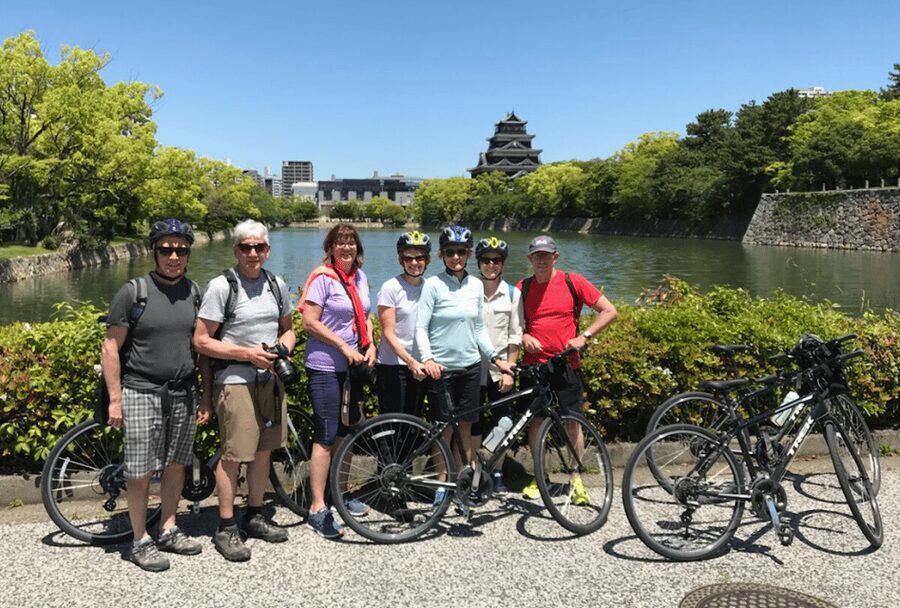
Hiroshima is a good city for sightseeing by bike. The route described for this experience is flat, and much of it uses riverside paths, park areas, and quieter stretches rather than putting you onto busy roads. That matters here because the main sights are close enough to connect by bicycle, but far enough apart to make walking tiring.
You begin at Cycle Hiroshima HQ, where the staff give you a short orientation and adjust the bike. Arrive ready to spend a little time on the fitting. A proper saddle height and a comfortable frame make a big difference over several hours, especially if you have not cycled recently.
The available bikes cover a useful range. Standard Trek bikes suit most riders, while step-through bikes make mounting easier. E-bikes are available for an extra boost, though the flat route means you may not need one. Helmets and bottled water are included.
This is not a racing tour. The pace is designed for sightseeing, with regular pauses for explanations, photos, and questions. That makes it a good choice if you can ride a bicycle but do not want an athletic challenge. You should still be comfortable cycling for roughly 10 kilometers, often with stops along the way.
A few more Hiroshima trips to weigh up
- Hiroshima in a Nutshell: Morning Bike Adventure
★ 5.0 · 524 reviews - Hiroshima 2hr Peace Cycling Tour with Local Guide
★ 5.0 · 321 reviews - Hiroshima: Peace Cycling Tour with Local Guide
★ 4.8 · 286 reviews
Peace Memorial Park and the Atomic Bomb Dome
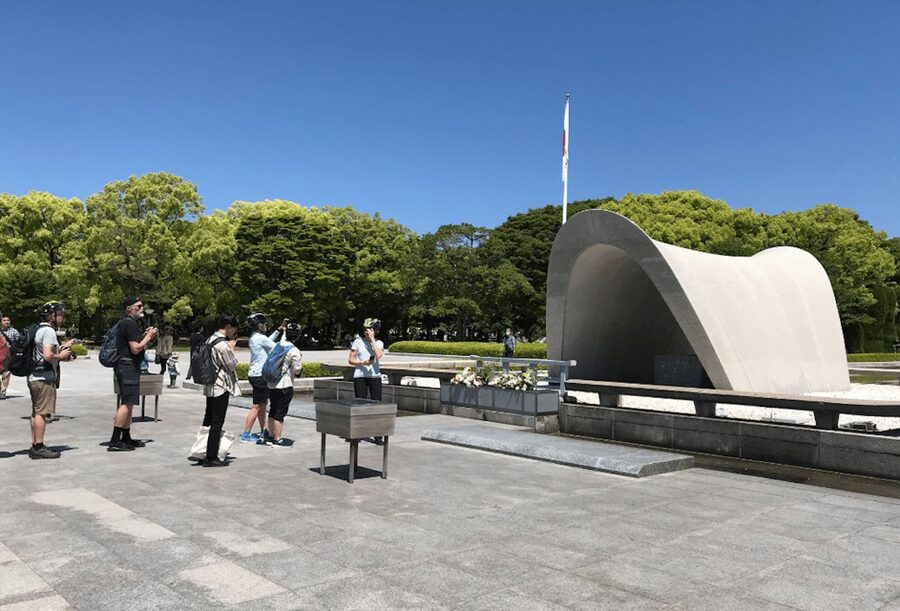
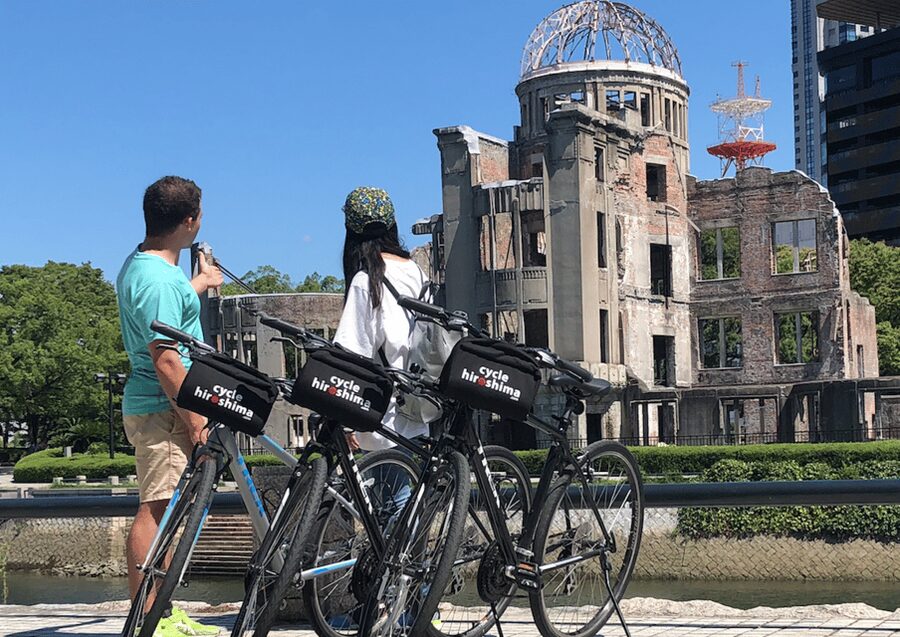
The first major section takes you to Peace Memorial Park by way of a relaxing riverside ride. This helps set the mood before you enter one of Japan’s most important memorial areas.
The Atomic Bomb Dome is the visual anchor. Its preserved structure is a UNESCO World Heritage Site, and seeing it in person gives the events of August 6th, 1945, a physical focus. Your guide explains what happened, how the city was affected, and how Hiroshima came to be known as the City of Peace.
This part of the tour calls for a respectful pace. You are not simply stopping for a photograph and moving on. The route allows time to listen, ask questions, and take in the memorials. Guides such as Miyu and Aimee have been praised for bringing a local and family perspective to the subject, while other guides, including Ehsan and Awais, are noted for explaining the bombing and recovery from more than one angle.
That human element is important. Hiroshima’s memorial sites can feel overwhelming when you visit alone, particularly if you are trying to understand the sequence of events while navigating a new city. A guide gives you a framework, then you can spend your own time looking and thinking.
The cycling format also has a practical advantage. You are not forced to make a long walk between the Peace Park and the next part of the city. You can leave the memorial area quietly, ride along the river, and shift gradually from reflection to the broader story of Hiroshima today.
Hiroshima Castle and Gokoku Jinja
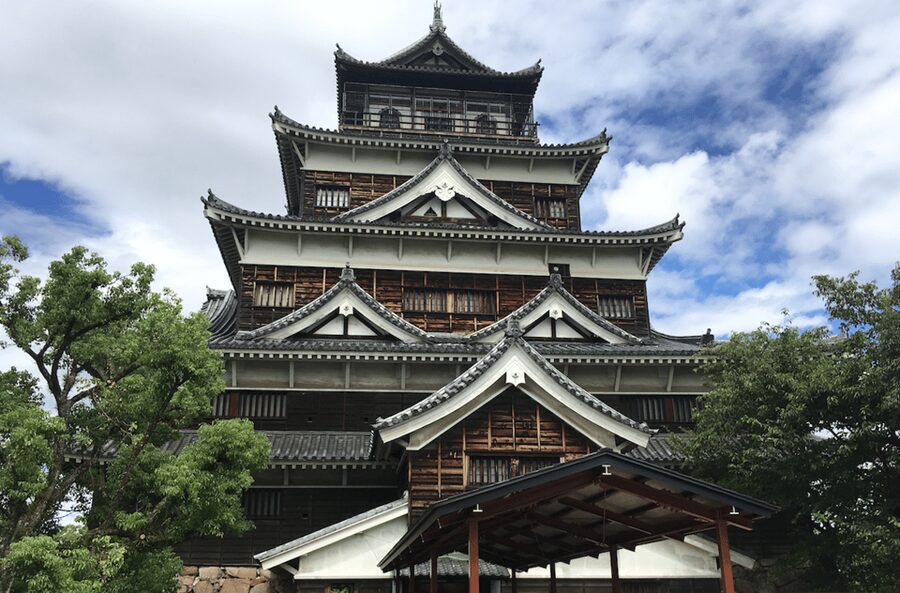
After Peace Memorial Park, the route heads north to Gokoku Jinja, one of the city’s most popular Shinto shrines. The shrine adds a different side of Hiroshima, with a focus on Japanese religious tradition rather than the modern memorial story.
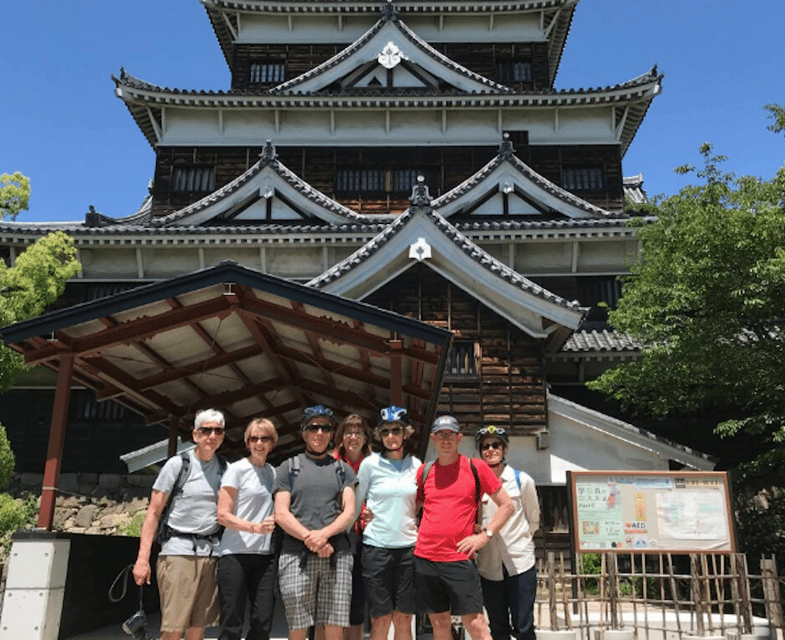
The next stop is Hiroshima Castle. Its grounds offer a glimpse into the city’s samurai-era past and help place Hiroshima within the longer story of Japan. This is one reason I like the itinerary. If you only visit the Peace Memorial Park, you may leave with a powerful but narrow picture of the city. The shrine and castle broaden the day.
The castle grounds are also a welcome change of pace after the emotional weight of the memorial sites. You can look at the setting, hear about the samurai period, and enjoy the ride through open grounds instead of moving from one solemn monument to another.
The tour does not promise a lengthy indoor visit to every attraction, so think of these stops as guided sightseeing points rather than a full museum day. If you want to explore Hiroshima Castle in detail, you may need to return independently. The bike tour is best for seeing the grounds and getting context while using your time efficiently.
Shukkei-en Garden is a calm final stop
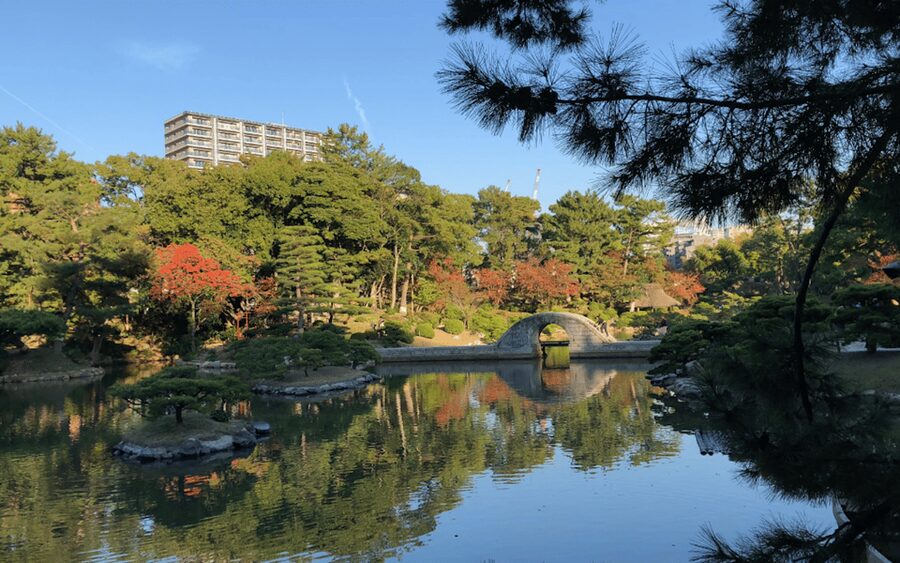
The last featured sight is Shukkei-en Garden, built during the Edo Period and regarded as one of the finest traditional gardens in Western Japan. Entry is included in the $70 price, which makes this more than a brief roadside photo stop.
Ending here is smart. The Peace Park asks you to think about loss and survival, while the castle and shrine provide historical and cultural context. Shukkei-en then gives the tour a quieter finish, with carefully arranged garden scenery and a slower final pause.
You should not expect the garden to be the main reason to book the tour, but it adds real value. It turns the itinerary into a rounded look at Hiroshima, from the bombing and reconstruction to older Japanese traditions and garden design.
Several guides have been praised for allowing time at the garden rather than rushing straight back to the shop. If you enjoy traditional gardens, you may want to linger after the tour if your schedule allows, though the supplied details do not specify how long you can remain after the guided visit.
Same city, a completely different kind of day:
- Peaceful Hiroshima & Miyajima UNESCO 1 Day Bus Tour
★ 5.0 · 5,309 reviews - Hiroshima: Hiroshima and Miyajima UNESCO Sites 1-Day Tour
★ 4.9 · 2,330 reviews - Hiroshima / Miyajima Full-day Private Tour with Government Licensed Guide
★ 5.0 · 1,298 reviews - Hiroshima Historical Walking Tour – Why A-Bomb was Dropped
★ 4.8 · 893 reviews
The guides shape the experience
The route is set, but the quality of the day depends heavily on the guide. The named guides associated with this experience include Awais, Aimee, Miyu, James, Ehsan, Hasan, Ihsan, Melissa, Ali, Alex, and Sage.
The strongest pattern is clear explanation paired with a relaxed manner. Awais is often singled out for making the story of Hiroshima easy to follow, while Aimee is praised for being friendly, funny, respectful, and attentive to questions. Miyu has been noted for sharing family stories that make 1945 feel less distant and abstract.
You may also find that the guide takes photographs for the group. This has been part of the experience for some outings, along with occasional extra explanations between the official stops. One guide extended the tour by about an hour when the group had no immediate time pressure, but you should treat that as a generous possibility, not a standard part of the advertised 210 minutes.
The small group limit of eight helps. A guide can check that everyone is following, stop for questions, and adjust the pace more easily than on a large coach tour. It also makes the ride less anonymous, which can be pleasant for solo visitors.
Do not expect every guide to tell the story in exactly the same way. Some place more weight on family memories, some on historical detail, and some on the city’s recovery. That variation is normal on a live guided tour and can be an advantage if you enjoy hearing history presented through a human voice.
Is $70 good value?
At $70 per person, this is not the cheapest way to move around Hiroshima. You can walk through some of the central sights, use public transport, and pay separately for any admission fees. But that comparison misses what you are buying.
The price includes an English-speaking guide, a quality bike, helmet rental, bottled water, and entry to Shukkei-en Garden. More important, you are paying for a carefully connected route and nearly four hours of explanation. You can see the Peace Park, Atomic Bomb Dome, shrine, castle grounds, and garden without spending the day working out directions or backtracking.
I consider the value strongest for a first visit or a short stay. If you have only one day in Hiroshima, the tour covers a lot without turning the city into a checklist. It also saves your feet, a point that matters after several days of walking around Japan.
The value is weaker if you already know Hiroshima well, have plenty of time, or prefer to spend hours inside museums. The bike tour gives you a guided overview, not an extended visit to every indoor attraction. You may still want to return to the Peace Memorial Museum or explore the castle on your own, depending on your plans.
Weather, clothing, and rider requirements
Good weather is required. If poor weather cancels the tour, you are offered another date or a full refund. This is worth considering during rainy periods or in very hot weather, when a cycling schedule can become less comfortable.
Wear comfortable clothes and shoes. You do not need specialist cycling gear, but sandals or stiff footwear may make the ride less pleasant. On hot days, the group may stop more often for water and breaks. One outing on a very hot day also included a quick stop for local food, though that is not listed as a guaranteed part of the tour.
The route is described as suitable for anyone who can ride a bike, but the formal restrictions matter. The experience is not suitable for children under 12, pregnant women, people with back or heart problems, people under 140 centimeters, or people with pre-existing medical conditions.
The supplier lists child-sized bikes, but the minimum age still applies. If your child is close to the age or height limit, check before booking rather than assuming a smaller bike solves the issue.
Who will enjoy this Hiroshima bike tour?
I would choose this for you if you want a clear introduction to Hiroshima and prefer moving through a city instead of relying on buses. It suits couples, solo visitors, families with older children, and anyone who can cycle at an easy pace.
It is particularly useful for:
- First-time visitors with limited time
- People who want the Peace Park explained by a guide
- Riders who dislike long walking days
- Visitors interested in both modern Hiroshima and its older cultural sites
- Solo visitors who enjoy a small social group
- Anyone who wants a flat route with a standard bike or e-bike option
I would be more cautious if you have mobility concerns, serious medical conditions, or little confidence on a bicycle. The route is gentle, but it is still a cycling experience. You also need to accept that rain or poor weather can change the plan.
Booking details that matter
The meeting point is Cycle Hiroshima HQ, marked by a large Cycle Hiroshima sign at the front. Hotel pickup and drop-off are not included, so you need to make your own way to the shop.
The tour lasts 210 minutes, or three and a half hours. Starting times vary, so check availability for your date. The live language is English, and the group is limited to eight people.
You can cancel up to 24 hours in advance for a full refund. The reserve-now, pay-later option is useful if your Japan plans are still shifting. I would still book ahead for a preferred date, especially if you want an e-bike or have a small group of your own.
Should you book it?
Book this tour if you want Hiroshima’s key sights connected into one thoughtful, manageable half-day. The flat route, comfortable bikes, small groups, and strong guides make it an efficient way to cover more ground without hurrying.
The best reason to go is the balance. You get the emotional weight of the Atomic Bomb Dome and Peace Memorial Park, then the shrine, samurai-era castle grounds, and peaceful garden. That wider view helps you understand Hiroshima as more than one historic event.
Skip it if you want a full museum day, dislike cycling, or need a tour that runs in any weather. For most visitors who can ride comfortably, the $70 cost is fair for the time, equipment, guide, and included garden admission.
FAQ
How long does the Hiroshima bike tour last?
The tour lasts 210 minutes, or three and a half hours.
How much does the tour cost?
The listed price is $70 per person.
What sights are included on the route?
The route includes Peace Memorial Park, the Atomic Bomb Dome, Gokoku Jinja, Hiroshima Castle grounds, and Shukkei-en Garden.
Is the route difficult?
The route is completely flat and designed for anyone who can ride a bicycle. The ride is described as relaxed, with stops along the way.
How many people can join the tour?
The group is limited to a maximum of eight participants.
Is the tour conducted in English?
Yes. The experience includes a live English-speaking guide.
Are bikes and helmets included?
Yes. A high-quality bike and helmet rental are included. Trek bikes, step-through bikes, e-bikes, and child-sized bikes are available.
Is admission to Shukkei-en Garden included?
Yes. Entry to Shukkei-en Garden is included in the tour price.
What happens if the weather is bad?
The tour requires good weather. If it is canceled because of poor weather, you can choose another date or receive a full refund.
Just added around Hiroshima
- The Journey of Hiroshima from Tragedy to Peace★ 4.8 · 44 reviews
- Miyajima: Private Rickshaw Tour to Itsukushima Shrine★ 4.9 · 45 reviews
- Hiroshima: Miyajima Half-day Historical Walking Tour★ 4.7 · 100 reviews
- Hiroshima:Guided Virtual Tour/PEACE PARK TOUR VR★ 5.0 · 29 reviews
- Hiroshima/Miyajima Private Custom Tour with Local Guide★ 5.0 · 134 reviews
- Hiroshima: Saijo Sake Tasting at 7 Breweries Guided Tour★ 4.8 · 29 reviews
- Hiroshima: Tour of Atomic Bomb Dome & Peace Memorial Museum★ 5.0 · 20 reviews
- Hiroshima: Private Walking Tour with a Local★ 4.6 · 70 reviews
Cycling Tours, compared.

3h Tokyo E-Bike Tour: Hidden Gems, and Local Life with guide
Read our review →
Arashiyama Bamboo Forest & Hidden Gems Bike Tour (Early Bird)
Read our review →
Hiroshima in a Nutshell: Morning Bike Adventure
Read our review →
5 Top Highlights of Kyoto Full Day Bike Tour (E-bike option)
Read our review →Browse the lists this tour appears in