
REVIEW · HISTORICAL TOURS
Asakusa: 2-hour history exploration
Asakusa’s great strength is easy to miss: its famous gates and temple are not just photogenic stops, but pieces of a 1,400-year story. This two-hour walk connects the Sumida River, Senso-ji, Asakusa Shrine, and Nakamise Shopping Street so you understand how the neighborhood grew around its temple.
I like the clear English guiding and the use of headsets for groups of three or more. I also like the small, human touches: a traditional snack along the way, help finding a particular souvenir, and possibly a bonus origami lesson. The main drawback is that two hours goes quickly, and one guide may pack in so many details that the tour feels less structured than some visitors expect.
In This Review
- Key points to know before booking
- Why this short Asakusa walk works
- Starting by the Sumida River
- Looking across Asakusa from the Tourist Information Center
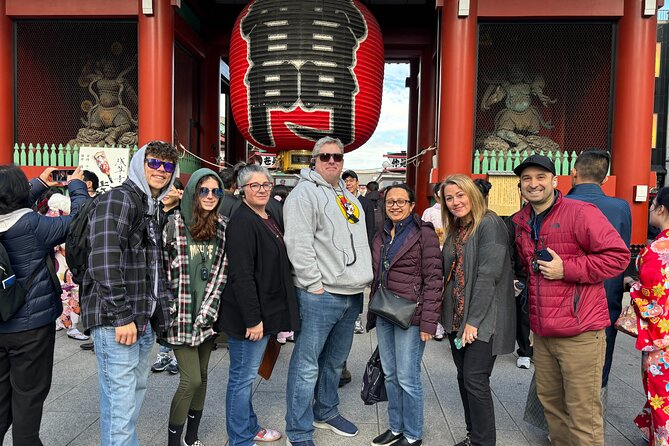
- Decoding the giant lantern at Kaminarimon
- Walking Nakamise with a snack in hand
- Passing beneath Hozomon Gate
- Understanding the rituals at Senso-ji
- Seeing Buddhism and Shinto side by side at Asakusa Shrine
- Headsets, group size, and the walking pace
- What the $64.55 price really buys you
- Who should book this Asakusa experience
- Final decision: book it for context, not speed
- FAQ
- How long is the Asakusa history tour?
- Where does the tour start?
- Where does the tour end?
- Is hotel pickup included?
- Are headsets provided?
- Can I cancel for a full refund?
Key points to know before booking
- See Asakusa from the Sumida River to Senso-ji: The route gives you both the district’s river setting and its major religious sights.
- Hear the guide in crowded streets: Headsets are supplied for groups of three or more.
- Taste a traditional Asakusa snack: Your guide chooses a suitable stop based partly on your preferences.
- Learn why a Buddhist temple and Shinto shrine share one precinct: This is one of the tour’s most useful cultural lessons.
- Expect a maximum group of 20: It is not a private walk, but the fixed route keeps the group moving.
- Finish at a restaurant connected with a geisha activity: Hotel pickup is not included.
Why this short Asakusa walk works
Asakusa can seem simple at first. You follow the crowd through Kaminarimon, walk under the giant red lantern, browse Nakamise, and reach Senso-ji’s main hall. You can take fine photographs this way, but you may not understand what you are seeing or why the precinct matters.
This tour gives the route a clear starting point. The story begins beside the Sumida River, where Asakusa’s early development took shape. From there, the walk moves toward the temple through a series of gates, shops, rituals, and religious buildings. That order matters because it lets you see Asakusa as a living district rather than a string of disconnected sights.
The tour is conducted in English by a local certified guide. Named guides connected with the experience include Choco, Yasu, and Amy, though your guide will depend on the date. The strongest part of the guiding is the plain explanation of local customs and the willingness to answer questions. Guides have also helped with practical shopping requests, such as finding a Japanese knife.
At $64.55 per person, this is not a bargain-priced stroll. The value comes from the amount of interpretation packed into two hours, plus the snack and the convenience of having the route explained as you go. If you would otherwise visit only Senso-ji and take a few pictures, the tour can add real value. If you already know Japanese religious customs and Asakusa’s history, the price may feel high for a short walk with no hotel pickup.
A few more Tokyo trips to weigh up
- Tokyo: Imperial Palace and Shogun Historical Walking Tour
★ 5.0 · 2,251 reviews - Tokyo: Imperial Palace Japanese History Walking Tour
★ 4.9 · 987 reviews - Tokyo: Shinjuku Historical Walking Tour & Secret Backstreets
★ 5.0 · 530 reviews
Starting by the Sumida River
The meeting point is outside Burger King Asakusa Azumabashi, at 2-chome-20-6 Kaminarimon. The start time is 9:30 a.m. Arrive with enough time to locate the exact meeting point, since the tour begins in a central but busy part of Asakusa.
The first stop is the Sumida River. You cross Azumabashi Bridge and look toward two memorable Tokyo sights: Tokyo Skytree and the Asahi Breweries headquarters, topped by the famous golden flame object. Admission is free, and this opening section takes about 15 minutes.
I like this beginning because it places Asakusa in its wider setting. The river is not just a scenic backdrop. It explains why this area became important and gives you a better sense of the relationship between old Asakusa and modern Tokyo.
This is also a good point for photographs, especially if you want a view that includes the river, Skytree, and the Asahi building. The stop is brief, so do not expect a long river walk. It is an introduction, not a separate sightseeing visit.
Looking across Asakusa from the Tourist Information Center
From the river, you walk to the Asakusa Culture Tourist Information Center. The building is an attraction in its own right, with eight levels arranged to resemble separate wooden structures stacked at different angles. Its design gives the building a distinctive profile beside the older streets.
The group visits the open terrace observation deck on the eighth floor for a preview of the route. From there, you can identify Tokyo Skytree and the Asahi flame again, along with Kaminarimon, Nakamise Shopping Street, Hozomon Gate, and Senso-ji.
This viewpoint is useful early in the tour because it turns a busy collection of streets into a readable plan. You see where you have been and where you are going. The stop lasts about 15 minutes and does not require an admission ticket.
Do not expect a long museum visit here. The building’s role on this tour is mainly to provide orientation and a high view. For a first visit to Asakusa, that may be more useful than spending extra time inside a larger exhibition.
Decoding the giant lantern at Kaminarimon
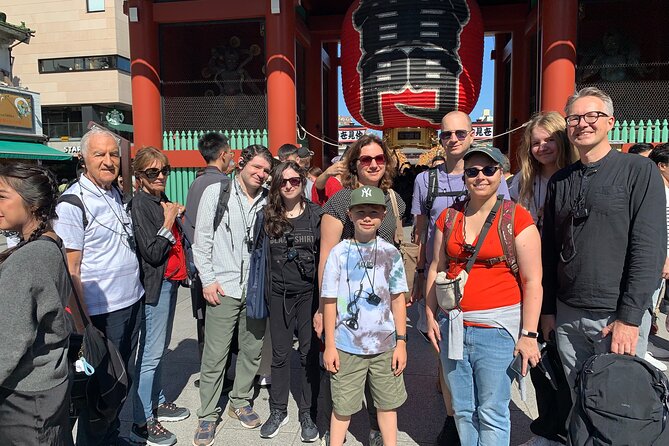
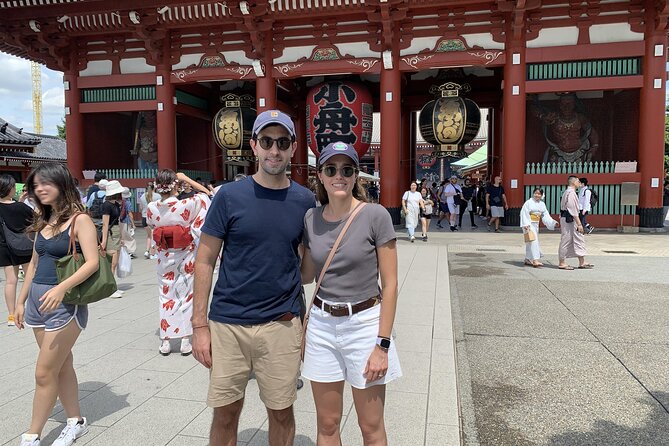
Kaminarimon means Thunder Gate, and it is the outer entrance to the Senso-ji complex. Most people notice the huge red lantern first, then move on with the crowd. Your guide pauses to explain the lantern, the gate, and the statues around it.
That explanation is worthwhile because Kaminarimon is one of those Tokyo sights that can look familiar before you know what it represents. The guide helps you read the gate instead of treating it as a background for a photograph.
The stop lasts about 15 minutes. Crowds can gather here, and the area is one of the busiest points on the route. The headsets help if your group has three or more people, since you can hear the guide without standing shoulder to shoulder. You should still stay close enough to follow the group and see what the guide is discussing.
Same city, a completely different kind of day:
- Mt Fuji and Hakone 1-Day Bus Tour Return by Bullet Train
★ 5.0 · 26,383 reviews - 1-Day Tokyo Bus Tour
★ 5.0 · 14,250 reviews - Tokyo: TOKYO SKYTREE® Admission ticket
★ 4.5 · 11,192 reviews - Tokyo: teamLab Planets TOKYO Digital Art Museum Entry Ticket
★ 4.6 · 9,779 reviews
Walking Nakamise with a snack in hand
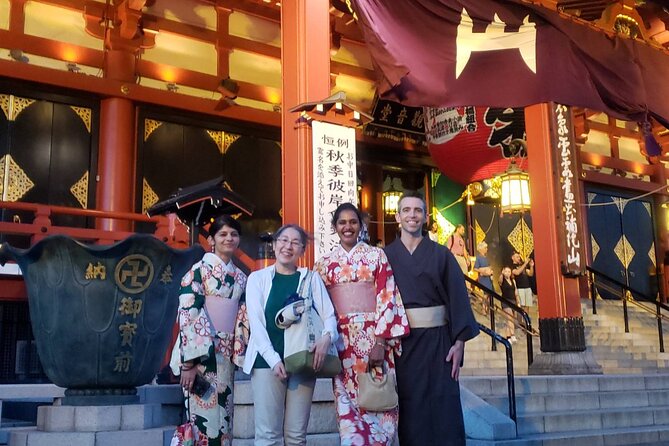
Nakamise Shopping Street runs about 250 meters from Kaminarimon to Senso-ji’s inner gate. Its narrow approach is lined with souvenir shops and food stalls. This is the most commercial section of the walk, but it also has a clear connection to the temple approach.
Your guide can point out where to shop for the sort of souvenir you want. That personal help is more useful than a general list of stores. If you are looking for a particular Japanese item, ask early and be specific. The guide may also adjust the snack stop to suit your preferences.
The traditional snack is included as part of the walking experience. It is a small detail, but it makes Nakamise more than a street to hurry through. Food gives you a reason to pause, watch the shops, and notice how the approach works.
Near the end of Nakamise, look for history tablets along the side of the street. They show how Asakusa began and developed around Senso-ji. This is an important bridge between the food stalls and the temple. You are not simply moving from shopping to worship. You are following the physical growth of the district.
Nakamise takes about 30 minutes, the longest single stop. That makes sense, since the street combines shopping, food, history, and movement toward the temple. Still, you should not expect a leisurely shopping session. The tour has a fixed time, so save serious souvenir buying for after the walk unless you find exactly what you need.
Passing beneath Hozomon Gate
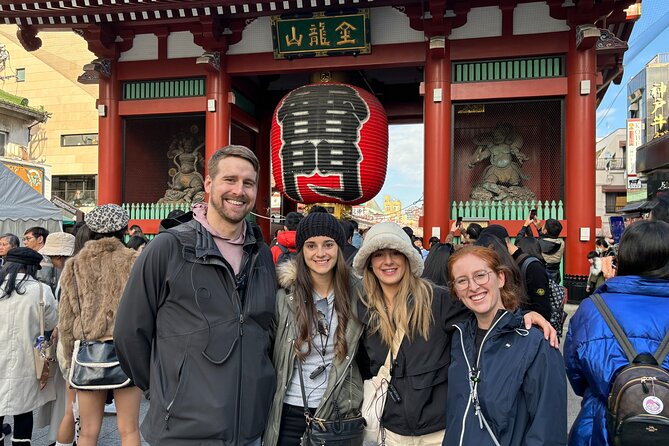
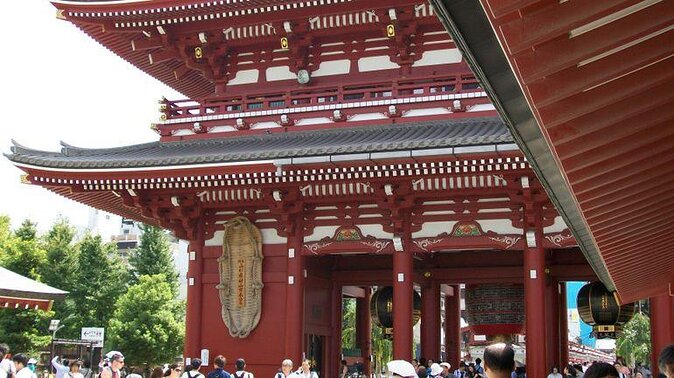
Hozomon, or Treasure-House Gate, is the inner gate leading toward Senso-ji’s main hall. It is a two-story structure, with temple treasures kept on the upper level. On the lower level, the guide points out two statues, three lanterns, and two large sandals.
This is a compact stop of about 15 minutes, but it adds detail that is easy to miss when the gate is crowded. The large sandals are especially memorable, while the statues and lanterns help show how much visual information is packed into the temple precinct.
The gate also creates a strong change in mood. Nakamise is lined with shops and food stalls. Beyond Hozomon, the space opens toward the temple buildings and religious rituals. The guide helps you notice that transition.
Understanding the rituals at Senso-ji
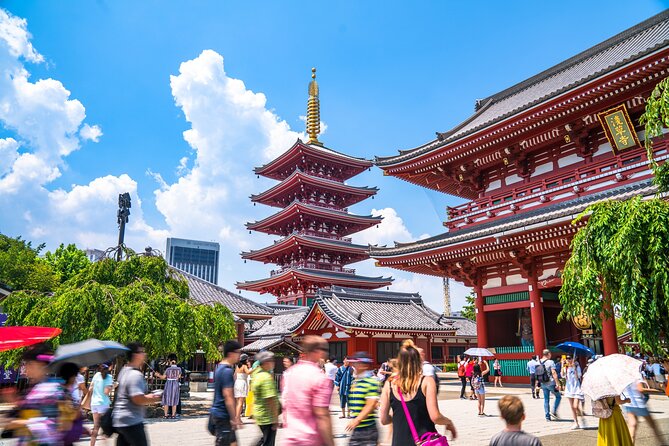
Senso-ji is the centerpiece of the walk. Before reaching the main hall, you pass the five-storied pagoda, which rises 53 meters and is described as Japan’s second-highest pagoda. Its top floor holds Buddha’s ashes given by the Sri Lankan government.
The pagoda deserves more than a quick photograph. Its height gives the precinct a vertical focus, while its religious purpose links Asakusa to Buddhist practice beyond Japan. Your guide explains what you are seeing without requiring you to already understand Buddhist architecture.
The tour also introduces three actions that you may see people performing before entering the main hall.
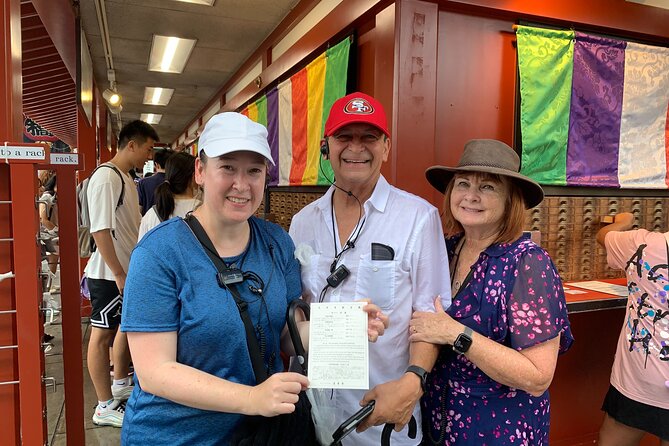
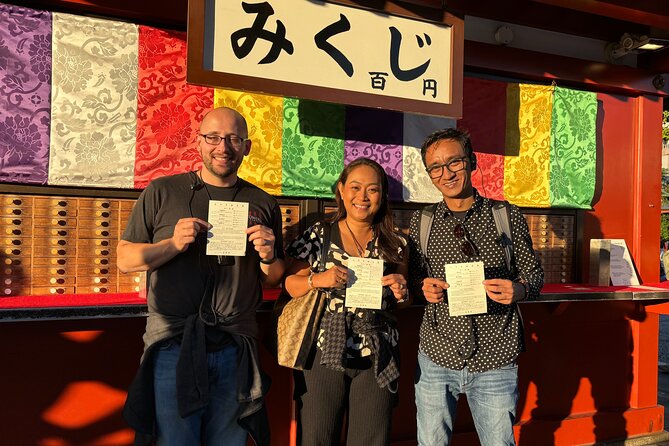
First, you can draw an omikuji, or paper fortune. This is a chance to receive a prediction about your future. The fortune reading was one of the most memorable parts for at least one guide participant, and it gives you a playful way to take part rather than only observe.
Second, you can stand near the large bronze incense burner and let the smoke pass over your hands and face. Many Japanese people use this ritual to ward off illness before going up the steps to pray.
Third, you use the water purification fountain. The guide explains how people purify themselves before entering the sacred area. These customs can look mysterious if you watch them without context. A short explanation helps you take part respectfully.
The Senso-ji section is listed at about 15 minutes, so the pace is brisk. You will receive an introduction rather than a long temple study. If you want time for a careful prayer, fortune reading, photographs, and quiet observation, plan to return later on your own.
Seeing Buddhism and Shinto side by side at Asakusa Shrine
Asakusa Shrine is the final major stop. It shares the broader Senso-ji precinct, which can surprise visitors who assume a Buddhist temple and a Shinto shrine should always be in separate places.
This is the cultural question that gives the tour its best wider context: how can these two faiths share origins, worshipers, and a single historic site? Your guide explains how Buddhism and Shinto have been woven into ordinary Japanese life.
That lesson is more useful than memorizing architectural terms. It helps you understand why a visit to Japan can include temple and shrine customs in the same afternoon, and why the boundary between them has not always been as strict as a first-time visitor might expect.
The stop takes about 15 minutes. Asakusa Shrine is not treated as an isolated attraction. Instead, it completes the story that began at the river and moved through the Buddhist temple grounds.
Headsets, group size, and the walking pace
The tour accepts a maximum of 20 people. That is small enough to keep the route manageable, but it is not a private experience. You may need to stay alert at crossings, gates, and crowded shopping areas.
Headsets are provided for groups of three or more. This is a practical advantage in Asakusa, where street noise and crowds can make a soft-spoken guide hard to follow. The equipment also lets you look at the building or ritual being discussed without pressing right against the guide.
The walk is described as leisurely, but you should still be comfortable walking for two hours and remaining on your feet. There is no hotel pickup. The central starting point is near public transportation, and the tour ends at Saryō Ichimatsu, 1-chome-15-1 Kaminarimon, at the restaurant where a geisha activity is held.
The ending location is useful if you have another Asakusa plan afterward, though the tour itself does not include that activity. Check your schedule before booking so you do not confuse the end point with a full geisha performance.
What the $64.55 price really buys you
The fee includes the two-hour history tour, live English guiding by a local certified guide, headsets for qualifying groups, and a traditional snack. It does not include hotel pickup or admission charges, though the listed stops themselves are free to enter.
You are paying mainly for interpretation. Senso-ji and Nakamise are easy to visit without a guide. The added value lies in learning why the river matters, what the gates contain, how to approach the temple, and why Asakusa Shrine shares space with Senso-ji.
The snack and shopping help are modest extras, not reasons alone to pay the fee. I would book this at the beginning of an Asakusa visit if you want the rest of your time in the district to make more sense. I would skip it if you prefer to move at your own pace, spend a long time shopping, or already have a strong grasp of Japanese religious history.
The experience is popular enough that it is booked about 30 days ahead on average. That does not guarantee every date will sell out, but it is a useful sign to reserve early if your Tokyo schedule is fixed. Group discounts may be available, and the ticket can be stored on your mobile device.
Who should book this Asakusa experience
This tour fits first-time visitors who want a clear introduction without giving up a whole day. It is also a good choice for anyone interested in Japanese history, temple customs, architecture, or the relationship between Buddhism and Shinto.
Families and mixed-age groups may appreciate the snack, fortune reading, and short stops. The route is active but not presented as a strenuous hike. Most people can participate, and service animals are allowed.
English ability matters less than guide clarity, and that is one of the tour’s strongest points. Guides such as Choco, Yasu, and Amy have been associated with clear explanations, friendly conversation, and useful answers to questions. Still, individual guiding styles vary. One guide may tell many details, while another may keep the story tighter.
The main caution is structure. If you want every minute arranged with a firm narrative, ask questions when the connection between stops is unclear. The provider has recognized that the tour can sometimes include too many details without fully completing a promised story. That is a fair warning for anyone who prefers a tightly scripted walk.
The experience is rated 4.9 out of 5, with 97 percent recommending it. Those figures fit the tour’s strongest features: clear English, friendly guides, useful headsets, and a route that makes Asakusa easier to understand.
Final decision: book it for context, not speed
Book this tour if you want Asakusa to become more than Kaminarimon, souvenir shops, and a temple photograph. The river opening, eighth-floor view, snack stop, temple rituals, and explanation of Buddhism alongside Shinto create a strong first look at the district.
Skip it if you want extended shopping time or silent temple visits. Two hours is enough for a thoughtful introduction, not enough for every corner of Senso-ji. For most first-time visitors, the $64.55 price is reasonable when the goal is to understand what you are seeing, especially if you take the tour early in your Tokyo stay.
FAQ
How long is the Asakusa history tour?
The tour lasts approximately two hours, beginning at 9:30 a.m.
Where does the tour start?
It starts at Burger King Asakusa Azumabashi, near Bil Royal Palace, 2-chome-20-6 Kaminarimon, Taito City, Tokyo 111-0034.
Where does the tour end?
It ends at Saryō Ichimatsu, 1-chome-15-1 Kaminarimon, Taito City, Tokyo 111-0034. The restaurant is where the geisha activity is held.
Is hotel pickup included?
No. Hotel pickup is not included, so you must make your own way to the central meeting point.
Are headsets provided?
Yes. Headsets are provided for groups of three or more so you can hear the English-speaking guide clearly in busy streets.
Can I cancel for a full refund?
Yes. You can cancel for a full refund up to 24 hours before the experience start time. Cancellations or changes made less than 24 hours before the start time are not accepted for a refund.
Just added around Tokyo
- Private Memorable Tokyo Tour with English Speaking Driver★ 5.0 · 30 reviews
- Tokyo Photography Masterclass – Private Photography Lesson★ 5.0 · 25 reviews
- Private Tokyo Custom Full-Day Tour by Chartered Vehicle★ 5.0 · 16 reviews
- Private Sightseeing to Mt Fuji and Hakone with English Driver★ 5.0 · 51 reviews
- Private Mt. Fuji Day Trip from Tokyo with English-Speaking Driver★ 5.0 · 33 reviews
- 4 Day Tour – Mount. Fuji, Tokyo, Hakone, Kamakura and Yokohama★ 5.0 · 19 reviews
- Private Unforgettable Mt Fuji Tour with English Speaking Driver★ 5.0 · 142 reviews
- Private Tokyo Food Tour – A Journey Through Time Through Food★ 5.0 · 36 reviews
Historical Tours, compared.
World Heritage Shirakawa-go and Experience Tours from Kanazawa
Read our review →
Imperial Palace and Shogun Historical Walking Tour
Read our review →
World Heritage Kyoto & Nara Uji Authentic Matcha Experience
Read our review →
Kyoto Gion: 2-Hour Geisha Culture & History Walking Tour
Read our review →
World Heritage Shirakawa-go Morning Guided Tour
Read our review →
Hiroshima Historical Walking Tour – Why A-Bomb was Dropped
Read our review →
Hiroshima Peace (Heiwa) Walking Tour at World Heritage Sites
Read our review →Browse the lists this tour appears in