
REVIEW · FOOD
Discover Real Osaka: A Cultural Walk with Food & Drink
Osaka reveals itself best at street level, and this walk takes you from youth fashion and neon signs to a moss-covered Buddhist statue, market food, and the old-fashioned streets of Shinsekai. Guide Mico Yamamoto brings a local and artist’s eye to the city, with stories, sketching experience, and personal map tips that continue after the four-hour walk.
I like the mix of food and neighborhood life, not just famous photo stops. I also like the manageable maximum of nine people, which should make it easier to ask questions and keep the walk personal.
The main drawback is the pace. You cover several districts in four hours, and the stops are short. Transportation costs are extra if you choose a train or taxi, and some of the more ambitious additions, such as Osaka Castle and Abeno Harukas, are available only on private tours.
In This Review
- Key points to know before booking
- Why this walk gives you a fuller Osaka picture
- America Mura brings Osaka’s youth culture first
- Dotonbori delivers the famous Osaka signs
- Shinsaibashi shows the commercial side of the city
- Hozenji Yokocho slows the pace
- Kuromon Market is the food center of the morning
- DenDen Town adds anime, games, and gadgets
- Tower Knives offers a practical shopping pause
- Shinsekai brings the retro Osaka finish
- Nishinari is optional and deserves a thoughtful approach
- Private tours open the door to longer stops
- Group size, guide style, and the value of personal maps
- Who should book this Osaka walk
- Should you book it?
- FAQ
- Where does the tour begin?
- Where does the tour finish?
- How long does the experience last?
- What food and drinks are included?
- Are transportation costs included?
- How large is the group?
- Are Osaka Castle and the other museum stops part of the regular tour?
Key points to know before booking
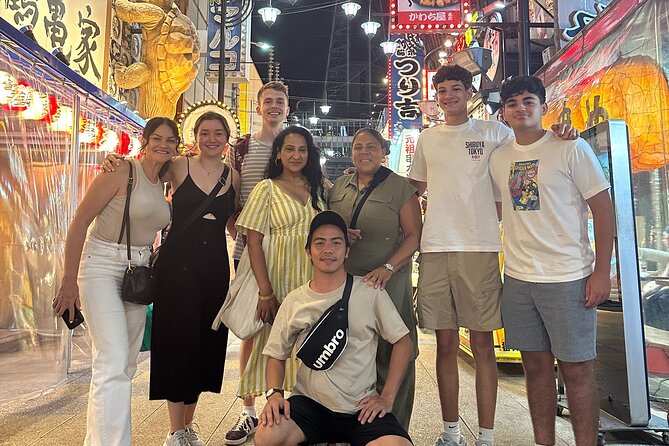
- The route crosses Osaka’s cultural center: You move from America Mura and Shinsaibashi to Hozenji, Kuromon Market, DenDen Town, and Shinsekai.
- Food is part of the price: Takoyaki and okonomiyaki are included, along with one alcoholic drink, usually sake, and one non-alcoholic drink.
- Small groups keep the walk flexible: The regular group format is capped at nine people, with private options also available.
- The endpoint is useful: You finish near Dobutsuen-Mae Station, close to Shinsekai, with easy train connections toward Namba and Umeda.
- Private tours can go beyond the standard route: Osaka Castle, a woodblock print museum, Abeno Harukas, and the Osaka Museum of Housing and Living may be added privately.
- You receive lasting planning help: Mico provides personal Google Map links and tips for Osaka, Kyoto, Tokyo, and other destinations.
Why this walk gives you a fuller Osaka picture
Many Osaka walks stay around Dotonbori, where the giant signs and food stalls make an easy first impression. This route uses that famous district, but it does not stop there. You also see the city’s youth culture, religious traditions, shopping streets, food market, anime scene, and retro entertainment quarter.
That range is the best reason to book. In one morning or afternoon, you get a useful orientation to several parts of central Osaka. You can note which areas deserve a return visit, ask Mico where to eat later, and use the personal map links when planning the rest of your stay.
The tour begins at 10:00 am outside Swissotel Nankai Osaka in Namba. That is a practical starting point, especially if you are staying near Namba or arriving by the Nankai railway. Wear comfortable shoes. Even though the route is urban and mostly level by ordinary city standards, four hours on foot can feel long when you add food stops and busy sidewalks.
The standard experience is listed at about $78.38 per person. That is a fair price if you value a personal guide, two food tastings, two drinks, and local orientation. It is less attractive if you mainly want a quick set of photographs or prefer to explore independently with a map. Since transportation is not included, keep a little extra money available if the group takes a train or taxi.
A few more Namba trips to weigh up
- Osaka Delights: Traditional Japanese Food Tour
★ 4.5 · 33 reviews - Osaka: Namba Local Food Walking Tour (Taste 15 Dishes)
★ 5.0 · 20 reviews - Tokyo: Shinjuku Food Tour (13 Dishes at 4 Local Eateries)
★ 5.0 · 6,603 reviews
America Mura brings Osaka’s youth culture first
Your first stop is America Mura, often shortened locally to Amemura. The area is associated with urban fashion, street art, and hip-hop culture, so it gives you a different opening view of Osaka than temples or historic buildings would.
The scheduled stop is about 20 minutes. That is enough to get your bearings and hear how the neighborhood developed its American-inspired identity, but not enough for a long shopping session. If you want to browse clothing stores or spend time with the street art, make a note to return later.
I like beginning here because it sets up an important point about Osaka. The city is not only old shrines, food traditions, and merchant districts. It also has a playful modern side, and Amemura places that side right at the start.
Dotonbori delivers the famous Osaka signs
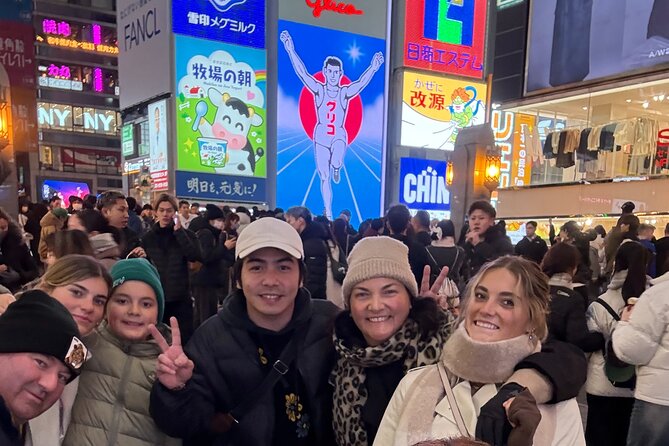
From Amemura, the walk continues toward Dotonbori. This is the part of Osaka most people recognize from photographs: bright signs, food stalls, the canal, and the Glico Running Man sign.
The stop lasts about 20 minutes, so expect a compact introduction rather than a full evening in the district. Mico helps you handle the visual overload and points out the places that matter. You should have time for photographs, but the schedule does not leave much room for standing in line at several food counters.
Dotonbori can feel crowded, particularly around the most famous signs. That is not a flaw in the tour so much as a fact of the location. The guide’s value here is practical. You get the classic Osaka scene, then move on before the area takes over the entire day.
Shinsaibashi shows the commercial side of the city
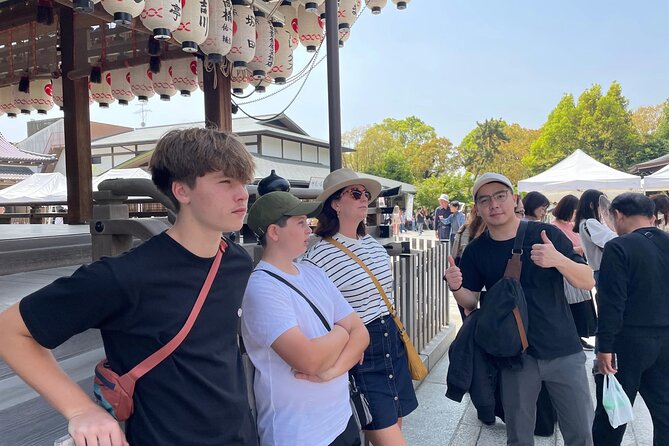
Shinsaibashi is the next short stop, with about 20 minutes to walk through its shopping streets and nightlife area. This part of town is less about one landmark and more about the flow of daily city life, retail, restaurants, and evening energy.
Mico also points out a less obvious place in plain sight and explains one of the area’s stories. That kind of detail can make a familiar shopping street more interesting. You may not remember every shop, but you will better understand how Shinsaibashi connects Namba’s entertainment areas.
The limitation is time. Do not book this walk expecting a leisurely shopping afternoon. Treat this section as an introduction, then return on your own if you want cosmetics, clothing, souvenirs, or department-store browsing.
Same city, a completely different kind of day:
- Osaka Bar Hopping Night Walking Tour in Namba (3 bars, 6 tastes)
★ 5.0 · 958 reviews - Osaka 4hr Private Tour with Government-Licensed Guide
★ 5.0 · 359 reviews - Osaka Sushi Making Class – Hands-On Nigiri & Rolls (Same-Day OK)
★ 5.0 · 352 reviews - Osaka 6hr Private Walking Tour with Government Licensed Guide
★ 5.0 · 174 reviews
Hozenji Yokocho slows the pace
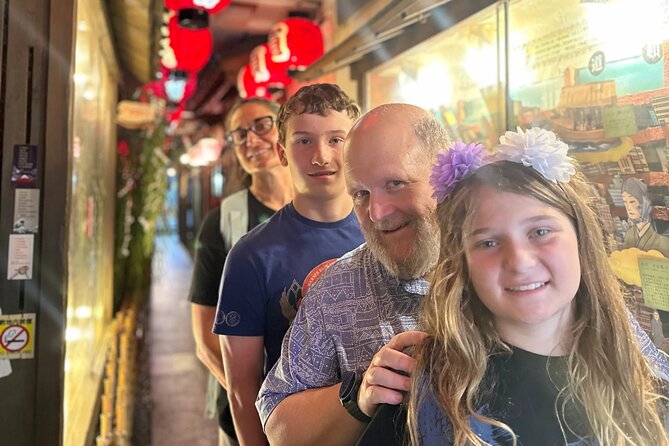
Hozenji Yokocho changes the mood. The lantern-lit lane is narrow, atmospheric, and close to the modern streets around Namba, yet it feels much quieter. Here you visit Hozenji Temple and its moss-covered Fudo Myoo statue.
The stop lasts about 30 minutes. Mico uses the setting to explain Japanese spiritual practice in a direct, accessible way. That matters because visitors often see a small temple, copy the motions of others, and move on without knowing what they are doing. A good explanation gives the place more meaning without turning it into a lecture.
This is also one of the tour’s most useful contrasts. Within a short walk, Osaka shifts from giant advertising signs to incense, stone, lanterns, and personal devotion. I would pay attention here, even if you are more excited about the food stops. It is one of the few parts of the route where the city’s older religious character comes through clearly.
Kuromon Market is the food center of the morning
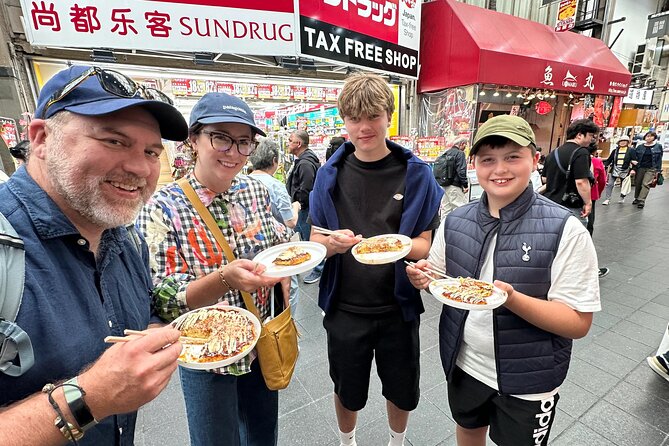
The longest scheduled stop is Kuromon Market, with about one hour. Often called Osaka’s Kitchen, the market has served the city for more than 200 years and remains one of the best places on this route to connect food with local life.
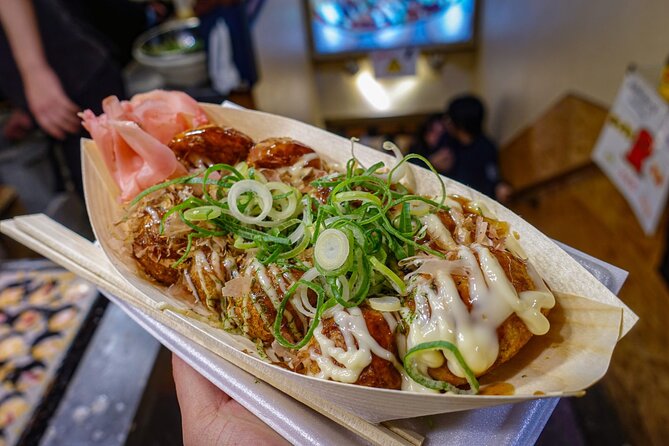
Takoyaki and okonomiyaki are included. Takoyaki gives you the familiar ball-shaped snack filled with octopus, while okonomiyaki is a savory pancake cooked with a range of ingredients. The experience takes you to Mico’s favored okonomiyaki spot, which is more useful than simply being turned loose among dozens of food counters.
One alcoholic drink and one non-alcoholic drink are also included. You can choose sake for the alcoholic option, or select the non-alcoholic choice instead. If you do not drink alcohol, you are not forced into a sake tasting.
An hour is a sensible amount of time for a guided market visit, but it can pass quickly. Kuromon is a working food district as well as a sightseeing stop, so crowds, queues, and changing shop conditions may affect how much you taste. The included snacks are a strong part of the $78.38 price, but do not assume every item you see is included.
This is the point where the guide can save you from spending blindly. Mico’s personal recommendations give you a starting point, and the map links let you record places for later. If you are especially interested in Japanese food, ask questions here rather than waiting until the end.
DenDen Town adds anime, games, and gadgets
The route can continue into DenDen Town, Osaka’s district for anime, gaming, electronics, and unusual gadgets. This is a sharp change from Kuromon Market and helps show how varied central Osaka can be.
The available details do not give a fixed duration for this stop, so expect it to fit around the main schedule rather than receive the same time as Kuromon Market. If anime, games, or Japanese technology interest you, this could be one of the most memorable sections. If not, you may find it more useful as a quick look at a specialized shopping district.
Because the tour covers many neighborhoods, you should not expect a long store-by-store search. Use Mico’s guidance to identify the parts worth returning to. The route works best when you see it as an introduction, not a full shopping expedition.
Tower Knives offers a practical shopping pause
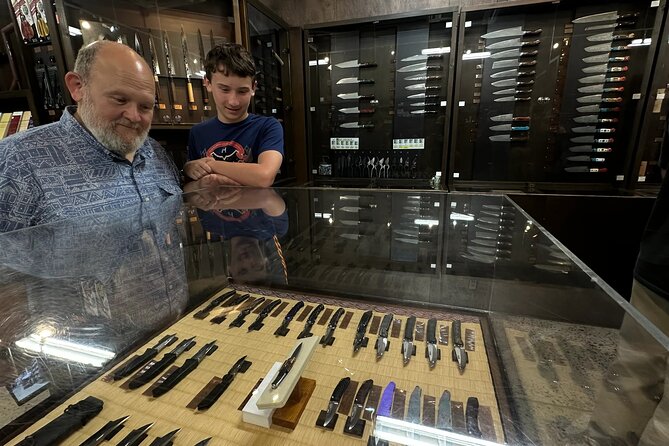
Near Tsutenkaku Tower, Tower Knives specializes in Japanese kitchen knives. Staff members can demonstrate how the knives are made and explain the products, making this a practical stop for cooks and serious food lovers.
A knife purchase is not included, and you should remember that any shopping here is optional. A Japanese kitchen knife can be a fine souvenir, but it is also a purchase that may involve questions about size, care, sharpening, and transporting it home. Mico can help place the shop within the route, while the shop staff handle the product details.
This stop also fits the food theme. After seeing Osaka’s markets and tasting local dishes, you get a look at one of the tools behind Japanese cooking. If you are not interested in buying a knife, the visit may be brief.
Shinsekai brings the retro Osaka finish
The walk reaches Shinsekai, a district known for old-style eateries, neon signs, and Tsutenkaku Tower. The scheduled visit is about 30 minutes, and the tour ends near Dobutsuen-Mae Station, close to this area.
Shinsekai feels different from polished Shinsaibashi and camera-ready Dotonbori. Its appeal comes from its retro character and the sense that you are seeing an older entertainment district still used for everyday eating and wandering. This is a good place to finish because it leaves you near restaurants and a major subway line.
The endpoint is useful for your next move. Dobutsuen-Mae Station is on the Midosuji Line, also called the Red Line, which connects toward Namba and Umeda. Mico can help with directions if you need them. Since you do not return to the starting point, plan your belongings and onward route before you begin.
Nishinari is optional and deserves a thoughtful approach
If the group requests it, the walk may include Nishinari, around Dobutsuen-Mae, for roughly 30 minutes. The area is presented as a rawer, less polished part of Osaka, and the tour aims to show a side of the city beyond its postcard streets.
This is not a standard must-see attraction in the same way as Dotonbori or Hozenji. It may appeal to you if you want to understand Osaka’s less decorated urban character and are comfortable with a neighborhood described in stark terms. You should also listen carefully to Mico’s local context rather than treating the area as a spectacle.
Because this section is conditional, do not book the experience solely for Nishinari. Think of it as a possible extension when the group wants a more direct look at the city.
Private tours open the door to longer stops
Private tours can be arranged for five or six hours instead of the standard four. That extra time matters because the route contains more possibilities than one morning can comfortably hold.
Private options may include Osaka Castle, which recalls Toyotomi Hideyoshi’s ambition and the castle’s construction in 1583. They may also include a central museum with original Edo-period ukiyo-e prints, including an authentic print of The Great Wave off Kanagawa, Abeno Harukas with its 300-meter observation deck, or the Osaka Museum of Housing and Living, where life-size Edo-period streets recreate earlier city life.
These additions should not be treated as part of the regular group walk. They are specifically for private tours, and the information provided does not state that admission fees are included. Ask for the exact route, duration, entrance costs, and transport plan before booking a private version.
The private format is best if you have a clear interest, such as Japanese art, city views, Osaka history, or traditional urban life. It also gives you more control over pacing than the group outing.
Group size, guide style, and the value of personal maps
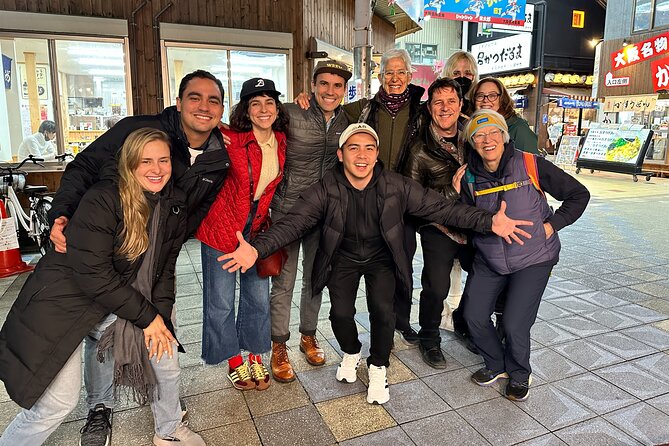
The group maximum is nine people. That is small enough for a more direct exchange with Mico, though the experience can still feel busy in Dotonbori or Kuromon Market. A private tour is the better choice if your group has a tight schedule, mobility needs, or a very specific interest.
Mico Yamamoto is identified as a local Osaka guide and artist who has spent years walking and sketching the city. One published account specifically praises Mico’s work across Kyoto and Osaka, which supports the idea that this experience is strongest when you want a guide who can connect several neighborhoods rather than simply lead you from sign to sign.
The lifetime access to personal Google Map links is a useful extra. A four-hour walk gives you only a sample of Osaka. The maps can help you return to food spots, plan future days, and carry local suggestions into Kyoto and Tokyo. That long-term use improves the value, especially if this is your first visit to Japan.
Who should book this Osaka walk
I would choose this experience if you are visiting Osaka for the first time and want a broad, street-level introduction. It suits people who like food, neighborhoods, small cultural details, and a guide who can explain what you are seeing.
It is also a good fit if you want to avoid spending your entire day in Dotonbori. The route gives you famous Osaka images, but it also includes Amemura, Hozenji, Kuromon, DenDen Town, and Shinsekai.
You may want another tour if you prefer long museum visits, formal historical commentary, or a slow meal with many courses. Four hours is not enough for deep time at every stop. The route is active and varied, so it rewards curiosity more than a desire for a relaxed schedule.
Free cancellation is available up to 24 hours before the start time. Group tours do not include hotel pickup, so you meet at Swissotel Nankai Osaka. Service animals are allowed, the route is near public transportation, and most people can participate, but contact the provider if you have specific walking concerns.
Should you book it?
Book this walk if you want your first Osaka day to include food, nightlife districts, spiritual tradition, youth culture, and a practical subway endpoint. The included takoyaki, okonomiyaki, sake or soft drink, small group size, and lasting map access make the price reasonable for a guided introduction.
Choose the private version if Osaka Castle, the art museum, Abeno Harukas, or the Edo-period streets matter to you. Stay with the group option if you want a lively overview at a lower total cost and do not mind short stops.
The best reason to book is Mico’s personal connection to Osaka. The main caution is simple: this is a brisk sampler. You will see a lot, taste several local staples, and leave with better ideas for the rest of your stay, but you will need to return on your own when a neighborhood catches your interest.
FAQ
Where does the tour begin?
The tour begins at Swissotel Nankai Osaka, located at 5-1-60 Namba, Chuo, Osaka. The scheduled start time is 10:00 am.
Where does the tour finish?
The walk finishes near Dobutsuen-Mae Station on the Midosuji Line, close to Shinsekai. The station provides access toward Namba, Umeda, and other destinations.
How long does the experience last?
The standard experience lasts about four hours. Five-hour and six-hour options are also available, with private tours offering additional flexibility.
What food and drinks are included?
Takoyaki and okonomiyaki are included. You also receive one alcoholic drink, with sake as an option, and one non-alcoholic drink.
Are transportation costs included?
No. This is primarily a walking tour, and any train or taxi rides are paid for separately. Transportation can be arranged upon request.
How large is the group?
The group experience has a maximum of nine people. Private tour options are also available.
Are Osaka Castle and the other museum stops part of the regular tour?
No. Osaka Castle, the ukiyo-e museum, Abeno Harukas, and the Osaka Museum of Housing and Living are listed for private tours only.
Just added around Namba
- Osaka 6hr Private Walking Tour with Government Licensed Guide★ 5.0 · 174 reviews
- Private Airport transfer Kansai Intl. Airport(KIX) to OSAKA CITY★ 4.5 · 12 reviews
- Osaka: Namba Local Food Walking Tour (Taste 15 Dishes)★ 5.0 · 20 reviews
- Osaka Delights: Traditional Japanese Food Tour★ 4.5 · 33 reviews
- Osaka Private Tour with a Local Guide (Must See Places in 1 Day)★ 5.0 · 57 reviews
- Badminton in Osaka & Kyoto with Locals!★ 5.0 · 15 reviews
- From Osaka/Kyoto: Kyoto & Nara Day Trip with Optional Lunch★ 4.5 · 79 reviews
- 1 Day Takoyaki Making and Osaka Castle Walking Tour★ 5.0 · 15 reviews
Food, compared.
Shinjuku Food Tour (13 Dishes at 4 Local Eateries)
Read our review →
Tokyo Tsukiji Fish Market Food and Culture Walking Tour
Read our review →
Shinsekai Food Tour with 13-15 Dishes at 5 Eateries
Read our review →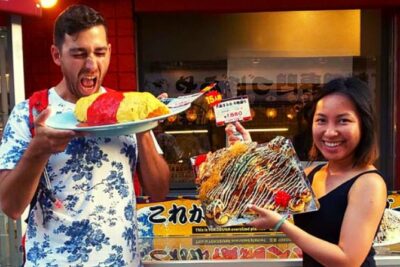
Osaka Food Tour: 13 Dishes at 5 Local Eateries
Read our review →
Shinjuku Food Tour (15 Dishes and 4 Eateries)
Read our review →
Best of Shinjuku: Izakaya Food Tour (4 Stops, 14+ Tastings)
Read our review →
Kyoto Night Foodie Tour in Gion (9+ dishes + 6 Sake tastings)
Read our review →
Hungry Osaka Street Food Tour:15 Tastings & 3 Drinks with a Local
Read our review →Browse the lists this tour appears in