REVIEW · OSAKA TOURS
Seasonal Japanese Culture Osaka Paint and Wine Experience
A seasonal Japanese painting, two drinks, and a finished canvas make this a pleasant change from Osaka’s usual sightseeing circuit. At Cafe&Bar go garageGallery in Shinsaibashi, instructor Miyuki helps beginners get started, then gives you room to create your own version of the theme. You do not need art skills, and the session welcomes solo visitors, couples, and small groups.
I like the relaxed social mood and the fact that your souvenir is something you make yourself, not something pulled from a shop shelf. I also like the thoughtful seasonal program, from cherry blossoms in March to fireworks in July and Christmas in December. The main consideration is that this is free-form painting, not a strict class where everyone copies one finished image, so you should book it if you enjoy personal choice.
In This Review
- Key points at a glance
- Painting Japan’s seasons in central Osaka
- Arriving at Cafe&Bar go garageGallery
- The first brushstrokes at 1:30 pm
- Two drinks and a free hand with the theme
- From painting table to gallery
- Miyuki’s role in the afternoon
- What the $63.93 price really covers
- Who will enjoy this most
- Practical details before you reserve
- The final canvas and the lasting souvenir
- Should you book the Shinsaibashi paint and wine session?
- FAQ
- Where does the painting experience begin?
- What time does the activity start?
- How long does the experience last?
- Where does the activity end?
- Are drinks included?
- Can someone under 20 drink alcohol during the activity?
- Is food included?
- Do I need painting experience?
- What painting subjects are offered?
- Can I take my painting home?
- How many people can join?
- Can I cancel for a full refund?
Key points at a glance
- Seasonal Japanese subjects: Paint cherry blossoms, autumn in Kyoto, fireworks, Osaka scenes, and other monthly themes.
- Miyuki’s beginner-friendly guidance: You receive help with both drawing and painting techniques, without needing previous experience.
- Two drinks included: Choose wine or soft drinks while you work, with non-alcoholic options for anyone under 20.
- A personal canvas to take home: Your finished artwork becomes a compact, handmade Osaka souvenir.
- Small group setting: The maximum group size is 20 people, leaving room for a social but manageable afternoon.
- Convenient Shinsaibashi location: The activity begins and ends at Cafe&Bar go garageGallery, near public transportation.
Painting Japan’s seasons in central Osaka
This experience takes a simple idea, paint and sip, and gives it a Japanese seasonal frame. The subject changes through the year, so the image you create depends on when you visit.
March focuses on cherry blossoms, one of Japan’s most familiar spring symbols. Other months bring their own prompts: Hatsumode, or the first shrine visit of the year, in January; sky lanterns in February; Easter in April; Osaka in May; umbrella streets in June; fireworks in July; the ocean in August; autumn in Kyoto in September; Halloween in October; snow monkeys in November; and Christmas in December.
That monthly rotation gives the activity a stronger sense of place than a standard art workshop. You are not simply painting a random still life. You are working with images tied to Japan’s calendar, festivals, weather, and visual traditions.
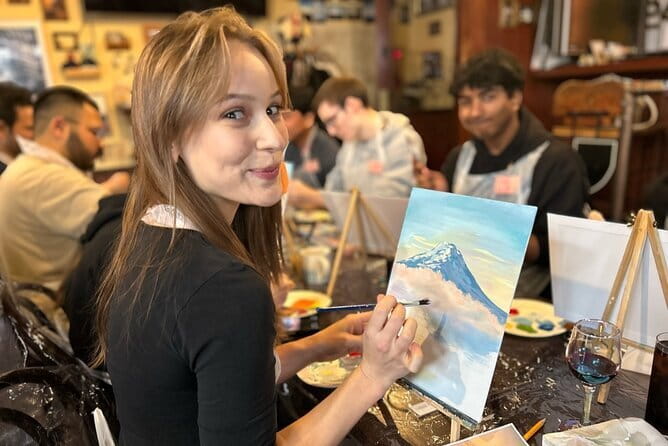
Still, keep your expectations clear. The theme is a starting point, not a fixed stencil. One particularly useful detail is that you can paint freely rather than follow one identical picture from beginning to end. If you want the instructor to demonstrate every brushstroke, this may feel loose. If you prefer to make the artwork your own, that freedom is a real benefit.
A few more Osaka trips to weigh up
- Japanese Wine Omakase in Shibuya – Guided Tasting, Not Sake
★ 5.0 · 15 reviews
Arriving at Cafe&Bar go garageGallery
The meeting point is Cafe&Bar go garageGallery Bldg. at 1-chōme-18-6 Higashishinsaibashi, in Osaka’s Chuo Ward. The session starts at 1:30 pm and lasts about three hours, returning to the same place at the end.
Shinsaibashi is a practical setting for this kind of afternoon activity. It is well connected by public transportation, and you can pair the session with shopping, dinner, or an evening walk in central Osaka. The address is in a city building rather than a grand cultural institution, so allow yourself time to find the entrance.
One useful point from the available feedback is that the outside of the building can look a little unpromising, while the interior feels relaxed and comfortable. Do not judge the activity by the first impression of the facade. Confirm the address before you set out, and arrive ready for a casual cafe and gallery setting rather than a formal art school.
The mobile ticket makes entry easier, but you still need to have the meeting point and start time to hand. With a 1:30 pm beginning, this fits well after a late breakfast or morning visit to Osaka Castle, a museum, or the Kuromon area.
The first brushstrokes at 1:30 pm
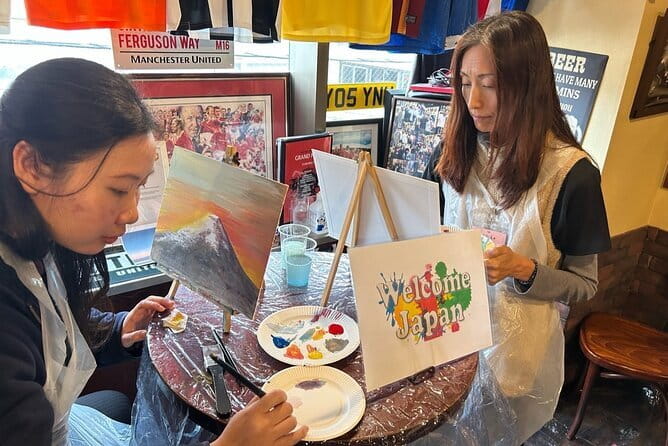
Beginners receive an introduction at the beginning of the session, with everyone then painting together. The format is designed to remove the fear of a blank canvas. You receive paints, brushes, and the other needed supplies, along with an apron and gloves to help protect your clothes and hands.
The instruction appears to be practical rather than academic. Miyuki has been praised for giving advice on drawing and painting technique, and for helping people who have never painted before. That matters because a friendly correction at the right moment can save you from spending half an hour worrying about proportions, color, or where to place the next brushstroke.
You can expect help, not pressure. The point is to spend a calm afternoon making something, not to produce a gallery-quality painting. The setting also allows you to talk with other participants as you work, which makes this a useful choice if you want a social activity but do not want a loud bar or a formal group tour.
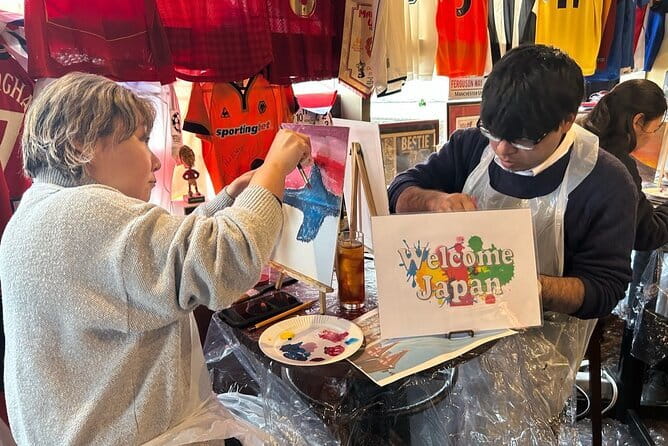
The maximum group size is 20. That is large enough to create a friendly mix of local and international participants, but small enough for the instructor to move around and offer advice. The actual feel may depend on the day’s attendance, but the limit keeps the gathering from becoming unwieldy.
Two drinks and a free hand with the theme
Two drinks are included in the price. You can choose wine or a soft drink, so the activity does not force alcohol on anyone. Japanese law prohibits drinking alcohol under age 20, and minors receive non-alcoholic drinks.
The drinks are part of the social rhythm, not a meal replacement. No food is included, so eat before the session if you need more than a light refreshment. For many people, the first drink helps mark the shift from sightseeing mode to a slower creative afternoon.
The relaxed format is one of the strongest reasons to book. You can chat, compare color choices, and see how differently people handle the same seasonal idea. You might arrive with a partner or friend, yet still find the activity works well for meeting new people.
There is a small tradeoff. A drink-in-hand painting event can feel less focused than a traditional lesson. If your priority is intensive technical training, you may want a dedicated art course instead. Here, the goal is social creativity with useful instruction woven through it.
Same city, a completely different kind of day:
- Osaka Go Karting Tour with Funny Costume
★ 5.0 · 2,658 reviews - Osaka Castle: Museum and Tower Entry Ticket
★ 4.5 · 2,380 reviews - Osaka: Shinsekai Food Tour with 13-15 Dishes at 5 Eateries
★ 4.8 · 2,204 reviews - Osaka Food Tour: 13 Dishes at 5 Local Eateries
★ 5.0 · 2,149 reviews
From painting table to gallery
The session includes time to explore a gallery, talk, and continue painting. This break gives the afternoon some shape. You are not expected to stare at one canvas for three straight hours, and viewing other art can help when you need an idea for color or composition.
The gallery element also supports the venue’s identity as more than a bar with paint supplies. It gives you a chance to look around, discuss what you are making, and return to your canvas with fresh eyes. For beginners, that pause can be helpful. A painting often looks different after you step away for a few minutes.
The activity description suggests that the artwork might capture cherry blossoms in full bloom, nighttime sakura, the sound and mood of wind bells, or the bright colors of fireworks. These examples show the range of the seasonal prompts. You are working with mood and imagery, not just copying a diagram.
Because the artwork is personal, finished pieces will vary. One person may create a neat, recognizable scene, while another may prefer bold colors and loose shapes. That variety is part of the fun, but it also explains why you should not expect a polished professional result without putting in your own effort.
Miyuki’s role in the afternoon
The instructor and host, Miyuki, is a major part of the experience. She has been described as warm, funny, talkative, and highly encouraging. She also communicates well in English, which is important for an activity built around instructions, questions, and casual conversation.
The praise is especially strong from first-time painters. Miyuki helps with both drawing and painting technique, and you can ask for advice as your work develops. Her approach seems to combine instruction with a light touch, so you can improve without feeling as if you are being graded.
That balance suits an international social event. You may meet people with very different levels of experience, from someone who has never held a paintbrush to someone who already enjoys art. A good instructor must support both groups without turning the session into a lecture, and Miyuki’s role appears built around that middle ground.
The experience is not presented as a formal certification class, and you should not book it expecting a detailed study of Japanese art history or professional acrylic technique. Its strength is direct, friendly help in a low-pressure setting.
What the $63.93 price really covers
At $63.93 per person, the price is not just paying for a drink and a blank canvas. It covers about three hours at a central Osaka venue, instruction, acrylic paints, painting equipment, protective items, two drinks, and the finished artwork.
That is a fair value if you place importance on time, atmosphere, and a take-home souvenir. A shop-bought print may cost less, but it will not carry the memory of an afternoon spent creating it. The included materials also mean you do not need to buy brushes, paint, an apron, or a canvas before arriving.
The value is strongest for couples, friends, and solo visitors who want something beyond sightseeing. You get a planned activity and a chance to meet people, with the cost of two drinks already included. The price is less compelling if you only want a quick craft session or if you have no interest in keeping your artwork.
Booking patterns suggest that people often reserve about 37 days ahead. That does not guarantee every date sells out, but it is a good reason to plan early if you need a particular month’s theme, especially March for cherry blossoms or October for Halloween.
Who will enjoy this most
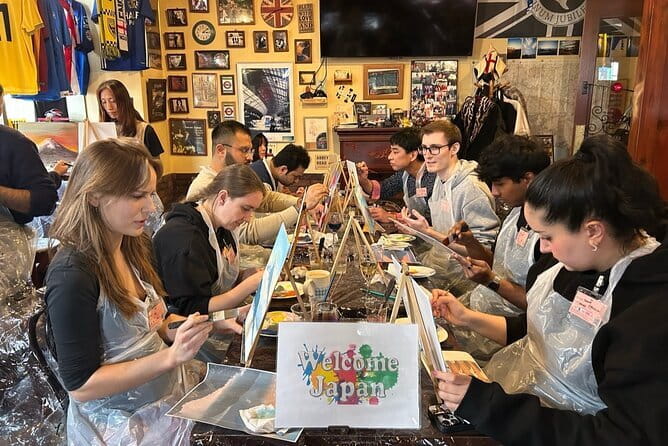
I would recommend this for beginners, casual art fans, couples, solo visitors, and anyone who wants a slower afternoon in Osaka. It also suits a birthday outing or a creative activity with friends. One couple used the session as a birthday surprise, and the format worked well for sharing an interest without requiring both people to have the same skill level.
You will likely enjoy it if you like meeting people while doing something with your hands. The conversation is part of the appeal, and the group may include locals and international visitors. It can be easier to talk while painting than while standing in a crowded sightseeing queue.
Families should check the age details before booking. Most people can participate, but anyone under 20 receives soft drinks because of Japanese alcohol laws. The available information does not give a separate child price or a detailed age range.
You should think twice if you want a quiet, private art lesson. The group can include up to 20 participants, and the social atmosphere is central to the event. You should also be comfortable making creative choices, since the class does not appear to require everyone to produce the same image.
Practical details before you reserve
The activity is about three hours, begins at 1:30 pm, and ends back at the meeting point. Food is not included, so plan a meal before or after. The location is near public transportation, but the building exterior may not immediately look like an art venue.
All painting materials are supplied. Aprons and gloves are included, which reduces the worry about splashes, though sensible casual clothing is still a good idea. Bring only yourself, your mobile ticket, and an open mind about the finished result.
Confirmation arrives at booking. Most people can participate, and the maximum group size is 20. Free cancellation is available up to 24 hours before the local start time for a full refund. Changes or cancellations inside that 24-hour window are not accepted, so keep your Osaka schedule firm once the deadline passes.
The final canvas and the lasting souvenir
The best part of the experience comes at the end, when you take your canvas with you. It may not look like the work of a trained artist, but that is not the point. You get a physical reminder of a particular season in Japan and of the choices you made during the afternoon.
A handmade souvenir can also be more personal than another keychain or snack box. A cherry blossom painting made in Osaka carries a clear sense of time and place. The same is true of an autumn Kyoto scene, a fireworks image, or an Osaka-themed work, depending on the month.
I also like that the activity leaves room for individual style. If everyone painted the same picture, the result might be easier to predict but less personal. Here, your canvas can reflect your own colors, mood, and level of confidence.
Should you book the Shinsaibashi paint and wine session?
Book it if you want a friendly, creative break from Osaka sightseeing, especially if you are new to painting or enjoy meeting people from different places. Miyuki’s warm instruction, two included drinks, supplied materials, and take-home canvas give the afternoon a clear value.
Skip it if you want a serious technical course, a private session, or a meal included with your activity. The building may look a little rough from outside, and the free-form format will not suit everyone.
For most casual visitors, this is a smart three-hour choice. Pick the month whose theme appeals to you, arrive at Cafe&Bar go garageGallery before 1:30 pm, and let the finished canvas be imperfect. That is part of its charm.
FAQ
Where does the painting experience begin?
It begins at Cafe&Bar go garageGallery Bldg., 1-chōme-18-6 Higashishinsaibashi, Chuo Ward, Osaka, 542-0083, Japan.
What time does the activity start?
The activity starts at 1:30 pm.
How long does the experience last?
The session lasts approximately three hours.
Where does the activity end?
It ends back at the same meeting point, Cafe&Bar go garageGallery.
Are drinks included?
Yes. Two drinks are included. You can choose wine or soft drinks.
Can someone under 20 drink alcohol during the activity?
No. Japanese law prohibits alcohol for anyone under 20, so minors receive non-alcoholic drinks.
Is food included?
No. Food is not included in the activity.
Do I need painting experience?
No. The session is suitable for beginners, and painting instruction and all materials are provided.
What painting subjects are offered?
The subject changes by month. Themes include Hatsumode in January, sky lanterns in February, cherry blossoms in March, Easter in April, Osaka in May, umbrella street in June, fireworks in July, ocean in August, autumn in Kyoto in September, Halloween in October, snow monkeys in November, and Christmas in December.
Can I take my painting home?
Yes. You can take your finished artwork home as your own canvas souvenir.
How many people can join?
The activity has a maximum of 20 participants.
Can I cancel for a full refund?
Yes, if you cancel at least 24 hours before the local start time. Cancellations or changes made less than 24 hours before the start are not accepted for a refund.
Just added around Osaka
- Samurai dress-up and shows, plus Tea Ceremony & Calligraphy★ 5.0 · 27 reviews
- Kyoto & Nara Private customized tour with English speaking Guide★ 4.5 · 99 reviews
- Well-balanced BENTO (lunch box) Cooking Class★ 5.0 · 35 reviews
- Urban Canvas: Osaka Street Art Bike Tour★ 5.0 · 47 reviews
- OSAKA:Feel the Power! Learn Taiko Drum from Professionals★ 5.0 · 28 reviews
- Volleyball in Osaka & Kyoto with Locals!★ 5.0 · 21 reviews
- Three Types of Ramen Cooking Class in Osaka★ 5.0 · 119 reviews
- 1.5〜2 Hours Traditional Kintsugi Work Shop in Namba Osaka★ 5.0 · 75 reviews
Osaka Tours, compared.

Shinsekai Food Tour with 13-15 Dishes at 5 Eateries
Read our review →
Osaka Food Tour: 13 Dishes at 5 Local Eateries
Read our review →
Hungry Osaka Street Food Tour:15 Tastings & 3 Drinks with a Local
Read our review →
Hotspots & Hidden Gems Walking Tour Private or Group
Read our review →