
REVIEW · NARA DAY TRIPS
All must-sees in 3 hours – Nara Park Classic Tour! From JR Nara!
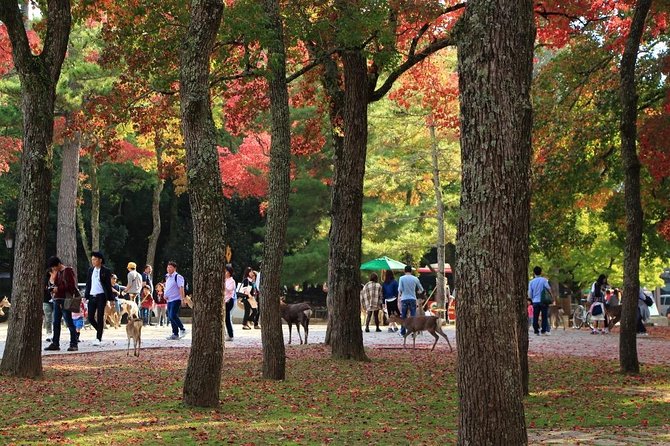
Nara’s famous deer are only the beginning. This three-hour walk links the city’s big sights in a sensible order, from Kasuga Grand Shrine through the wooded park to Todai-ji’s huge Buddha Hall and Kofuku-ji’s pagoda. Along the way, your guide explains why deer roam freely, how Shinto and Buddhism shaped Nara, and where to stop for photos.
I like two things here. First, the single bus ride from JR Nara Station saves you an initial stretch of road walking. Second, the tour usually finishes around 1 p.m., leaving your afternoon open for lunch, mochi-making demonstrations, museums, or a slower return to the park. The guides, including Nobuko, Reiko, Makiko, Kazu, and Shigeru, are often praised for helping with photos and practical plans.
The main caution is simple: this is a real walking tour, not a quick shuttle between sights. Expect steps, gravel, and plenty of time on your feet. The group can reach 15 people, and the guide cannot wait for late arrivals, so getting to the correct station entrance early matters.
In This Review
- Key points at a glance
- A smart first morning in Nara
- Meeting at JR Nara Station at 10 a.m.
- Kasuga Grand Shrine and Nara’s deer
- Todai-ji and the Great Buddha Hall
- Nara Park on foot, with room for detours
- Kofuku-ji and the end near the five-storied pagoda
- What the guides add to the walk
- Pace, group size, and physical effort
- Is $42.94 a fair price?
- Who will get the most from this tour
- Booking and planning advice
- Should you book it?
- FAQ
- Where does the tour start?
- What time does the tour begin?
- Can I join the tour from Kintetsu Nara Station?
- How long does the tour last?
- What sights are included?
- Is admission to Todai-ji included?
- Is transportation included?
- Is this a private tour?
- Is the tour suitable for strollers?
Key points at a glance
- Three major Nara sights in one morning: Visit Kasuga Grand Shrine, Todai-ji, Nara Park, and Kofuku-ji without having to work out the route yourself.
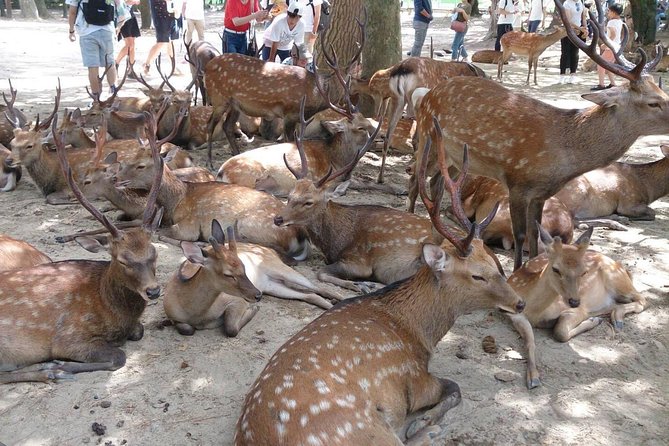
- A meaningful look at deer culture: Learn why deer are associated with Nara and how to feed them safely, especially around male deer with antlers.
- Great Buddha Hall admission included: The entrance fee for Todai-ji’s Great Buddha Hall is covered.
- A useful 10 a.m. start: The tour normally ends near 1 p.m., giving you time for lunch and independent sightseeing.
- Local help beyond the monuments: Guides can point you toward train stations, food, shopping streets, photo locations, and afternoon plans.
- Compact group format: The maximum group size is 15, though the tour is not private.
A smart first morning in Nara
Nara is easy to visit independently, but the most important sights are spread across a large park. You can walk between them on your own, yet it is easy to lose time reading signs, choosing the wrong path, or arriving at a temple without understanding what you are seeing.
This tour gives you a clear three-hour framework. You meet at JR Nara Station at 10 a.m., ride one bus toward the park, and then continue mainly on foot. The route covers the classic sights while adding the cultural background that turns a pleasant park visit into a more meaningful one.
The tour is especially useful if Nara is a half-day stop from Kyoto or Osaka. You get the main introduction in the morning, then decide how much more energy you want to spend. If you are staying longer, the guide’s suggestions can help shape the rest of your day.
The tour has a very strong 4.9 out of 5 rating from 108 ratings, with 98 percent recommended. The praise centers on the guides’ warmth, clear explanations, patience with questions, and ability to keep the walk comfortable. That pattern matters more than a single enthusiastic comment because the experience is built around the guide.
More Nara Day Trips in Nara
- World Heritage Kyoto & Nara Uji Authentic Matcha Experience
★ 5.0 · 1,573 reviews - Nara Half Day Trip Walking Tour (Private Option Available)
★ 5.0 · 937 reviews - Nara Early Morning Tour (Kyoto or Osaka Departure Available)
★ 5.0 · 676 reviews
Meeting at JR Nara Station at 10 a.m.
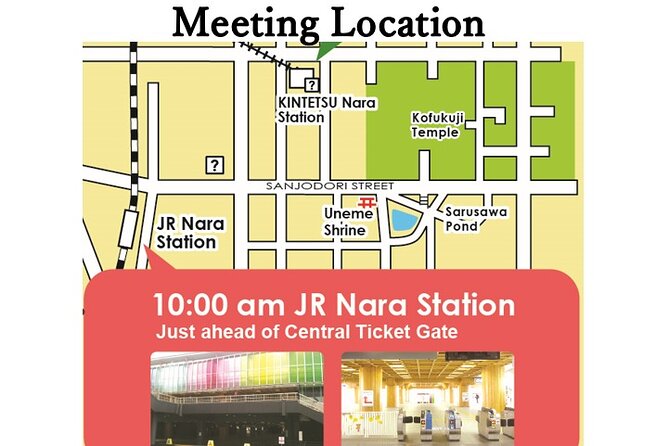
The starting point is in front of the ticket gates at JR Nara Station, at 1 Sanjohonmachi. Look for the guide holding a white NaraWalk flag. JR Nara Station has one ticket-gate area, which makes the meeting point fairly easy once you are inside the station.
Do not go to Kintetsu Nara Station by mistake. If your train arrives there, you need to make your own way to JR Nara Station. The tour’s bus connection begins at JR Nara, and the group does not stop at Kintetsu for pickups.
Arrive early. The tour starts punctually, and late arrivals cannot join because the group moves on. This is one of those small details that can decide whether your morning works, especially if you are coming from Osaka or Kyoto and need a train transfer.
The included bus ride is practical rather than scenic. It takes you from the station toward the Nara Park area, where the walking portion begins. Having that ride included means your three hours can focus more on the temples, shrine, deer, and park paths.
Kasuga Grand Shrine and Nara’s deer
Kasuga Grand Shrine is the first major stop, with about 30 minutes in the precinct. This is a good opening because it introduces both the setting and the ideas behind the rest of the morning.
Your guide explains the connection between the shrine and Nara’s deer, along with the difference between Shinto and Buddhism. Those subjects can be confusing when you first encounter Japanese religious sites. A guide can explain what you are looking at as you move through the grounds, rather than asking you to sort out unfamiliar customs from a signboard.
You will likely see deer around the shrine and on the paths leading through the park. The deer are not placed in a separate enclosure. They wander through the public spaces, which makes the encounter feel less like a zoo visit and more like an unusual part of daily Nara.
You can feed them deer crackers, but use care. The supplied experiences specifically warn that males with antlers can become pushy or aggressive if they feel threatened. Keep the crackers controlled, pay attention to the animal in front of you, and do not assume a calm-looking deer will always behave gently.
The 30-minute stop is enough for an introduction, photos, and a talk about the shrine. It is not enough for a slow exploration of every path and lantern, so anyone wanting a detailed visit to Kasuga Taisha will need extra time after the tour.
Todai-ji and the Great Buddha Hall
Todai-ji receives about 40 minutes, including admission to the Great Buddha Hall. This is the visual centerpiece of the morning and the one place where the tour’s included entrance fee has a clear benefit.
Inside, the scale changes immediately. The Great Buddha Hall is built to hold a massive bronze Buddha, and your guide gives context about the statue and the temple rather than leaving you to simply take a photo and move on. The stop is also one of the strongest photo opportunities on the route.
One famous feature is the wooden pillar with a narrow opening said to match the size of the Great Buddha’s nostril. A review describes the opening as about 37 by 30 by 110 centimeters and connects passing through it with good health and protection from bad luck. It is a playful detail, but the gap is very small, so do not feel obliged to attempt it.
Forty minutes goes quickly here. You have time to see the Buddha Hall, listen to the explanation, take pictures, and absorb the building’s scale. If you want to linger over every figure or browse nearby shops, plan to return later.
This part also shows the practical value of a guide. Todai-ji is famous, but fame does not explain itself. Hearing why the temple matters, how the Buddha fits into Nara’s religious story, and what details deserve a closer look gives the visit more shape.
Same city, a completely different kind of day:
- Osaka: Nara and Uji Day Trip with Deer Park and Hot Spring
★ 4.4 · 302 reviews - Kyoto/Osaka: Kinkakuji, Bamboo Forest, and Nara Deer Park
★ 4.4 · 265 reviews - Nara 6hr Private Tour with Government-Licensed Guide
★ 5.0 · 219 reviews - E-Bike Nara Highlights – Todaiji, Knives, Deer, Shrine
★ 4.8 · 186 reviews
Nara Park on foot, with room for detours
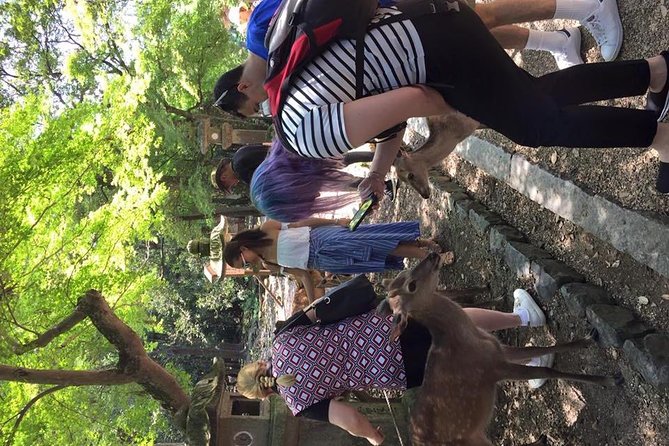
Nara Park is listed as its own stop, with about 30 minutes usually set aside for the park paths. In a strict sense, Kasuga Grand Shrine, Todai-ji, and Kofuku-ji are all part of the wider Nara Park area. The park stop is therefore less about one monument and more about moving through the space that ties the sights together.
The guide may add extra locations depending on the season and the group’s walking speed. That flexibility is useful, but it also means the exact route can change. You may spend more time at a quiet corner, a good photo spot, or an area with fewer people, or you may stay closer to the main sights if the group needs a slower pace.
Several guides are praised for finding less crowded paths and helping groups avoid getting bogged down around the busiest temple approaches. That is a real advantage in Nara, where the deer, school groups, tour parties, and temple visitors can all converge in the same space.
The park is also where the walking becomes most noticeable. Some families report covering roughly five miles overall, although the exact distance depends on the guide, group pace, and route. The tour is described as manageable rather than punishing, but hot and humid weather can change that quickly.
Bring water, wear shoes with good grip, and do not treat the three-hour estimate as three hours of standing. You will be walking between sites, stopping for explanations, and navigating gravel paths.
Kofuku-ji and the end near the five-storied pagoda
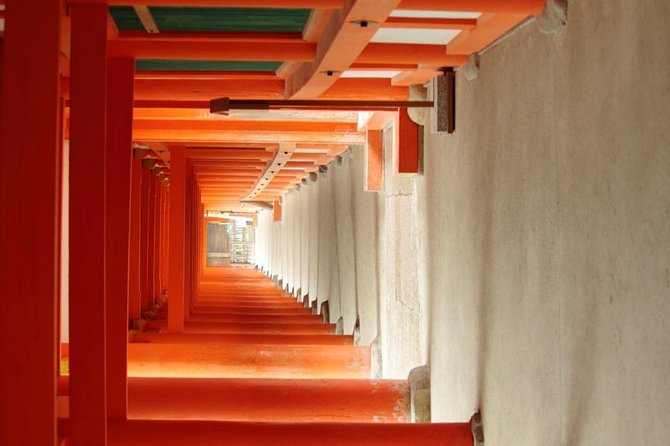
The tour usually ends at Kofuku-ji after about 20 minutes there. The five-storied pagoda is an especially photogenic finish, and the guide explains its place in Nara’s story before directing you toward the next part of your day.
Ending here makes practical sense. Kofuku-ji sits closer to shopping streets, food options, and onward routes than some of the deeper park areas. Your guide can help with directions to train stations, lunch suggestions, and afternoon plans.
This is also where the tour’s time limit becomes an advantage. You are not held through a full day of sightseeing when your legs are tired and your attention is fading. You get the key introduction, then decide if you want lunch, more temples, a return to the deer, or a train back.
Some participants have continued for several hours afterward, visiting a mochi demonstration and exploring the nearby streets. Those additions are not part of the formal tour, but the end point gives you a useful launch point for them.
What the guides add to the walk
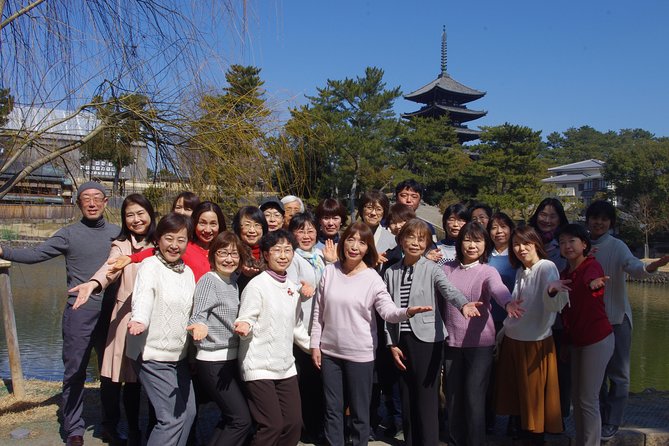
The experience depends heavily on the person leading your group. Guides named in the feedback include Mayumi, Nobuko, Seiko, Makiko, Kazu, Yoshi, Reiko, Shigeru, Setsuko, Motoko, Satomi, Lay, and Mamiko. You are not guaranteed a particular guide, but the repeated strengths are clear.
The best guides do more than recite dates. They answer questions, explain religious customs in plain language, notice activities taking place around the route, and help you understand how deer fit into the city. Several also offer to take photos, which is valuable if you are traveling alone or want a picture of your whole family.
Reiko is praised for helping a solo participant during rain and for bringing an umbrella before the tour. She also received praise for keeping a family comfortable in the heat and connecting well with a teenager. Nobuko is repeatedly described as patient, kind, and attentive to different interests.
Setsuko is noted for years of experience, extra small locations, and ways to avoid crowds. Makiko and her assistant received praise for making the visit lively and memorable, while Kazu is singled out for clear explanations of religion, customs, and deer feeding.
English ability may vary by guide. One rating of four stars describes a guide who worked hard and used a folder with pictures to make explanations easier, but whose English was less fluent than that of other local guides. Another three-star rating found the guide’s voice too soft and the pace too slow. These are useful cautions: the quality can depend on the individual guide and group mix.
Pace, group size, and physical effort
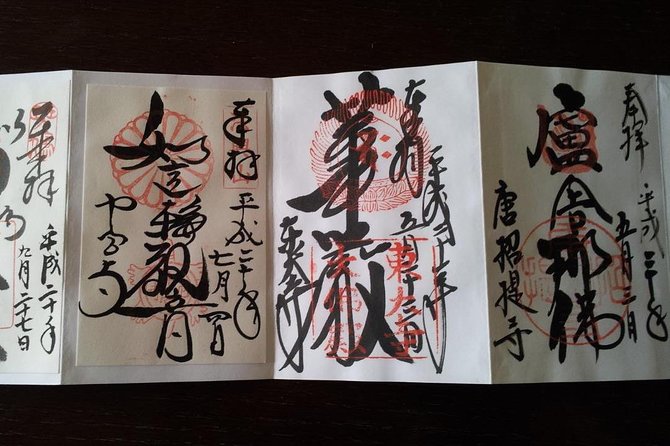
The maximum group size is 15. That is small enough for a more personal feel than a large coach tour, but it is still a group walk. You will not have the control of a private guide, and the guide must balance different ages, interests, and walking speeds.
Most of the praise focuses on a comfortable pace with time for photos and deer feeding. Families with children have completed the route, and older participants have enjoyed it when the walk was handled carefully. Still, one family estimated about five miles, and the route includes steps and gravel.
A stroller can be used, but the terrain is not effortless. The operator notes that you may need to carry a stroller or push it more firmly on gravel and steps. Service animals are allowed, and most people can take part, but anyone with limited walking ability should consider the distance and surfaces before booking.
Weather is a serious factor. The tour requires good weather and may be canceled in poor conditions. Heat and humidity have made the walk tiring for some participants, while rain has required extra care. A cool morning will make the route much easier than a hot summer day.
One useful point is that the tour does not promise a fixed speed for every group. The guide may add spots if the group moves quickly, while a slower group may spend more time at the central sights. If you want a brisk checklist, say so politely at the beginning. If you need a gentler pace, mention that as well.
Is $42.94 a fair price?
At $42.94 per person, this is not the cheapest way to walk through Nara Park. You can reach the sights on your own, and much of the park itself is free. The price makes more sense when you count the included admission to the Great Buddha Hall, the bus ride from JR Nara Station, and three hours of local guidance.
I see the value most clearly for a first visit or a short stay. A guide prevents the morning from becoming a series of disconnected photo stops. You learn why the deer are present, how the shrine and temple traditions differ, and which details at Todai-ji deserve your attention.
The price also buys planning help. Directions to lunch, train stations, shopping areas, and afternoon sights may save you time after the formal walk ends. If you are comfortable researching every site, navigating the park, and reading about the religious background yourself, the fee may feel less worthwhile.
Because the tour is capped at 15 rather than designed as a large bus outing, the format offers a reasonable middle ground. You receive personal help without paying private-tour rates. Just remember that the price does not include meals or drinks.
Who will get the most from this tour
I would choose this tour if you have only a morning or half-day in Nara and want the major sights organized for you. It is also a strong fit for families, solo visitors, and first-time visitors who want help with photos and a plain-language explanation of Japanese religion.
It suits you if deer are a major reason for visiting, but you also want more than animal pictures. The tour puts the deer in the setting of Kasuga Grand Shrine and Nara Park, then connects that experience to Todai-ji and Kofuku-ji.
It may not suit you if you dislike group schedules or want to study one temple for hours. Independent visitors who prefer a slow, unstructured morning may find the three-hour route too directed. You should also think twice if gravel, steps, heat, or five miles of walking would be a serious problem.
The tour is less suitable for anyone likely to arrive late at JR Nara Station. The punctual start is firm, and the guide cannot collect you from Kintetsu Nara Station.
Booking and planning advice
Use the mobile ticket and check the meeting instructions before leaving your hotel. Aim to be at the front of the JR Nara ticket gates before 10 a.m., not walking into the station at exactly 10.
Wear comfortable shoes with reliable grip. Take water, especially between late spring and early autumn, and keep some flexibility in your clothing for changing weather. If you want to feed the deer, follow the guide’s directions and stay alert around antlers.
Leave the afternoon open rather than booking a tight connection immediately after 1 p.m. The tour usually ends around then, but group pace and small route changes can affect the exact finish.
Free cancellation is available up to 24 hours before the start time for a full refund. Changes or cancellations inside that window are not accepted for a refund. If poor weather cancels the tour, you are offered another date or a full refund.
Should you book it?
Book this Nara Park Classic Tour if you want a well-organized first look at the city, especially when your time is limited. The combination of the deer, Kasuga Grand Shrine, Todai-ji’s Great Buddha Hall, and Kofuku-ji gives you the essential sights, while the guides add the cultural context that is easy to miss alone.
I would skip it only if you want complete freedom, dislike walking, or already know Nara’s temples well. For most first-time visitors, $42.94 is a fair trade for the bus connection, included Todai-ji admission, route planning, photo help, and three hours of local explanation. Just arrive early, wear good shoes, and save your appetite for lunch near the finish.
FAQ
Where does the tour start?
It starts in front of the ticket gates at JR Nara Station, at 1 Sanjohonmachi, Nara. Look for a guide holding a white NaraWalk flag.
What time does the tour begin?
The tour starts at 10 a.m. It begins punctually, so late arrivals cannot join.
Can I join the tour from Kintetsu Nara Station?
No. You must go to JR Nara Station. The tour includes a bus ride from JR Nara Station and does not pick up at Kintetsu Nara Station.
How long does the tour last?
The tour lasts about three hours and usually ends around 1 p.m.
What sights are included?
The route includes Kasuga Grand Shrine, Todai-ji Temple and its Great Buddha Hall, Nara Park, and Kofuku-ji Temple.
Is admission to Todai-ji included?
Yes. Admission to the Great Buddha Hall is included in the tour price.
Is transportation included?
One bus ride from JR Nara Station to the Nara Park area is included. The rest of the route is mainly on foot.
Is this a private tour?
No. It is a group tour with a maximum of 15 participants.
Is the tour suitable for strollers?
The route includes steps and gravel paths. You may need to carry a stroller or push it more firmly, so it is not an effortless stroller route.
More 3-Hour Experiences in Nara
- 3-Hour Kyoto Insider Sake Brewery Tour with Tastings & Pairings
★ 5.0 · 917 reviews - Tokyo Top Highlights 3h Guided E-bike Tour
★ 5.0 · 714 reviews - 3h Tokyo E-Bike Tour: Hidden Gems, and Local Life with guide
★ 5.0 · 670 reviews - Tokyo: 3-Hour Bike or E-Bike City Highlights Tour
★ 4.8 · 435 reviews
Just added around Nara
- Private Nara Tour and Sake Tasting (Departing from Kyoto/Nara)★ 5.0 · 40 reviews
- Nara World Heritage PRIVATE TOUR★ 4.5 · 15 reviews
- Nara Private Tour: Flexible Pickup from Kyoto, Osaka, or Nara★ 5.0 · 17 reviews
- Hammer a Pattern on Your Ring Workshop★ 5.0 · 57 reviews
- Nara Sake Tasting Tour at Local Brewerie(tasting fee included)★ 5.0 · 12 reviews
- Nara Highlight Walking Tour with Furoshiki Experience with Lunch★ 5.0 · 73 reviews
- Nara – Heart of Nature Cross Bike Tour★ 5.0 · 19 reviews
- Sushi Making Experience Luxury Course in Nara★ 5.0 · 36 reviews
Nara Day Trips, compared.
World Heritage Kyoto & Nara Uji Authentic Matcha Experience
Read our review →
Kyoto/Osaka: Nara, Fushimi Inari Taisha, Arashiyama Bus Tour
Read our review →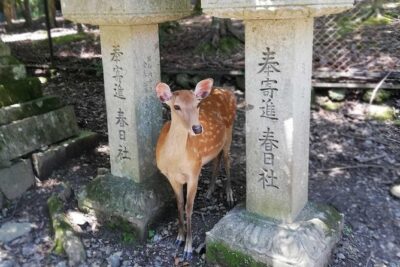
Nara Half Day Trip Walking Tour (Private Option Available)
Read our review →
Osaka/Kyoto: Arashiyama, Nara & Fushimi Inari Shrine w/Lunch
Read our review →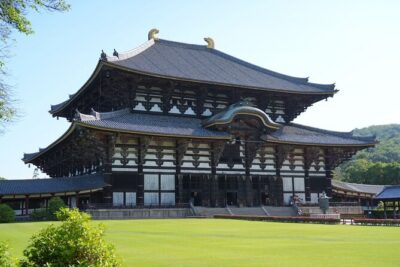
Nara Early Morning Tour (Kyoto or Osaka Departure Available)
Read our review →
Full Day Guided Tour to Kyoto and Nara from Osaka by Van
Read our review →
Browse the lists this tour appears in