
REVIEW · GO-KARTS
Tokyo: Guided Go Kart Tour from Harajuku to Shibuya Crossing
Tokyo: Guided Go Kart Tour from Harajuku to Shibuya Crossing
The most unusual part of this Tokyo outing is simple: you drive through the actual city streets, not around a private track. In 75 minutes, you follow a guide from the Shibuya area through Harajuku, Shibuya Crossing, Shinjuku, and nearby central neighborhoods, with Tokyo’s signs, traffic, tunnels, and towers passing close by.
I like the small groups of no more than five, since the guide can watch each driver and give clear hand signals. I also like the costumes and built-in photo stop service, which turn a short drive into a souvenir you can share. The main catch is the paperwork: Japan accepts only certain physical driving permits, and the tour can be rescheduled for rain.
In This Review
- Key points
- What the 75-minute Tokyo route feels like
- Starting near Shibuya Station
- Safety comes before costumes and photos
- The paperwork can make or break your booking
- Harajuku gives the ride its first city flavor
- Shibuya Crossing is the headline moment
- Shinjuku adds speed, signs, and city scale
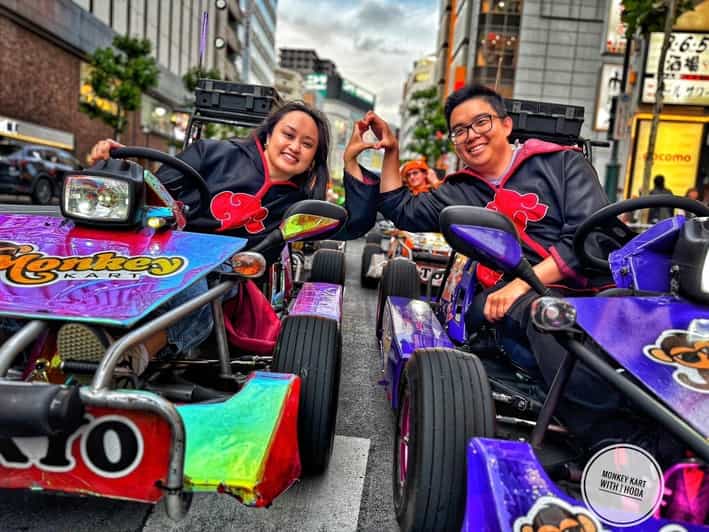
- Costumes and camera mounts make the outing more memorable
- Is $103 a fair price?
- Weather, timing, and comfort
- Who will enjoy this most?
- Should you book the Shibuya go-kart tour?
- FAQ
- How long is the Tokyo go-kart tour?
- Where is the meeting point?
- How many people are in each group?
- Is the tour conducted in English?
- What driving permit do I need?
- Are online or card-style permits accepted?
- Do drivers from France, Switzerland, Taiwan, Germany, Monaco, and Belgium need extra documents?
- Are costumes and photos included?
- Can the tour be canceled because of weather?
Key points
- Drive through Shibuya Crossing: You pass through one of Tokyo’s best-known intersections from behind the wheel.
- Follow a close-knit group: The guide leads a maximum of five participants and signals throughout the route.
- Choose a costume: Masks, glasses, and character-style outfits add a playful touch before you leave.
- See Tokyo after dark: Night tours bring neon signs and city lights into the experience.
- Receive photos afterward: Your guide takes pictures and sends digital copies by AirDrop or email, with one hard copy included.
- Check your permit early: A hardcopy 1949 Geneva Convention International Driving Permit is required for most drivers.
What the 75-minute Tokyo route feels like
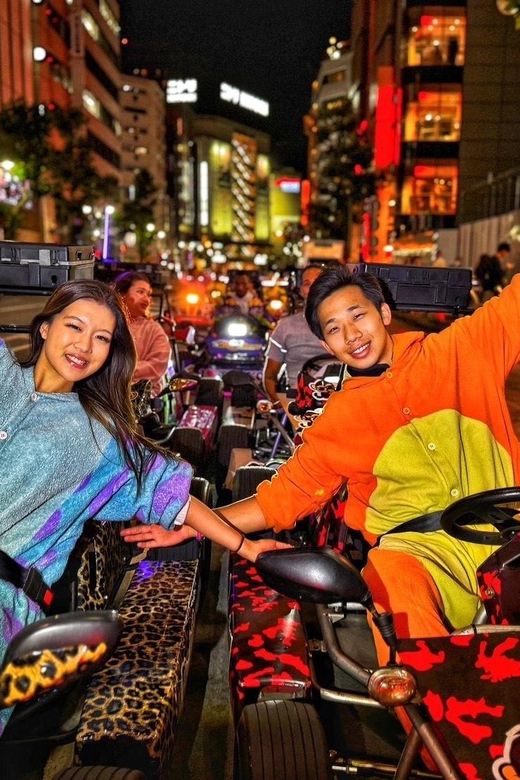
This is sightseeing with a steering wheel. You are not sitting in a bus watching Tokyo slide past a window. You are in a custom-built, street-legal go-kart, moving with traffic while a guide sets the route and pace.
The advertised route takes you through Harajuku, Shibuya, Shibuya Crossing, Shinjuku, and nearby central Tokyo streets. The exact rhythm depends on traffic, weather, and the size of the group, but the appeal is consistent: you get a moving view of the city at street level, with buildings and signs appearing around you rather than from a distant sidewalk.
A 75-minute booking does not necessarily mean 75 uninterrupted minutes behind the wheel. There is a safety briefing, preparation, costume selection, and photo time. One participant reported about 57 minutes of actual driving, so I would treat the advertised duration as the full activity window, not a guaranteed driving-time figure.
That distinction matters at $103 per person. This is not the cheapest way to see Tokyo, and it is not designed to replace a proper visit to Harajuku, Shibuya, or Shinjuku on foot. You are paying for the unusual access, the thrill of driving, the guide, and the photographs.
A few more Tokyo trips to weigh up
- Flagship 2-Hours Official Street Go-Kart Tour – Tokyo Bay Shop
★ 5.0 · 4,974 reviews - Official Street Go-Kart in Shibuya
★ 5.0 · 3,435 reviews - Official Street Go-Kart Tour – Akihabara
★ 5.0 · 1,578 reviews
Starting near Shibuya Station
The meeting point is near a FamilyMart at 3-chome-17-3 Shibuya, Shibuya City. From Shibuya Station, use Exit C2 and head toward the main big street. The central gate is listed as about a two-minute walk from the meeting area.
Give yourself time to find the shop and check in. Tokyo’s station area is packed with exits, crossings, signs, and large buildings, so a rushed arrival can begin the activity on the wrong foot. Hotel pickup and drop-off are not included, which makes the central location useful if you are already sightseeing around Shibuya.
Once you arrive, expect a short preparation period before the karts leave. The guide explains how to operate the vehicle and covers the road rules needed for the tour. This is especially important if you have never driven a small kart in city traffic.
The English-speaking guide stays at the front of the group and communicates through signals while driving. Past guides named in the feedback include Lewis, Rakesh, Mirko, Gas, Gus, Juani, Kevin, Luna, Chris, Shin, and Matthias. The individual guide on your date may be different, but the repeated pattern is clear: the guide’s role is not just to point out sights. It is also to set a manageable pace, check on the group, and help you feel comfortable on the road.
Safety comes before costumes and photos
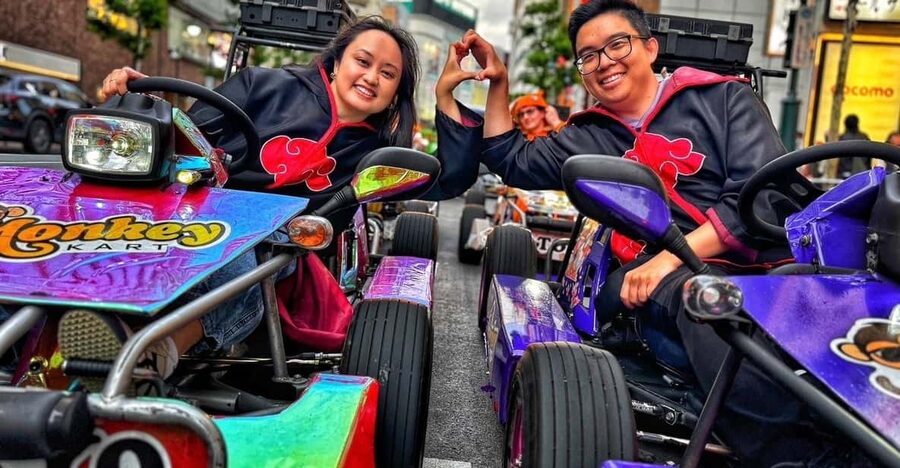
The tour begins with a proper briefing rather than sending you straight into traffic. You learn how to use the kart and how to follow the guide’s signals. That preparation is one of the most important parts of the outing, since the setting is Tokyo’s public road system.
Past descriptions of the experience repeatedly point to clear instructions, orderly driving, and regular signaling. That does not make the ride risk-free. You are still operating a motor vehicle among other road users, and you need to pay attention at every turn, stop, and lane change.
The guide leads the group, but you remain responsible for driving your own kart. Follow instructions, keep your attention on the road, and do not treat the costumes as an excuse to stop taking the activity seriously. Alcoholic drinks are not allowed in the vehicle.
Drivers must be over 18. The experience is not suitable for pregnant women or people over 95 years old. The supplied information does not list a separate passenger option, so you should assume that each participant needs to meet the driving requirements.
The paperwork can make or break your booking
This is the practical issue I would check before paying. Most drivers need a physical, hardcopy paper booklet of a 1949 Geneva Convention International Driving Permit issued by an official agency in their home country. Examples include AAA, AA, CAA, and ATCUAE.
Japan does not recognize every international permit sold online. A 1968 Vienna Convention permit, an IDA permit, or an IAA-issued permit is not accepted. An online copy, Xerox copy, or card-style license is also not valid.
Drivers from France, Switzerland, Taiwan, Germany, Monaco, and Belgium need a Japanese translation of their local license. The physical translation can be obtained from the Japan Automobile Federation, known as JAF.
The supplied information also warns that permits from Indonesia, Pakistan, Saudi Arabia, Mexico, Brazil, Costa Rica, Colombia, Kuwait, Qatar, and some other countries may not permit driving in Japan. Check the rules for your country before leaving home, not after reaching Tokyo. The instruction is blunt for good reason: obtain the correct document in advance.
Bring the physical permit to the activity. A regular home driving license by itself is not enough for most participants.
Same city, a completely different kind of day:
- Mt Fuji and Hakone 1-Day Bus Tour Return by Bullet Train
★ 5.0 · 26,383 reviews - 1-Day Tokyo Bus Tour
★ 5.0 · 14,250 reviews - Tokyo: TOKYO SKYTREE® Admission ticket
★ 4.5 · 11,192 reviews - Tokyo: teamLab Planets TOKYO Digital Art Museum Entry Ticket
★ 4.6 · 9,779 reviews
Harajuku gives the ride its first city flavor
Harajuku is one of the first major areas on the route. From a kart, you get a different view than you would while walking Takeshita Street or browsing shops. The tour does not turn you into a pedestrian shopper, but it places you in the middle of the district’s busy central setting as the group passes through.
This part is best for atmosphere rather than a long stop. You will be looking at shopfronts, signs, passing traffic, and the steady movement of Tokyo around you. The guide may point out landmarks and offer city tips, as Juani and Lewis did for previous groups, but the activity is primarily a driving tour rather than a formal history walk.
The benefit is coverage. You can connect several famous districts in one short outing and get a sense of how they relate to one another. The tradeoff is that you will not have time to explore each neighborhood properly. Plan a separate walking visit if Harajuku’s fashion, shrines, cafés, or shops are high on your list.
Shibuya Crossing is the headline moment
The big draw is driving through Shibuya Crossing. You have probably seen the intersection from above, in photographs, or from the surrounding sidewalks. Passing through it in a go-kart gives you a more active view of the scene.
The crossing itself is not a private attraction. You are using the public streets, so traffic lights, road conditions, and the guide’s route control the experience. That unpredictability is part of the thrill, but it also means you should not expect a guaranteed long pause in the center for photographs.
The guide takes photos at suitable points along the route. You can focus on driving while someone else handles the camera, which is much safer and more useful than trying to take pictures yourself. The finished images are shared digitally by AirDrop or email, and one printed photo is included.
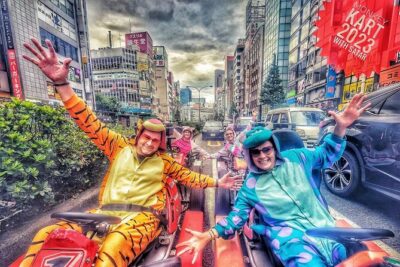
Costumes add a comic edge here. You can choose from character-style outfits, masks, and colorful glasses before setting out. A unicorn jumpsuit, for example, has been part of one participant’s Tokyo memory. The outfits are optional, but they make the photos more distinctive and help create the playful mood associated with go-kart tours.
Keep your expectations grounded. This is not an official video-game attraction, and the experience is governed by Japanese road rules. The operator states that the tours follow Japanese law and guidance confirmed by relevant local authorities.
Shinjuku adds speed, signs, and city scale
The route continues into Shinjuku and nearby central neighborhoods. Shinjuku gives the ride a larger, more urban feel, with tall buildings, dense streets, and plenty of illuminated signs after dark.
Some past participants especially enjoyed driving through a tunnel or along a faster stretch with little traffic. Those moments can feel thrilling because the kart is low to the road and open to the air. Still, conditions vary, and you should not book expecting a particular tunnel run or speed burst.
The guide’s pace is important here. A well-run group moves together, and the guide checks that nobody is falling behind. Several named guides, including Rakesh, Mirko, Uzii, and Kevin, were singled out for clear instructions, good pacing, or careful attention to the group. That is exactly what you need in a route that crosses several busy districts.
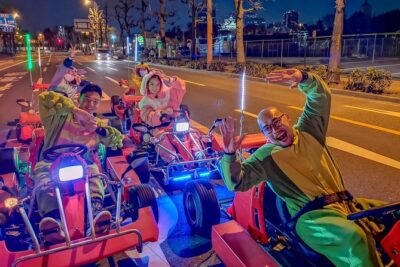
A night departure changes the mood. Tokyo’s lights, billboards, and building fronts become the main view, and the photographs can have a stronger city-at-night character. Daytime rides give you clearer views of the streets and buildings. If you have flexibility, choose based on the sort of pictures and atmosphere you prefer.
Costumes and camera mounts make the outing more memorable
The costume selection is included, so you do not pay extra for the main novelty. You can choose an outfit, mask, or pair of glasses before the ride, then use the city as your backdrop.
The experience also includes an action-camera or Insta360 mount. That gives you the option to record from the kart, provided you bring a compatible camera. The included guide photos are simpler and easier: the guide stops or positions the group at key locations and later sends the images to you.
You also receive one hard copy photo. It is a small detail, but it gives you something physical to keep rather than leaving the entire souvenir in your phone gallery.
The photo service is one of the strongest practical features. Driving and photographing yourself at the same time is a poor idea, especially at intersections. Letting the guide handle the camera means you can pay attention to signals, traffic, and the route.
Is $103 a fair price?
At $103, I would call this a special-event activity, not a budget sightseeing choice. You can see Shibuya, Harajuku, and Shinjuku by train and on foot for much less. You can also spend more time in each neighborhood that way.
The kart tour offers something those options cannot: you are part of the street scene. You feel the motion, manage the vehicle, and pass through the city in a compact group. The guide, costumes, digital photos, printed picture, water, and camera mount are included, which helps explain the price.
Value depends heavily on your interests. If you enjoy driving, playful photos, and unusual city activities, the cost can feel justified. If you mainly want architecture, shopping, food, or cultural sites, your money may go further on a walking tour, museum visit, or meal.
The small-group limit helps. With no more than five participants, the guide can give more attention than on a large coach excursion. A lucky quiet departure might even feel almost private, as happened for one morning group. That is not guaranteed, but the group cap is a real advantage.
Weather, timing, and comfort
Rain can cause the tour to be rescheduled. Tokyo weather can change your plans, so avoid placing this activity on the final possible day of a short visit if you have no room to move it.
The listed duration is 75 minutes, and starting times depend on availability. You can choose a daytime or nighttime slot when offered. A night ride may suit you if city lights and photos are your priority, while a daytime ride may make the streets easier to observe.
Wear clothing that works with a costume and an open go-kart. The supplied information does not specify a clothing list, so keep your outfit practical and comfortable. Bring your valid physical permit, and do not bring alcohol into the vehicle.
Cancellation is flexible up to 24 hours before the activity for a full refund. A reserve-now, pay-later option is also available, which is useful when your Tokyo schedule is still shifting.
Who will enjoy this most?
I would recommend the tour to adults who want an active break from temples, department stores, and train rides. It works especially well for couples, friends, and small groups who enjoy taking photos together and do not mind being conspicuous in costume.
It is also a strong first-day or early-trip activity if you want a quick orientation to several central districts. You will not learn everything about Tokyo in 75 minutes, but you will see how much energy is packed into the Shibuya, Harajuku, and Shinjuku corridor.
I would be more cautious if you dislike driving in traffic, feel uncomfortable on public roads, or want a calm sightseeing experience. The karts can feel faster than expected, and the ride requires attention. People hoping for a long stop at each landmark should also choose a different tour.
The activity is limited to drivers aged 18 and over, and the permit rules exclude some nationalities or require extra translation paperwork. Check that first. It is the difference between a great afternoon and an unusable booking.
Should you book the Shibuya go-kart tour?
Book it if you want the thrill of driving through real Tokyo streets, especially through Shibuya Crossing, and you are happy to pay for a novelty experience with photos. The guide support, small group, costumes, and careful signals make the outing more approachable than driving alone in an unfamiliar city.
Skip it if your priority is low cost, detailed sightseeing, or relaxed neighborhood exploration. You will still need separate time to walk Harajuku, Shibuya, and Shinjuku.
My practical call is this: confirm your driving permit before booking, allow flexibility for rain, and choose a night departure if the city lights matter most to you. If the paperwork checks out and the idea makes you grin, this is one of Tokyo’s most memorable ways to spend 75 minutes.
FAQ
How long is the Tokyo go-kart tour?
The activity lasts 75 minutes. This includes preparation, the safety briefing, costume selection, driving, and photography time.
Where is the meeting point?
Meet near the FamilyMart at 3-chome-17-3 Shibuya, Shibuya City, Tokyo. The location is about a two-minute walk from Shibuya Station Exit C2, near the station’s central gate.
How many people are in each group?
The tour is limited to five participants.
Is the tour conducted in English?
Yes. The tour includes an English-speaking live guide.
What driving permit do I need?
Most drivers need a physical hardcopy booklet of a 1949 Geneva Convention International Driving Permit issued by an official agency in their country.
Are online or card-style permits accepted?
No. Online copies, Xerox copies, and card licenses are not valid for this activity. Japan also does not recognize permits issued under the 1968 Vienna Convention, or permits issued by IDA and IAA.
Do drivers from France, Switzerland, Taiwan, Germany, Monaco, and Belgium need extra documents?
Yes. Drivers from those countries need a Japanese translation of their local license. The physical translation can be obtained from a JAF office.
Are costumes and photos included?
Yes. Costumes, a photo session, digital photos, one hard copy photo, water, and an action-camera or Insta360 mount are included.
Can the tour be canceled because of weather?
Yes. The tour may be rescheduled due to rain. You can cancel up to 24 hours in advance for a full refund.
Just added around Tokyo
- Tokyo: Customizable Private Guided Walking Tour★ 4.5 · 129 reviews
- Private Harajuku Omotesando Architecture Tour★ 4.9 · 18 reviews
- Tokyo: Private Personalized Local Food Tour★ 4.5 · 101 reviews
- Tokyo: Guided Helicopter Ride★ 4.9 · 24 reviews
- Tokyo: Guided Walking Tour of Tsukiji Market with Lunch★ 4.4 · 24 reviews
- Tokyo GINZA: KONPARU Japanese Cabaret Show with Drink★ 4.8 · 38 reviews
- Tokyo: Guided Walking Tour of Tsukiji Market with Breakfast★ 4.4 · 134 reviews
- Tokyo: Gotokuji Cat Temple, Shinjuku Cat Cafe & 3D Cat Tour★ 4.9 · 38 reviews
Go-Karts, compared.
Flagship 2-Hours Official Street Go-Kart Tour – Tokyo Bay Shop
Read our review →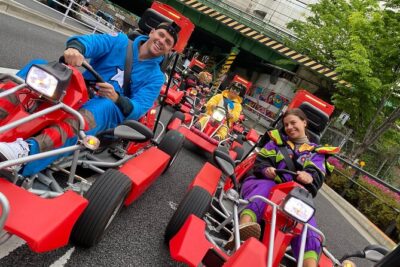
Tokyo Go Kart: Asakusa, Skytree, and Akihabara **IDP MUST**
Read our review →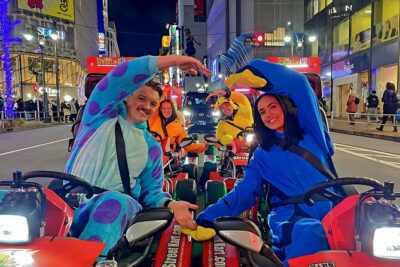
Shibuya Official Street Go-Kart in Shibuya Annex
Read our review →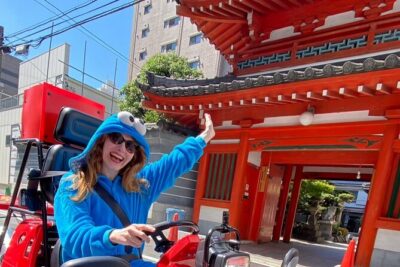

Asakusa, Skytree & Akhihabara Go-Kart City Experience
Read our review →Browse the lists this tour appears in