
REVIEW · PHOTOGRAPHY SESSIONS
Tokyo Cyberpunk Street Photo Tour
Tokyo after dark is made for photography. Neon signs glow above narrow lanes, crowds stream through Shibuya Crossing, and wet pavement can turn an ordinary street into a scene from a science-fiction film. This small-group walk gives you a practical way to photograph it all, with a professional photography guide showing you what to change on your camera or phone.
I especially like two things here: the tiny group, capped at four people, and the fact that you can use a smartphone. Guides such as Charles, Lukasz, and Stephane are praised for patient, hands-on help, including simple iPhone adjustments, exposure control, composition, and long-exposure settings. The main drawback is pace. One guide reportedly walked too fast, so you should speak up if you need more time or have trouble keeping the group in sight.
In This Review
- Key points at a glance
- Why this Tokyo photo walk works after dark
- Meeting at Shinjuku at 7 p.m.
- Kabukicho: neon, signs, and busy streets
- Omoide Yokocho in a compact half hour
- The train to Shibuya
- Shibuya Crossing: photographing motion
- What the photography lesson actually covers
- Is $184.99 good value?
- Which guide style suits you?
- What to bring and how to prepare
- Who should book this experience?
- Should you book the Tokyo Cyberpunk Street Photo Tour?
- FAQ
- How long does the Tokyo Cyberpunk Street Photo Tour last?
- What time does the tour start?
- Where does the tour begin?
- Where does the tour finish?
- Can I use a smartphone instead of a camera?
- How many people can join?
- Is transportation included?
- What happens if bad weather cancels the tour?
Key points at a glance
- Shinjuku after sunset: Start among Kabukicho’s neon streets and the busy lanes around Tokyo’s largest railway station.
- Omoide Yokocho in 30 minutes: Photograph a compact alley district filled with signs, small restaurants, and close-up street scenes.
- Shibuya Crossing finale: Work on crowd shots, motion, and long exposures at Tokyo’s famous intersection.
- Camera or phone friendly: You do not need advanced equipment, and guides have helped both beginners and serious photographers.
- Maximum of four people: A small group makes it easier to receive direct advice on framing and settings.
- $184.99 per group of up to two: The price makes more sense for a couple or two friends sharing the booking than for one person alone.
Why this Tokyo photo walk works after dark
This is not simply a sightseeing stroll with a camera in your hand. It is a short night-photography workshop that happens to move through two of Tokyo’s most photogenic districts.
I like that the guide teaches beside the street rather than in a classroom. You may stop, frame a shot, adjust shutter speed or exposure, and try again while the scene is still in front of you. That immediate practice is useful. You are not just hearing a tip and hoping to remember it later.
The tour is designed for a wide range of skill levels. Beginners can learn where to find exposure controls, how to keep unwanted clutter out of the frame, and how to place a subject within a busy scene. More experienced photographers can work on motion blur, long exposure, leading lines, and the difficult balance between bright signs and dark streets.
The small group matters. With a maximum of four people, a guide can look at your camera and offer specific help. Several guides, including Charles and Lukasz, are praised for working with different camera systems, including Canon and Fuji models, while also helping people who use only an iPhone.
The experience is listed as about three hours, while the detailed schedule describes a 2.5-hour photo adventure. Allow roughly three hours from the 7 p.m. start, including the move between Shinjuku and Shibuya. The listed stops add up to about two hours, leaving time for walking, instruction, and the train transfer.
A few more Tokyo trips to weigh up
- Best Go Kart Experience in Shibuya Crossing with Iconic Photos
★ 5.0 · 348 reviews - Tokyo Go-Karting Experience: Shibuya Crossing with Photos
★ 4.8 · 190 reviews - Tokyo: 1-Hour Private Photoshoot
★ 5.0 · 16 reviews
Meeting at Shinjuku at 7 p.m.
The meeting point is outside Happy Lemon Keio Shinjuku Shop at 1-chōme-1-4 Nishishinjuku, Shinjuku City. Shinjuku Station is enormous, so do not treat the meeting instructions casually. One participant arrived near the station early but still lost about 20 minutes trying to locate the group.
I would contact the operator in advance if you are unsure where to stand. The guide names can vary, and the local station area has many exits and busy pedestrian flows. Arriving early is wise, but arriving early at the wrong exit will not help much.
The tour finishes at 2-chōme-2-1 Dōgenzaka in Shibuya, near the station. This is useful planning information. You do not return to Shinjuku, so arrange your evening plans around a Shibuya finish.
Kabukicho: neon, signs, and busy streets
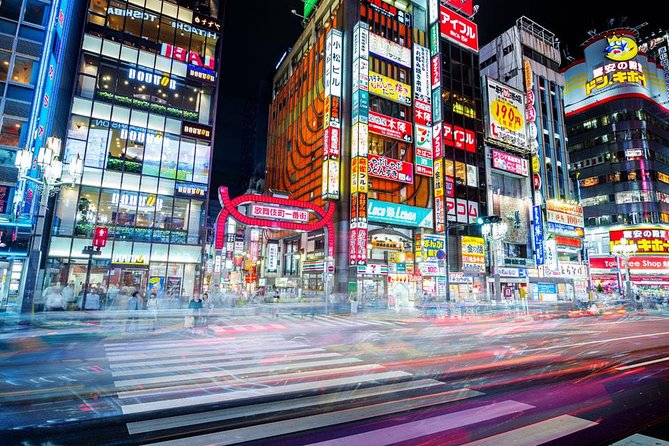
The first main stop is Kabukicho, where you spend about an hour. This is the strongest place to learn the basics because there is no shortage of material: glowing signs, people moving through the streets, layered storefronts, and changing light.
Your guide may start with simple composition. Look for lines created by buildings, signs, and sidewalks. Then watch how people move through the frame. Tokyo’s nighttime streets can look chaotic, but a good photograph often depends on choosing one clear subject and letting the surrounding lights support it.
This is also where camera settings become practical rather than abstract. Bright signs can fool your camera into making the rest of the image too dark. Your guide can help you adjust exposure and decide whether to freeze movement or allow a little blur.
If you are using a phone, the instruction can still be useful. The guides have helped participants find contrast controls, exposure adjustments, focus locks, and other tools that are easy to overlook. Those small changes can make a bigger difference than buying new equipment.
Kabukicho can be crowded, and that affects the lesson. You will need to keep track of your guide and group while also watching your surroundings. One complaint about the experience involved a fast pace and losing sight of the guide. Stay close, especially while crossing streets or moving through dense foot traffic.
Omoide Yokocho in a compact half hour
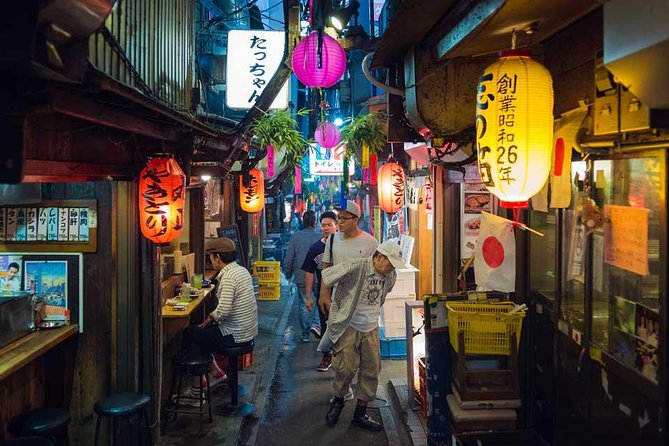
Omoide Yokocho, also called Memory Lane, is scheduled for about 30 minutes. This narrow restaurant district offers a different kind of night image from the broad neon streets of Kabukicho.
Here, I would focus on details. Look for signs, lantern-like lights, tight perspectives, steam, doorways, and the contrast between the small lanes and the tall buildings nearby. You might find that the best frame is not the biggest scene, but a small arrangement of light, texture, and people.
Thirty minutes is enough for a focused stop, but it is not a long time. If you see a promising angle, work efficiently. Ask the guide for help before moving on. This is one reason the small group is valuable: you have a better chance of getting individual advice without waiting behind a large line of participants.
Omoide Yokocho is also a good place to practice photographing in low light without relying only on famous landmarks. You are working with atmosphere and composition instead of simply pointing at a recognizable building.
Same city, a completely different kind of day:
- Mt Fuji and Hakone 1-Day Bus Tour Return by Bullet Train
★ 5.0 · 26,383 reviews - 1-Day Tokyo Bus Tour
★ 5.0 · 14,250 reviews - Tokyo: TOKYO SKYTREE® Admission ticket
★ 4.5 · 11,192 reviews - Tokyo: teamLab Planets TOKYO Digital Art Museum Entry Ticket
★ 4.6 · 9,779 reviews
The train to Shibuya
The tour then moves from Shinjuku to Shibuya by train. The fare is not included, so bring money or a suitable way to pay for the local ride. The exact cost is not stated, and the transfer itself takes time from the evening, but it connects two very different Tokyo photo settings.
This change of district keeps the walk from feeling repetitive. Shinjuku gives you dense signs and back streets. Shibuya brings youth culture, entertainment venues, dining streets, and one of the world’s best-known pedestrian intersections.
You should keep your camera ready but secure during the transfer. The group may be moving through a crowded station, and the pace can be brisk. If you need help with equipment or directions, tell the guide before the group leaves a stop.
Shibuya Crossing: photographing motion
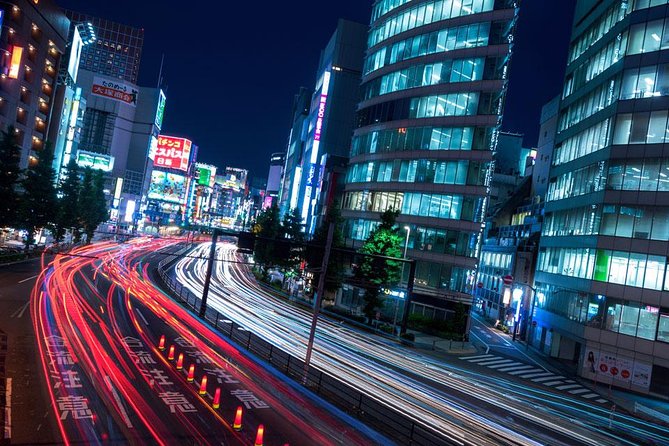
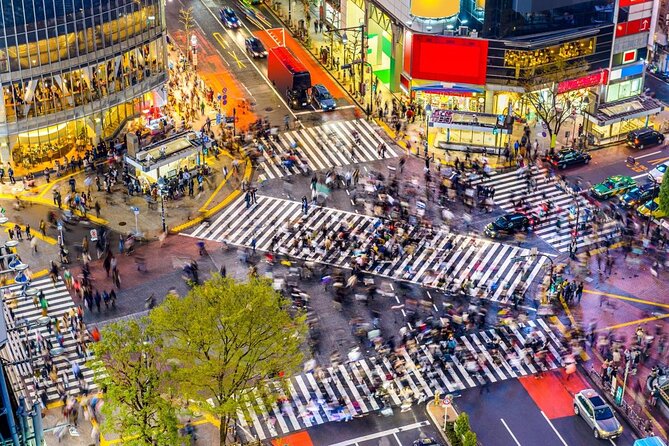
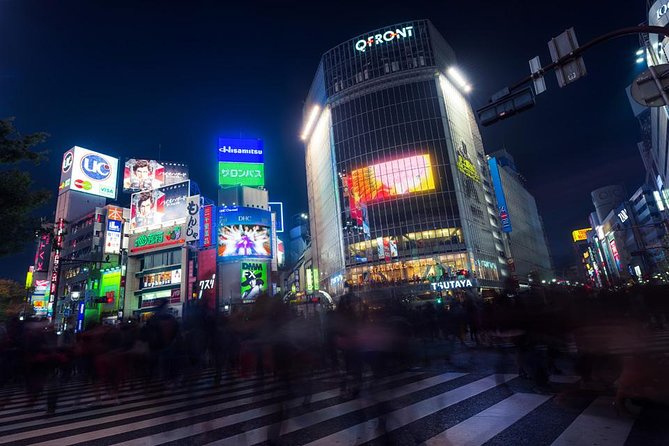
The final major stop is Shibuya Crossing, scheduled for about 45 minutes. This is the tour’s headline scene, but it is not automatically easy to photograph.
The crossing gives you repeated waves of movement. That lets you try different approaches. A faster shutter can freeze individual figures. A longer exposure can turn the crowd into streaks while keeping the surrounding signs and buildings visible. Your guide can help you choose settings that fit the effect you want.
The familiar comparison to Blade Runner makes sense visually, especially when the signs glow and the crowd fills the intersection. Still, the best result will come from your own framing. The crossing has been photographed countless times, so look for an unusual angle, a clear silhouette, or a moment when several paths and signs line up.
Forty-five minutes is a useful amount of time here. You can make several attempts instead of treating the crossing as a single quick photo stop. If rain appears, wet streets may add reflections, though poor weather can also cause the tour to be canceled.
The tour ends near Shibuya Station after this stop. Your camera or phone should be full of material from neon streets, tight alleyways, and moving crowds.
What the photography lesson actually covers
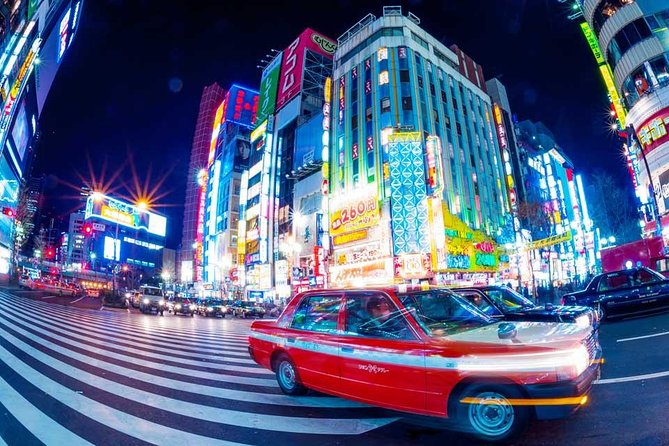
The instruction is practical and varies with your equipment and ability. Based on the experience details, you can expect help with:
- Shutter speed and exposure for dark streets
- Long-exposure techniques
- Framing crowded scenes
- Composition and keeping distractions out of the image
- Finding strong positions for famous views
- Camera-specific controls
- Smartphone contrast, exposure, and focus-lock tools
- Street photography and candid moments
The teaching style appears to be demonstration followed by practice. Lukasz is praised for showing a technique and then giving people time to try it. That format suits me better than a guide giving a long speech while everyone stands still.
The tour is strictly focused on photography. Do not book it if your main goal is a detailed cultural or historical tour of Shinjuku and Shibuya. You will receive some local insight about the districts, but the main purpose is to improve your pictures.
Is $184.99 good value?
The price is $184.99 per group of up to two people. For a couple or two friends, that works out to about $92.50 each before the train fare. For one person, the same group price is harder to justify, although a solo participant may receive more direct instruction.
The value depends on what you want. If you already know night photography well and mainly want someone to lead you to familiar city sights, the price may feel high. You can visit Shibuya Crossing and parts of Shinjuku without a guide.
If you want a compact lesson tailored to your camera, the calculation looks better. A professional guide can save you time finding useful viewpoints and help you solve settings problems while the scene is available. The small group also gives you more personal attention than a standard city walk.
The 4.9 rating and 97 percent recommendation figure suggest a strong record, but I would still choose this experience for the instruction, not simply for the rating. The quality of your evening will depend on the guide assigned, the pace, the weather, and how ready you are to practice.
Which guide style suits you?
Guide names appearing in the experience feedback include Charles, Lukasz, Stephane, and Nat. Charles is repeatedly described as patient, friendly, and energetic, with strong help for both cameras and phones. Lukasz is praised for a workshop approach, careful attention to each person, and keeping small groups together. Stephane is described as patient and accommodating, while Nat is noted for local knowledge and a pleasant manner, with the important caution that his walking pace felt too fast for one pair.
You cannot assume which guide you will receive, but you can make your needs clear at the start. Tell the instructor your skill level, equipment, and whether you want help with basic controls or more advanced technique.
If you are tired after a long flight, the format can still work. One participant joined after more than 18 hours without sleep and found the guide attentive and encouraging. I would not count on that being easy for everyone, though. A three-hour night walk through crowded districts requires enough energy to stay alert.
What to bring and how to prepare
A camera with some control over shutter speed or overall exposure is useful. A tripod was suggested for some participants, but no tripod is listed as included, so bring one only if you already have a practical way to carry it.
A smartphone is acceptable. You can still learn about exposure, contrast, composition, and focus lock. Clean your lens before leaving, charge your battery, and make sure you know how to open the camera controls quickly.
Wear comfortable shoes. The route includes walking through Shinjuku and Shibuya, station movement, and crowded streets. Keep your gear light so you can react quickly when the guide points out a good position.
Because the experience requires good weather, check the forecast before you go. If the operator cancels due to poor weather, you are offered another date or a full refund. If you cancel for another reason, the booking is non-refundable and cannot be changed.
Who should book this experience?
I would recommend it to:
- Beginners who want direct help using a camera or phone
- Couples or two friends who can share the group price
- Photographers interested in neon, street scenes, crowds, and long exposures
- People who want strong nighttime images early in a Tokyo visit
- Anyone who prefers learning by trying rather than reading camera instructions
I would be more cautious if you dislike walking in crowds, need a slow pace, or want a broad cultural tour. The experience is about making photographs. It is not a food tour, a history walk, or a relaxed evening stroll.
Should you book the Tokyo Cyberpunk Street Photo Tour?
Book it if you want to come home with better night photographs and practical advice you can use after Tokyo. The combination of Kabukicho, Omoide Yokocho, and Shibuya Crossing gives you varied scenes, while the four-person maximum makes personal instruction possible.
I would book it for two people, arrive early at the exact meeting point, bring a camera or phone with manual exposure controls, and tell the guide immediately if you need a slower pace. If your interest is only sightseeing, spend the $184.99 elsewhere. If you want a compact night-photography lesson in one of the world’s most visually intense cities, this is a well-targeted choice.
FAQ
How long does the Tokyo Cyberpunk Street Photo Tour last?
The experience is advertised as approximately three hours. The detailed description calls it a 2.5-hour photo adventure, so you should allow roughly three hours for the walk, instruction, and transfer between districts.
What time does the tour start?
The tour starts at 7 p.m.
Where does the tour begin?
You meet at Happy Lemon Keio Shinjuku Shop, 1-chōme-1-4 Nishishinjuku, Shinjuku City, Tokyo 160-0023, Japan.
Where does the tour finish?
The tour finishes at 2-chōme-2-1 Dōgenzaka, Shibuya, Tokyo 150-0043, near Shibuya Station.
Can I use a smartphone instead of a camera?
Yes. The photography instructor can provide tips for smartphone photography, including exposure, contrast, composition, and focus-lock adjustments.
How many people can join?
The maximum group size is four people. The listed price of $184.99 covers a group of up to two.
Is transportation included?
The train journey from Shinjuku to Shibuya is taken at your own expense. Bus fare is also not included.
What happens if bad weather cancels the tour?
If the operator cancels because of poor weather, you are offered a different date or a full refund. The experience requires good weather.
Just added around Tokyo
- Tokyo: Customizable Private Guided Walking Tour★ 4.5 · 129 reviews
- Private Harajuku Omotesando Architecture Tour★ 4.9 · 18 reviews
- Tokyo: Guided Helicopter Ride★ 4.9 · 24 reviews
- Tokyo: Guided Walking Tour of Tsukiji Market with Lunch★ 4.4 · 24 reviews
- Tokyo: Private Personalized Local Food Tour★ 4.5 · 101 reviews
- Tokyo GINZA: KONPARU Japanese Cabaret Show with Drink★ 4.8 · 38 reviews
- Tokyo: Guided Walking Tour of Tsukiji Market with Breakfast★ 4.4 · 134 reviews
- Tokyo: Gotokuji Cat Temple, Shinjuku Cat Cafe & 3D Cat Tour★ 4.9 · 38 reviews
Photography Sessions, compared.
Best Go Kart Experience in Shibuya Crossing with Iconic Photos
Read our review →
Tokyo Go-Karting Experience: Shibuya Crossing with Photos
Read our review →
Kyoto Gion Kiyomizudera Kimono Yukata Hairstyle | Photoshoot
Read our review →Browse the lists this tour appears in