REVIEW · TOKYO TOURS
Japanese Speaking Experience Meet the locals Friend Cafe Shibuya
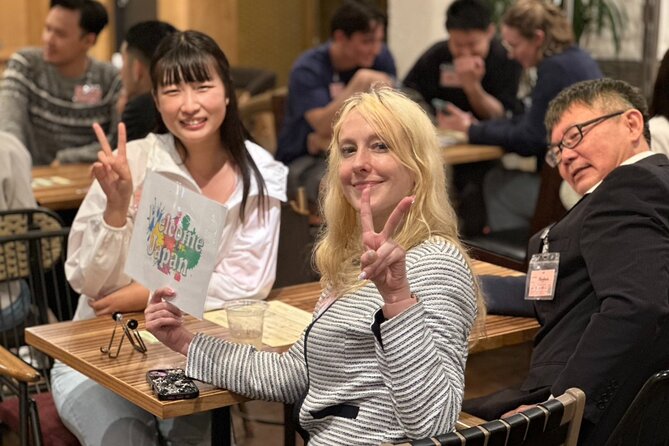
The most useful part of this Shibuya language exchange is its simple rhythm: 15 minutes of English, 15 minutes of Japanese, then a short break and a new group. You are not stuck making small talk with one person all evening. Staff keep the conversations moving, so you meet several people from Japan and other countries in two hours.
I like the beginner-friendly setup. You do not need to speak Japanese well, and topic cards give you a way into the conversation when your mind goes blank. I also like the modest group size, with about three or four people in each group. The main consideration is the setting: this is an over-18 activity in a pub and bowling cafe, so the room may be noisy at times.
In This Review
- Key points at a glance
- A structured way to meet people in Tokyo
- Finding the cafe in Shibuya
- Check-in, drinks, and the first conversation
- The six 15-minute rounds
- Topic cards and the art of keeping a chat alive
- Meeting local and international participants
- A social evening, not just a study session
- Price, timing, and group size
- Who will get the most from this experience?
- Should you book the Shibuya language exchange?
- FAQ
- Where does the Japanese speaking experience take place?
- What time does the event run?
- How long does the activity last?
- Is the experience suitable for Japanese beginners?
- How are the conversations organized?
- Do participants change seats?
- Are drinks and food included?
- Is there an age requirement?
- What is the cancellation policy?
Key points at a glance
- Six short conversation rounds: Alternate between English and Japanese, with 15 minutes for each language.
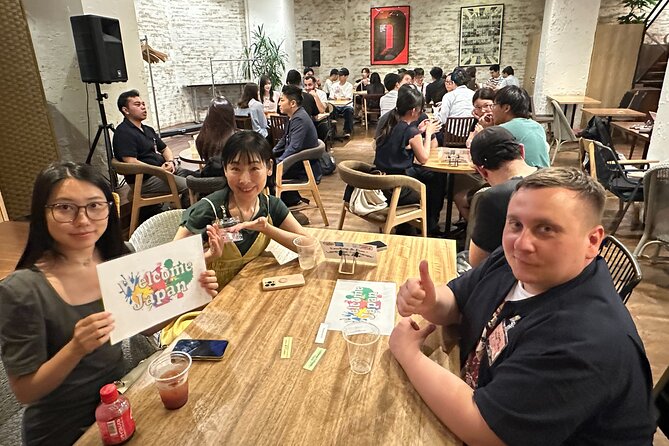
- Small mixed groups: Staff aim to combine Japanese and international participants in groups of three or four.
- Topic cards are provided: Use them to keep the chat going, especially if you are a beginner.
- Seats change several times: You get the chance to speak with more than one group during the evening.
- Drinks cost extra: Your ticket covers the event fees and taxes, but you must buy at least one drink at the venue.
- Convenient Monday night plan: The event runs from 7:30 to 9:30 p.m. near public transportation in Shibuya.
A structured way to meet people in Tokyo
Language exchanges can be awkward when nobody knows how to begin. This one avoids that problem with a clear schedule and staff direction. You check in, buy a drink, take your assigned seat, and begin with a guided conversation rather than waiting for strangers to approach you.
The format serves two groups at once. If you are studying Japanese, you get a low-pressure chance to practice with Japanese speakers. If you are from an English-speaking country, you can help someone work on English while getting help with Japanese in return.
That exchange matters. You are not sitting through a class or repeating phrases from a worksheet. You are talking about the topic in front of you, listening to another person, and trying to make yourself understood. Even a short conversation can show you which words you actually know and which ones disappear when you need them.
The event also welcomes complete beginners. You can take part even if your Japanese is limited to greetings, numbers, and a few useful phrases. The topic cards are there to reduce the pressure, and the staff divide people into small groups rather than one large circle.
Other Tokyo days people book alongside this one:
- Mt Fuji and Hakone 1-Day Bus Tour Return by Bullet Train
★ 5.0 · 26,383 reviews - 1-Day Tokyo Bus Tour
★ 5.0 · 14,250 reviews - Tokyo: TOKYO SKYTREE® Admission ticket
★ 4.5 · 11,192 reviews
Finding the cafe in Shibuya
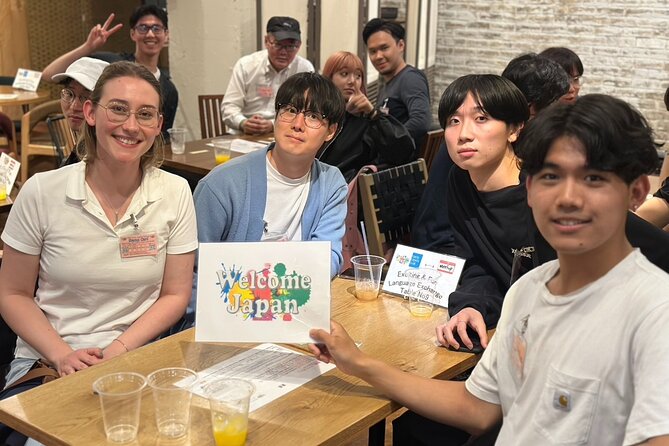
The meeting point is Shibuya Bowling Cafe, Shibuya EST, at 1-chome-14-14 Shibuya, Tokyo 150-0002. The cafe is on the B1F level. The venue is near public transportation, which helps when you are making your way there after a day of sightseeing.
Allow time to locate the building and go downstairs. Reception begins 10 minutes before the start time, so arriving close to 7:30 p.m. could leave you rushing through check-in and your drink purchase. The scheduled event runs on Monday from 7:30 to 9:30 p.m.
This is not a walking tour of Shibuya. You remain at the venue for the full activity, and it ends back at the meeting point. That makes it easy to fit into an evening plan. You can treat it as the night’s main activity or use it as a social start before continuing elsewhere in Shibuya.
The bowling setting adds character, but it also has a practical downside. Bowling was noted as a little loud, so you may occasionally need to listen closely. If hearing every word is your top concern, this is worth considering. The pub atmosphere is part of the social appeal, but it is not the quietest classroom.
Check-in, drinks, and the first conversation
After check-in at reception, you buy a drink from the bar or store at your own cost. The ticket does not include alcohol, food, or any other drink. You must purchase at least one drink when you arrive, and only people aged 18 or older can join.
The $29 price covers the organized event, staff support, topic cards, seat changes, and all fees and taxes. Adding a drink means your final cost will be higher, but the price is still reasonable if you want a planned social activity in central Tokyo rather than an unstructured night at a bar.
Staff prepare a seat for each person and place attendees into small groups. The stated group size is three or four people, with a mix of Japanese and international participants. A group this size gives you room to speak without forcing you to perform for a crowd. It also means you can follow the conversation if your Japanese is still developing.
The first round is English conversation. This gives Japanese participants a chance to practice English and lets you meet your group before switching languages. The topic cards can help you move beyond the usual questions about where you are from and how long you are in Tokyo.
The six 15-minute rounds
The event follows a clear sequence:
- English conversation
- Japanese conversation
- Five-minute break and seat change
- English conversation
- Japanese conversation
- Five-minute break and seat change
- English conversation
- Japanese conversation
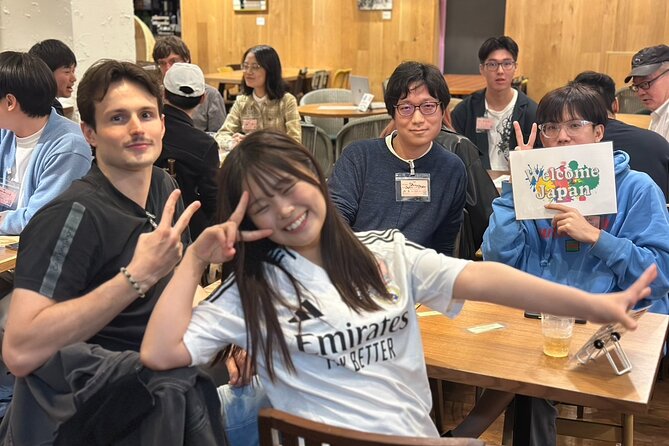
- Closing group photo
Each language block lasts 15 minutes. That is long enough to settle into a subject but short enough to prevent one difficult pairing from taking over your whole evening. If a conversation feels slow, you will soon have a new group. If it is going well, you still get several more chances to meet people.
The alternating language format is the heart of the activity. During English time, you may find yourself explaining a word, answering questions about your home country, or helping someone form a sentence. During Japanese time, you get a chance to try your own phrases and hear natural responses.
Do not expect a formal Japanese lesson. Staff organize the room and the timing, but the learning comes through conversation. You will need to take an active role, ask questions, and accept that some sentences will come out imperfectly. That is exactly why the format works better for practice than a passive presentation.
The five-minute breaks are short but useful. They give staff time to move people around and give you a moment to think about what you want to ask next. The changes also prevent the evening from becoming a single long conversation with the people who happened to sit beside you first.
Same city, a completely different kind of day:
- Tokyo: teamLab Planets TOKYO Digital Art Museum Entry Ticket
★ 4.6 · 9,779 reviews - Mt Fuji & Hakone Cruise, Drum Show Bullet Train 1 Day from Tokyo
★ 4.0 · 7,413 reviews - Tokyo: Shinjuku Food Tour (13 Dishes at 4 Local Eateries)
★ 5.0 · 6,603 reviews - Tokyo Mt Fuji 5th St & Hakone Cruise Bus Tour w/Bullet Train
★ 4.4 · 5,024 reviews
Topic cards and the art of keeping a chat alive
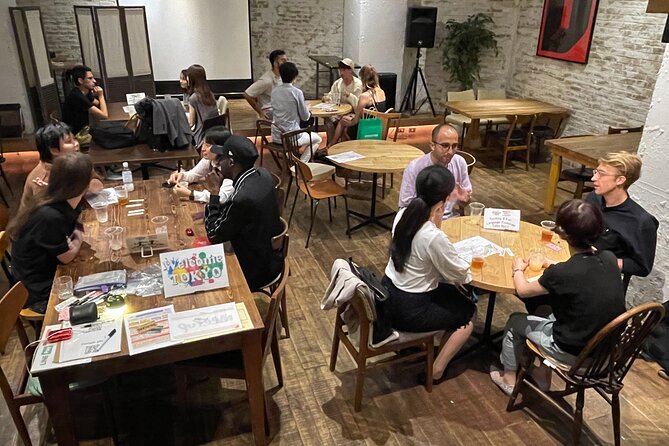
Topic cards are a small feature with a big practical benefit. Many people can manage a greeting in another language but struggle to keep the conversation going. A card gives you a shared subject and takes away some of the fear of silence.
You can use the cards as a starting point rather than a strict script. Ask a follow-up question, compare answers, or switch between English and Japanese around the same subject. The goal is to speak, not to complete a worksheet.
For beginners, the cards also give you a chance to prepare a few simple sentences before your turn. You might decide how to introduce yourself, describe a hobby, or ask a basic question. Keep your sentences short. Clear, simple Japanese is more useful here than a complicated phrase you cannot remember.
The group format makes mistakes easier to handle. You are not speaking alone in front of a teacher. You are part of a small conversation where everyone has a reason to practice. A friendly attitude matters more than perfect grammar.
Meeting local and international participants
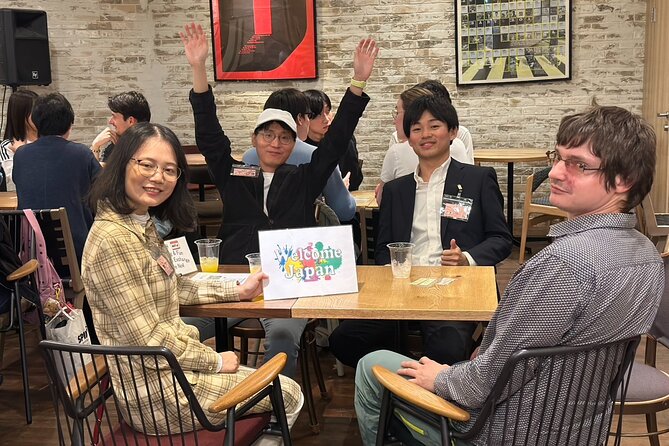
This event is built around a mix of people from Japan and around the world. That mix gives the evening more range than a standard language class. You might help someone with English, practice Japanese with someone local, and compare Tokyo life with another international participant during the same night.
The seat changes are important for that reason. Staff aim to give you the chance to speak with more than two or three different groups. You should not expect every group to have the same energy or language level, but the rotation improves your chances of finding a good conversational match.
The social side is a major part of the value. Several pieces of feedback point to friendly hosts, good organization, and an atmosphere that does not feel intimidating. Rikiya was singled out for making people more comfortable and helping the meetup run smoothly. Candice was also praised for bringing energy to the group and getting people laughing and dancing.
Those details suggest that the host role is more than checking names and watching the clock. Good staff can make a quiet participant feel included, explain the rules, and move a conversation along when it stalls. Still, you should come ready to participate. This is a meetup, not a one-on-one guided lesson.
A social evening, not just a study session
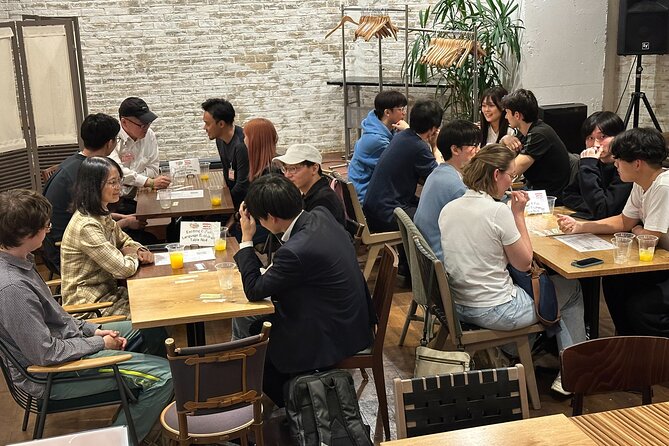
The activity can work as a standalone plan for Monday night. Two hours is enough to fill an evening without taking over your whole Tokyo visit. Since the meeting point is in Shibuya, you can also continue your night in the surrounding area after the closing photo.
The pub setting makes the event feel less formal than a classroom. You can buy a drink, chat across the table, and meet people in a setting designed for social contact. That may be especially helpful if you are traveling alone and want a planned way to meet others.
The same setting will not suit everyone. If you want quiet, intensive pronunciation work, or detailed grammar correction, this is probably not the right choice. The bowling cafe can be loud, and the conversation time is shared among several people. You get breadth and social practice rather than a private lesson.
I see the activity as a bridge between sightseeing and local contact. It does not promise a full view of Japanese culture, and it is not designed as a traditional cultural tour. Its value is more immediate: you sit down, talk with people, try some Japanese, and leave with a few new connections.
Price, timing, and group size
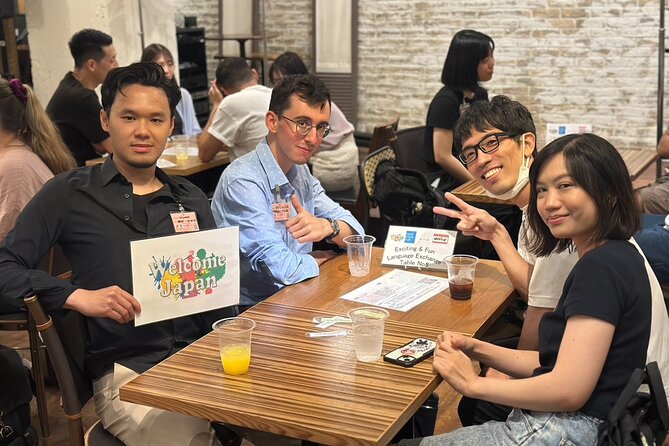
At $29 per person, the event is priced for an organized social activity in central Tokyo. The two-hour schedule, staff coordination, topic cards, seat changes, and mixed groups are all included. Fees and taxes are included too, which keeps the listed price easy to understand.
You still need to budget for at least one drink. Alcoholic beverages and food are not included, and the activity is for people aged 18 and older. If you are comparing the cost with a free meetup, the ticket pays for structure and staff support rather than for a major attraction or transport.
The maximum group size is 20 people. That is small enough for staff to manage the rotations, while still allowing a mix of Japanese and international participants. The actual feel of the night will depend on the number and language levels of people who attend, but the stated limit should prevent an enormous crowd.
The activity is often booked about 12 days ahead. For a Monday evening, that is a useful planning guide. You may want to reserve before the final days of your Tokyo stay, especially if this is one of the few social activities you have scheduled.
A mobile ticket is provided, and confirmation arrives at booking. You can cancel for a full refund up to 24 hours before the local start time. Changes or cancellations inside that 24-hour window are not accepted for a refund, so check your Monday plans before the deadline.
Who will get the most from this experience?
I would choose this for a solo visitor who wants a friendly, organized way to meet people. It also suits couples or friends who want to practice Japanese without committing to a full course. Beginners are welcome, so you do not need advanced language skills to justify the booking.
It is especially useful if you want to help Japanese participants with English. The exchange works best when both sides contribute. You should be willing to listen patiently, slow down, repeat a phrase, and let the other person try again.
You may want to skip it if you dislike group conversation, need a quiet room, or expect a professional language instructor. The schedule is fixed, the conversation is shared, and the bowling venue can create background noise.
Bring curiosity and a few simple Japanese phrases. Do not worry about being fluent. The format is designed around trying, changing groups, and trying again.
Should you book the Shibuya language exchange?
Book this if you want real conversation with local and international people, not a sightseeing stop or a traditional Japanese lesson. The rotating 15-minute format, small groups, and topic cards give beginners a clear way to take part. The friendly organization associated with hosts such as Rikiya and Candice adds to the social appeal.
The main tradeoffs are easy to understand: drinks cost extra, the venue can be noisy, and the experience is limited to a Monday evening from 7:30 to 9:30 p.m. For many visitors, those are fair compromises for a structured, low-pressure night in Shibuya.
If your goal is to practice Japanese and make a few connections in Tokyo, the $29 ticket offers solid value. If your goal is quiet, technical language instruction, spend your money elsewhere.
FAQ
Where does the Japanese speaking experience take place?
It takes place at Shibuya Bowling Cafe, Shibuya EST, 1-chome-14-14 Shibuya, Tokyo 150-0002, Japan. The cafe is on the B1F level.
What time does the event run?
The event runs on Monday from 7:30 p.m. to 9:30 p.m. Reception begins 10 minutes before the start time.
How long does the activity last?
The activity lasts approximately two hours.
Is the experience suitable for Japanese beginners?
Yes. Beginner Japanese learners are welcome, and you can participate even if you cannot speak much Japanese.
How are the conversations organized?
Staff divide participants into small groups of about three or four people, mixing Japanese and international participants. The schedule alternates between 15 minutes of English and 15 minutes of Japanese conversation.
Do participants change seats?
Yes. Staff change the seating during short five-minute breaks so you can speak with more than one group.
Are drinks and food included?
No. The ticket does not include food or drinks. You must buy at least one drink at the venue, and alcoholic beverages cost extra.
Is there an age requirement?
Yes. You must be at least 18 years old because the activity takes place in a pub.
What is the cancellation policy?
You can cancel at least 24 hours before the local start time for a full refund. Cancellations or changes made less than 24 hours before the start time are not accepted for a refund.
Just added around Tokyo
- Tokyo: Customizable Private Guided Walking Tour★ 4.5 · 129 reviews
- Private Harajuku Omotesando Architecture Tour★ 4.9 · 18 reviews
- Tokyo: Guided Helicopter Ride★ 4.9 · 24 reviews
- Tokyo: Guided Walking Tour of Tsukiji Market with Lunch★ 4.4 · 24 reviews
- Tokyo: Private Personalized Local Food Tour★ 4.5 · 101 reviews
- Tokyo GINZA: KONPARU Japanese Cabaret Show with Drink★ 4.8 · 38 reviews
- Tokyo: Guided Walking Tour of Tsukiji Market with Breakfast★ 4.4 · 134 reviews
- Tokyo: Gotokuji Cat Temple, Shinjuku Cat Cafe & 3D Cat Tour★ 4.9 · 38 reviews
Tokyo Tours, compared.

Mt Fuji and Hakone 1-Day Bus Tour Return by Bullet Train
Read our review →


teamLab Planets TOKYO Digital Art Museum Entry Ticket
Read our review →
Mt Fuji & Hakone Cruise, Drum Show Bullet Train 1 Day from Tokyo
Read our review →
Shinjuku Food Tour (13 Dishes at 4 Local Eateries)
Read our review →
Tokyo Mt Fuji 5th St & Hakone Cruise Bus Tour w/Bullet Train
Read our review →