REVIEW · TOKYO TOURS
IKEBANA experience
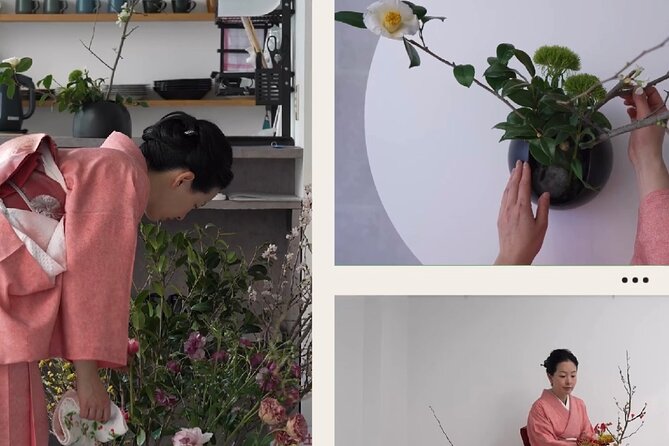
The best part of this Tokyo experience is its setting. Instead of learning ikebana in a large commercial studio, you enter Hiromi’s home, see Japanese-style rooms, and work with flowers in a calm neighborhood near Toritsu-daigaku Station. Hiromi teaches in clear English, beginning with a demonstration before giving you room to make your own arrangement.
I like two things especially: the lesson is private, so Hiromi can adjust her help to your skill and interests, and the final matcha and wagashi add a pleasant cultural finish. The main consideration is time. The class lasts about 90 minutes, and tea ceremony instruction or refreshments depend on having enough time after the flower arrangement.
In This Review
- Key points to know before booking
- Why this ikebana class feels different from a standard Tokyo activity
- Meeting Hiromi near Toritsu-daigaku Station
- Inside the Japanese-style room
- How the 90-minute lesson works
- Learning ikebana without Japanese
- Matcha, wagashi, and a taste of tea ceremony
- Who will get the most from this experience
- Is $115.31 a fair price?
- Practical planning and cancellation rules
- How this fits into a Tokyo day
- Final verdict: should you book Hiromi’s ikebana class?
- FAQ
- Where does the ikebana experience begin?
- How long does the class last?
- Is the lesson taught in English?
- Do I make my own flower arrangement?
- Is matcha included?
- Can I cancel for a full refund?
Key points to know before booking
- Private lesson with Hiromi: Only your group takes part, making it easy to ask questions and work at your own pace.
- Traditional Tokyo home setting: You see Japanese-style rooms, including a tatami room, rather than only a standard classroom.
- Clear English instruction: Hiromi demonstrates each stage and explains ikebana basics in English.
- Your own arrangement: You do not simply watch. You cut and arrange the flowers yourself, then receive comments and adjustments.
- Matcha and wagashi when time allows: The lesson may finish with Japanese tea, sweets, and basic tea ceremony guidance.
- Good for families and beginners: Past participants have included children, couples, parents, and three generations of one family.
Why this ikebana class feels different from a standard Tokyo activity
Tokyo offers plenty of polished cultural activities, but this one has a more personal shape. You meet Hiromi near Toritsu-daigaku Station, then enter a private home where the lesson takes place. That change of setting matters. You are not just being shown an item from Japanese culture. You are being welcomed into a Japanese-style room and given time to work with the art yourself.
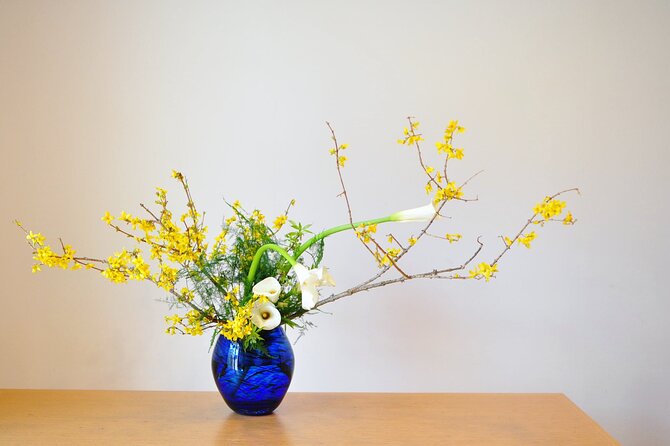
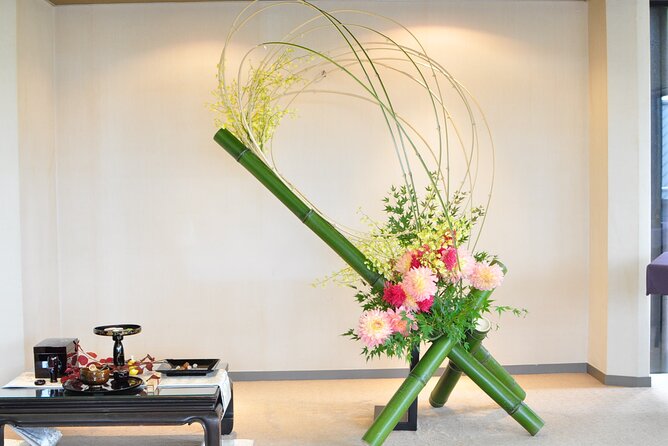
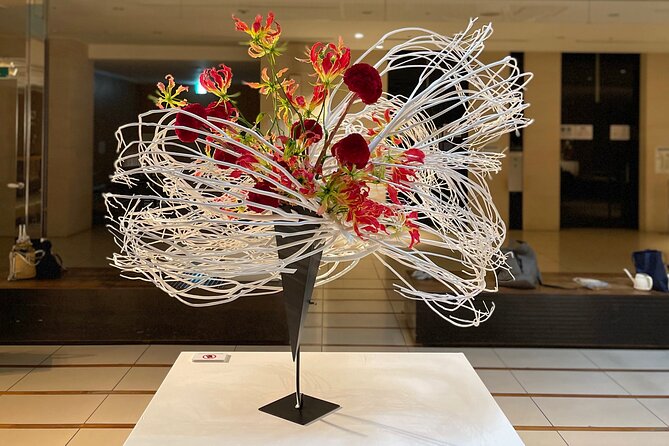
Ikebana is the Japanese practice of arranging flowers and branches with attention to line, space, balance, and the natural character of each stem. It is not simply a matter of filling a vase with as many flowers as possible. The lesson focuses on how a small number of flowers can create shape and movement.
I like that this gives the class a quiet pace. Tokyo can be noisy and fast, so 90 minutes spent cutting stems and considering their angles offers a useful pause. You still learn something concrete, but you are not rushed through a long schedule of sights.
Other Tokyo days people book alongside this one:
- Mt Fuji and Hakone 1-Day Bus Tour Return by Bullet Train
★ 5.0 · 26,383 reviews - 1-Day Tokyo Bus Tour
★ 5.0 · 14,250 reviews - Tokyo: TOKYO SKYTREE® Admission ticket
★ 4.5 · 11,192 reviews
Meeting Hiromi near Toritsu-daigaku Station
The meeting point is at Toritsu-daigaku Station, at 1-chōme-5-1 Nakane, Meguro City, Tokyo 152-0031. The exact activity begins from this meeting point, and it ends there as well. The area is near public transportation, which makes it a practical choice for fitting into a day in Meguro or nearby parts of Tokyo.
Allow yourself enough time to find the meeting point without hurrying. The experience is built around a private home, so clear arrival instructions matter. A mobile ticket is provided, and booking confirmation arrives at the time of booking.
Hiromi has also met a participant at the station and walked with her to the class, carrying an umbrella in strong sun. That kind of help cannot be assumed for every booking, but it gives you a sense of the friendly, personal approach. If you have trouble locating the meeting point, contact the provider rather than wandering around the neighborhood.
The activity is private. Your group takes part on its own, which is one of the strongest reasons to choose this class over a larger workshop. You can ask about ikebana, Japanese customs, or Tokyo without worrying about taking time from a room full of strangers.
Inside the Japanese-style room
The home setting is the heart of the experience. You may see a Japanese-style room, a tatami room, and a colorful garden as part of your visit. These details help place ikebana in its everyday cultural setting.
A tatami room is not just a pretty background for photographs. Traditional Japanese rooms are designed with restraint, open floor space, and a strong connection between the interior and the natural world outside. Ikebana fits naturally in this setting because an arrangement is meant to complement a room, not overpower it.
You should dress in something comfortable and easy to move in. The provided information does not specify a dress code, but this is a hands-on lesson rather than a formal ceremony. You will need to focus on cutting and placing flowers, so practical clothing makes sense.
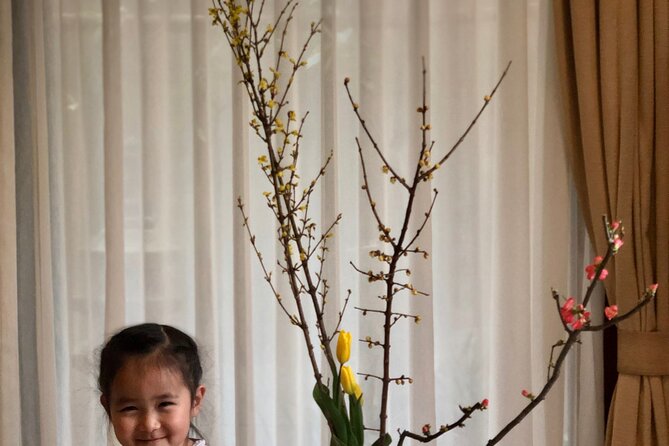
The room may feel intimate, especially if you are used to sightseeing in large museums or crowded attractions. That is a benefit for couples and solo visitors, though families with very young children should remember that flowers, tools, and a quiet home setting require some care. The class has welcomed children, including a three-year-old who enjoyed a freestyle arrangement, but each family should decide how well its children will manage the activity.
How the 90-minute lesson works
The class begins with an introduction to ikebana and its basic ideas. If you have a particular style or subject you want to learn, tell Hiromi at the start. You can also ask to begin with the fundamentals or use the textbook to explore an arrangement that suits your interests.
Hiromi first makes a sample arrangement while referring to the textbook. This demonstration gives you a clear model before you handle the flowers. Watch how she cuts the stems, chooses the direction of each piece, and builds the form.
Then you make your own arrangement. This is where the experience becomes more than a short demonstration. You decide how to use the flowers, while Hiromi offers help as needed. The lesson leaves space for personal expression, so your result does not have to copy her sample exactly.
That balance is important for beginners. Too much correction can make a creative activity feel like an exam. Too little guidance can leave you wondering what you are supposed to do. Hiromi’s approach, based on the lesson format, is to demonstrate first, let you work, then comment or revise the arrangement with you.
The supplied information notes that ikebana uses relatively few flowers because the focus is on line and the space around the flowers. This is useful for a first lesson. You are not faced with a giant bundle of stems or a complicated display. You can pay attention to how one branch changes the shape of the whole piece.
At the end, you take a photograph of your arrangement. That gives you a record of your work and a reference if you want to continue at home. One participant also purchased supplies to keep practicing after returning home, and Hiromi offers online lessons as another way to continue.
Same city, a completely different kind of day:
- Tokyo: teamLab Planets TOKYO Digital Art Museum Entry Ticket
★ 4.6 · 9,779 reviews - Mt Fuji & Hakone Cruise, Drum Show Bullet Train 1 Day from Tokyo
★ 4.0 · 7,413 reviews - Tokyo: Shinjuku Food Tour (13 Dishes at 4 Local Eateries)
★ 5.0 · 6,603 reviews - Tokyo Mt Fuji 5th St & Hakone Cruise Bus Tour w/Bullet Train
★ 4.4 · 5,024 reviews
Learning ikebana without Japanese
English instruction is a major practical advantage. Hiromi explains the process in English and has been described as patient, easy to understand, and flexible in her teaching. That matters because ikebana depends on small visual distinctions that can be hard to follow through translation alone.
You can ask questions during the lesson, including questions about Tokyo or Japanese culture. This turns the class into a conversation rather than a fixed speech. If you are curious about the meaning of an arrangement or how ikebana fits into Japanese life, this is the time to ask.
The teaching style also suits people who are not naturally artistic. You do not need to arrive with flower-arranging experience. Hiromi demonstrates the process, helps with technique, and gives you enough freedom to make choices of your own.
I would still keep expectations sensible. In 90 minutes, you learn foundations and make one arrangement. You are not completing a full professional training course or mastering a named school of ikebana. The value is in learning the basic approach, trying the process, and leaving with a clearer sense of why the art looks the way it does.
Matcha, wagashi, and a taste of tea ceremony
If the lesson finishes with enough time, Hiromi serves matcha and Japanese sweets, often called wagashi. This is a welcome ending after the hands-on work. The sweets provide a small seasonal and visual contrast to the flowers, while matcha gives you a chance to sit back and talk.
The tea portion is not guaranteed as a long, formal tea ceremony. The information says that basic tea ceremony instruction is available if you are interested and time permits. Think of it as an added introduction, not a separate full-length ceremony.
The setting makes this part especially appealing. Matcha and wagashi served in an original tatami room feel connected to the home and the class. You are not simply buying a tea-and-sweets set at a café. You are learning how these elements relate to Japanese hospitality and traditional rooms.
If tea ceremony is your main interest, ask Hiromi at the beginning so you can understand what can fit into the 90-minute visit. If ikebana is your priority, allow the flower lesson to take center stage and regard the tea as a bonus.
Who will get the most from this experience
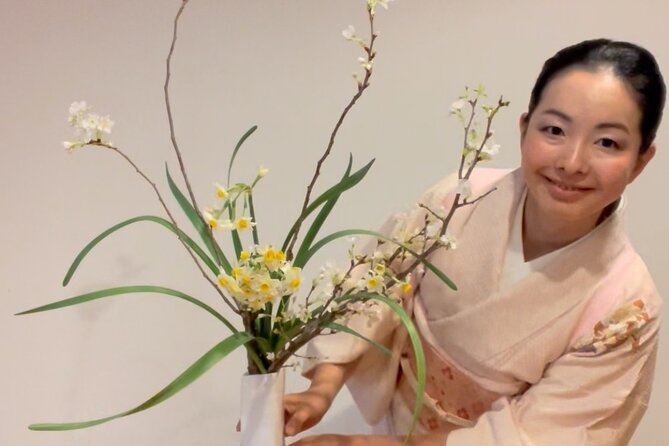
This class is a strong choice for first-time visitors who want a cultural activity with personal contact. It gives you a view of Japanese home life, a practical introduction to ikebana, and a chance to speak with an English-speaking local teacher.
It also works well for:
- Couples looking for a quiet shared activity
- Solo visitors who prefer direct instruction
- Parents and children who enjoy creative projects
- Families with several generations
- Anyone interested in flowers, Japanese rooms, or tea customs
- Repeat visitors who want something slower than another major attraction
The class has worked for groups that included a daughter and parent, a husband and son, and three generations together. Children have enjoyed freestyle ikebana, but the provider says most people can participate rather than promising a specific age range. For very young children, an adult should be ready to help them handle the activity carefully.
This is less suited to someone who wants a large, highly choreographed cultural show. It is also not the best pick if you want a long walking tour or a full tea ceremony. Its strength is the small scale and the chance to make something yourself.
Is $115.31 a fair price?
At $115.31 per person, this is not a cheap drop-in craft class. The price makes more sense when you consider what is included in the format: a private 90-minute lesson, English guidance from Hiromi, the use of a traditional home setting, your own arrangement, personal comments, a photograph, and possibly matcha and wagashi.
For a private activity in Tokyo, the one-to-one attention is the key value. A larger class might cost less, but you would likely receive less time for questions and less help shaping your own work. Here, the fee buys access to the teacher’s attention as much as it buys the flowers and room.
The value is strongest if you take part actively and continue the practice afterward. Bring your curiosity, ask about technique, and take notes or photographs of the arrangement. If you can purchase supplies, you may be able to recreate some of what you learn at home, though the exact items and cost are not specified.
Booking patterns suggest that this experience is often reserved about 28 days ahead. That is a useful planning clue, especially if you want a particular date or are visiting during a busy period. It does not mean you must book exactly four weeks in advance, but leaving this until the last day may limit your options.
Practical planning and cancellation rules
The experience is available with a mobile ticket, and booking confirmation is issued at the time of booking. It is near public transportation, with Toritsu-daigaku Station serving as the meeting point.
Free cancellation is available if you cancel at least 24 hours before the local start time. Changes made inside that 24-hour window are not accepted, and the payment is not refunded for a late cancellation.
The activity requires good weather and a minimum number of participants. That may seem unusual for an indoor home lesson, but it is part of the stated operating policy. If poor weather or an insufficient number of bookings causes cancellation, you are offered another date or experience, or a full refund.
The activity ends back at the meeting point. Plan your next stop with that in mind, and do not book a train connection so tight that a few extra minutes would cause trouble.
How this fits into a Tokyo day
Toritsu-daigaku is not presented as a major sightseeing stop within the activity itself. That can be an advantage. You can build the class into a day when you want a quieter break from Tokyo’s main shopping streets, towers, and museums.
Schedule the lesson when you have enough mental space to enjoy it. A 90-minute class is compact, but the meeting, walk to the home, photographs, conversation, and possible tea may make the visit feel fuller than the stated lesson time.
I would avoid placing a rushed reservation immediately afterward. If the class runs to its planned length, you will still need to return to the meeting point before moving on. A flexible afternoon or morning works best.
Final verdict: should you book Hiromi’s ikebana class?
Book it if you want to make something with your own hands, learn in English, and see a side of Tokyo that is more personal than a standard attraction. Hiromi’s patient instruction, private format, Japanese-style home, and possible matcha service give the experience a clear sense of place.
The main limits are the price and the short format. You learn the basics rather than becoming an expert, and the tea portion depends on available time. Still, for couples, families, solo visitors, and anyone drawn to flowers or Japanese design, this is a thoughtful use of 90 minutes.
My advice is to reserve ahead, arrive with a few questions, and tell Hiromi whether you want basic instruction, a freer arrangement, or tea ceremony guidance. If you value personal attention over a low-cost group workshop, this class is worth considering.
FAQ
Where does the ikebana experience begin?
The meeting point is near Toritsu-daigaku Station at 1-chōme-5-1 Nakane, Meguro City, Tokyo 152-0031, Japan.
How long does the class last?
The experience lasts approximately 1 hour and 30 minutes. It ends back at the meeting point.
Is the lesson taught in English?
Yes. Hiromi teaches the lesson in English and explains the demonstration and arrangement process clearly.
Do I make my own flower arrangement?
Yes. Hiromi first creates a sample while using a textbook, then you make your own arrangement. She comments on it or revises it with you, and you can take a photograph afterward.
Is matcha included?
If there is enough time after the lesson, Hiromi offers matcha and Japanese sweets. Basic tea ceremony instruction is also available if you are interested and time permits.
Can I cancel for a full refund?
You can cancel at least 24 hours before the local start time for a full refund. Cancellations or changes made less than 24 hours before the start time are not refunded or accepted.
Just added around Tokyo
- Private Memorable Tokyo Tour with English Speaking Driver★ 5.0 · 30 reviews
- Private Tokyo Custom Full-Day Tour by Chartered Vehicle★ 5.0 · 16 reviews
- Private Sightseeing to Mt Fuji and Hakone with English Driver★ 5.0 · 51 reviews
- Tokyo Photography Masterclass – Private Photography Lesson★ 5.0 · 25 reviews
- Private Mt. Fuji Day Trip from Tokyo with English-Speaking Driver★ 5.0 · 33 reviews
- 4 Day Tour – Mount. Fuji, Tokyo, Hakone, Kamakura and Yokohama★ 5.0 · 19 reviews
- Private Unforgettable Mt Fuji Tour with English Speaking Driver★ 5.0 · 142 reviews
- Private Tokyo Food Tour – A Journey Through Time Through Food★ 5.0 · 36 reviews
Tokyo Tours, compared.

Mt Fuji and Hakone 1-Day Bus Tour Return by Bullet Train
Read our review →


teamLab Planets TOKYO Digital Art Museum Entry Ticket
Read our review →
Mt Fuji & Hakone Cruise, Drum Show Bullet Train 1 Day from Tokyo
Read our review →
Shinjuku Food Tour (13 Dishes at 4 Local Eateries)
Read our review →
Tokyo Mt Fuji 5th St & Hakone Cruise Bus Tour w/Bullet Train
Read our review →