REVIEW · FULL-DAY
Full-Day Accessible Tour of Tokyo for Wheelchair Users
Tokyo is easier to enjoy when someone else handles the hard parts. This private wheelchair-accessible tour pairs a guide with Tokyo’s train system, crowded streets, ramps, and long routes between major sights. You can see Asakusa, Shibuya, Harajuku, and Meiji Shrine in one day without having to plan every station transfer yourself.
I like the one-to-one attention, since your guide can slow down, change the route, or explain a better way around an obstacle. I also like that train tickets are included, giving you a practical lesson in moving around Tokyo instead of keeping you inside a private vehicle.
The main consideration is stamina. Seven hours in Tokyo can mean a great deal of rolling and walking, and one family reported reaching 15,000 steps even with a 96-year-old using a rollator-wheelchair. The itinerary is flexible, but you should discuss your mobility needs before booking.
In This Review
- Key points to know before booking
- Why this Tokyo tour can make a big difference
- Starting in Asakusa at 9:30 in the morning
- Asakusa Culture Tourist Information Center
- Nakamise Shopping Street and Kaminarimon
- Senso-ji Temple, Tokyo’s colorful Buddhist landmark
- Sumida Park and the Tokyo Skytree view
- Shibuya Crossing and Cat Street
- Meiji Jingu Shrine and the quiet side of Harajuku
- Omotesando, tree-lined Tokyo shopping
- Using Tokyo trains with a guide beside you
- How flexible is the private format?
- Guides who add practical value
- Food, timing, and the end of the day
- Price, cancellation, and who gets the best value
- Should you book this accessible Tokyo tour?
- FAQ
- How long does the accessible Tokyo tour last?
- Is hotel pickup included?
- Are train tickets included?
- Is private car transportation included?
- How many people are required to book?
- What sights are included?
- Can service animals join the tour?
Key points to know before booking
- Private tour for your own group: You are not placed with strangers, and the guide can adjust the pace and order of stops.
- Train tickets are included: This gives you supported practice with Tokyo’s rail system, though private taxi or car transport costs extra.
- Pickup is offered within Tokyo’s 23 wards: Confirm the exact pickup and return plan, since the listed meeting point is the Asakusa Culture Tourist Information Center.
- Eight planned stops cover several sides of Tokyo: Expect temples, a shrine, parks, shopping streets, modern city scenes, and major crossings.
- Guides focus on practical access: Fumiko, Kaori, Yumi, Michiko, Emiko, and Keita Mizuri are among the guides praised for route planning, station help, and adapting to mobility needs.
- The tour requires at least two people: Caregivers count toward the minimum, and the minimum age is six.
Why this Tokyo tour can make a big difference
Tokyo is not impossible in a wheelchair, but it can be tiring to figure out. Stations are large. Platforms may be far apart. A route that looks short on a map can involve crowds, lifts, ramps, and several changes of direction.
That is where this tour earns its price. Your guide does not simply point at famous buildings. The guide helps you use public transport, requests ramp assistance at stations, and finds routes with fewer steps. One guide, Fumiko, was praised for keeping track of the group in dense crowds and making sure a seated participant could see what was happening.
The experience is private, so you can ask questions as they come up. Guides have adjusted the itinerary for tired legs, changed the order of sights, and made lunch suggestions. Kaori, for example, was praised for quickly adapting the day to a guest’s mobility needs.
The tour costs $191.08 per person and lasts about seven hours. For two people, that is a sizeable day-tour expense, but the price includes a professional guide, local taxes, train tickets, and hotel pickup and drop-off within Tokyo’s 23 wards. A private car or taxi is not included, so the value is strongest if you are comfortable using trains with assistance.
A few more Tokyo trips to weigh up
- From Tokyo: Mount Fuji Full-Day Sightseeing Trip
★ 4.5 · 4,970 reviews - Mount Fuji Full-Day Private Tour from Tokyo (Customizable)
★ 4.9 · 1,470 reviews - Tokyo Private Full-Day Tour by Car or Van
★ 5.0 · 684 reviews
Starting in Asakusa at 9:30 in the morning
The published start time is 9:30 a.m. The listed meeting point is the Asakusa Culture Tourist Information Center at 2 Chome-18-9 Kaminarimon, Taito City. Pickup from a hotel within Tokyo’s 23 wards is also offered, so confirm your preferred arrangement when you book.
Asakusa is a smart starting point. It gives you old Tokyo sights first, with a guide to explain the setting before the day moves into modern neighborhoods. The area can be crowded, especially around the temple gate and shopping street, so having someone lead the way matters.
The official itinerary gives about 15 minutes at the information center, followed by 20 minutes on Nakamise Shopping Street and 20 minutes at Senso-ji Temple. Those times are fairly short. You should expect an introduction and a focused look rather than a slow, detailed visit to every corner.
Asakusa Culture Tourist Information Center
The building itself is worth a look. Designed by Kengo Kuma, it rises eight stories beside Kaminarimon and offers sightseeing information, views, and a striking modern contrast to the traditional temple district.
For a wheelchair user, the center is also a useful orientation point. You can get a sense of Asakusa before entering the busiest pedestrian areas. The scheduled 15 minutes will likely be enough for a quick stop and explanation, though not for a long visit to every floor.
Nakamise Shopping Street and Kaminarimon
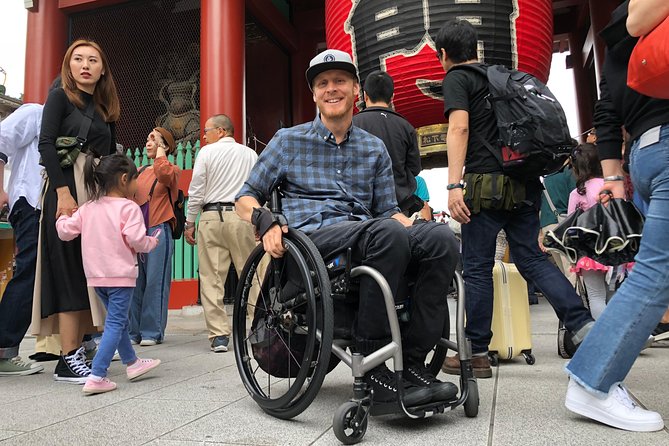
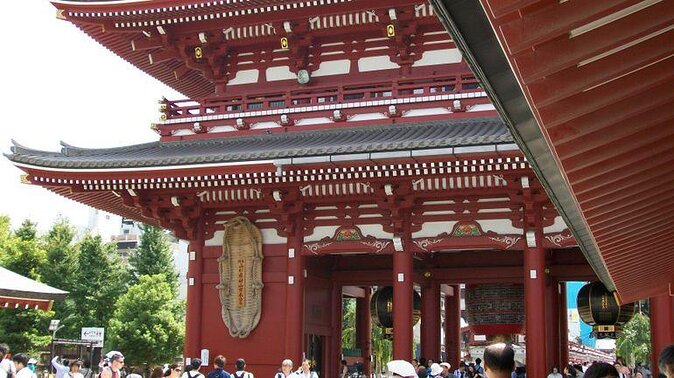
Kaminarimon, or Thunder Gate, is the famous outer gate of Senso-ji. Its large red lantern is one of Tokyo’s best-known sights, and the gate marks the entrance to Nakamise, a long shopping street leading toward the temple.
The street is lined with shops selling snacks, souvenirs, traditional goods, and small gifts. It is an enjoyable place to see Tokyo’s tourist side, but it can also be tight and crowded. Your guide can help you stay with the group and choose a route that avoids unnecessary steps.
Allow 20 minutes here. That is enough to see the gate, get a feel for the street, and perhaps pause at a shop. It is not enough for serious shopping, so you may need to choose between browsing and photography.
Same city, a completely different kind of day:
- Mt Fuji and Hakone 1-Day Bus Tour Return by Bullet Train
★ 5.0 · 26,383 reviews - 1-Day Tokyo Bus Tour
★ 5.0 · 14,250 reviews - Tokyo: TOKYO SKYTREE® Admission ticket
★ 4.5 · 11,192 reviews - Tokyo: teamLab Planets TOKYO Digital Art Museum Entry Ticket
★ 4.6 · 9,779 reviews
Senso-ji Temple, Tokyo’s colorful Buddhist landmark
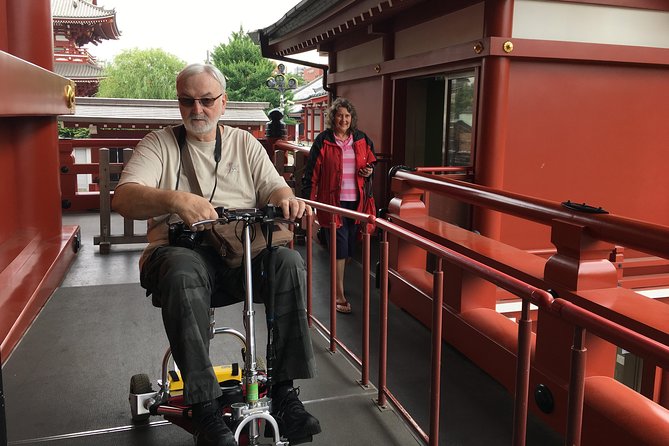
Senso-ji is one of Tokyo’s most popular temples. Its bright gates, incense, large grounds, and busy approach make it an easy place to connect Tokyo today with its older religious traditions.
The tour allows about 20 minutes at the temple. Your guide can explain the difference between a Buddhist temple and a Shinto shrine, a distinction Yumi was specifically praised for explaining during this route.
Access can change from one section to another. The tour is designed around wheelchair users, but that does not mean every surface is equally easy. Crowds, uneven areas, and the distance between the gate and temple can still take energy. Let the guide know early if you prefer a shorter temple visit.
Sumida Park and the Tokyo Skytree view
The next stop is Sumida Park, near Asakusa Station and along the Sumida River. You can look toward Tokyo Skytree and, in cherry-blossom season, enjoy one of the city’s better seasonal views.
The scheduled 15 minutes makes this a brief outdoor pause. It is useful after the crowded temple area, giving you room for photographs and a change of pace. The park is not presented as a long nature walk, so do not expect an extended break unless your guide adjusts the timing.
Shibuya Crossing and Cat Street
The day then shifts from historic Asakusa to modern Shibuya. Shibuya Crossing is famous for the mass of people moving through the intersection when the lights change. The tour allows 20 minutes, enough to see the crossing and take in the scale of the area.
The crossing itself is a spectacle, but it is not necessarily the most relaxed wheelchair stop. Crowds and wide pedestrian flows can make positioning difficult. A guide who knows where to pause is valuable here, especially if you want a clear view without being pushed along by foot traffic.
Cat Street follows, with about 25 minutes. This half-mile shopping route between Shibuya and Harajuku is associated with younger fashion and independent shops. You will see a different Tokyo from the temple district, with clothing stores, cafés, and street style.
The description calls it a catwalk for trendsetters, but you should treat the visit as a short look rather than a full shopping trip. The time is limited, and some shops may not be easy to enter with a larger chair. Your guide can help you decide how much of the street makes sense for your group.
Meiji Jingu Shrine and the quiet side of Harajuku
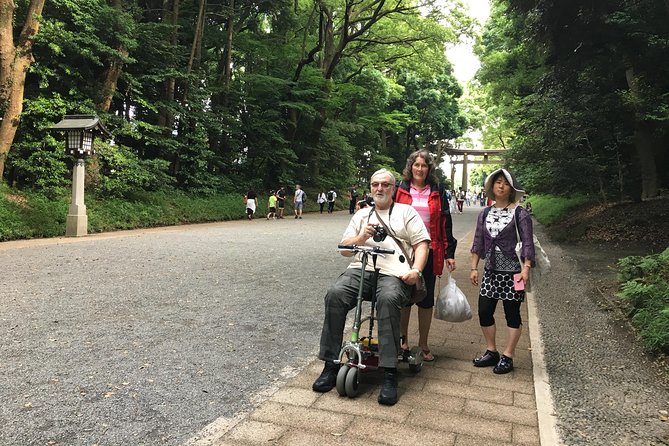
Meiji Jingu is dedicated to Emperor Meiji and Empress Shoken. It sits beside busy Harajuku Station, yet the shrine grounds offer a very different mood from the surrounding shopping streets.
The planned 50 minutes gives this stop the most time on the itinerary. That makes sense. The shrine area needs more than a quick photograph, and the guide can explain Shinto customs, the setting, and the difference between shrine and temple architecture.
You should still expect a fair amount of movement. A wheelchair-friendly route can avoid stairs, but it cannot remove all distance. One guide was praised for finding paths with the fewest steps when the group’s legs grew tired. Ask for that kind of adjustment before fatigue sets in, not after.
The shrine is also one of the places where the pace matters most. You may prefer a shorter visit with more time at another stop, or you may want to linger here and reduce time elsewhere. A private tour makes that conversation possible.
Omotesando, tree-lined Tokyo shopping
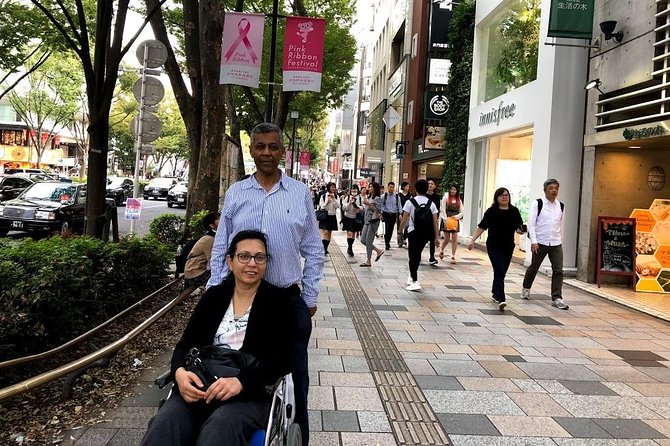
The final listed stop is Omotesando, a sloping, tree-lined boulevard in the Aoyama area. It runs through parts of Shibuya and Minato wards and is often linked with Harajuku.
This is a good closing stop because it shows Tokyo’s polished shopping side after the temple and shrine visits. The scheduled 20 minutes gives you time to look at the architecture, shops, and broad avenue without turning the tour into an all-day retail outing.
The word sloping matters for wheelchair users. Even with a careful route, grades can affect comfort and control. Tell your guide how your chair handles inclines, and do not hesitate to ask for a shorter section.
The overview also names Tokyo Tower among the accessible attractions covered by the experience, but Tokyo Tower does not appear in the detailed eight-stop schedule provided for this tour. If Tokyo Tower is important to you, confirm its inclusion before paying.
Using Tokyo trains with a guide beside you
The train portion is one of the tour’s most useful features. Your tickets are included, and the guide helps you navigate the rail system rather than simply arranging a private ride.
That support can be practical after the tour ends. You learn how station staff provide ramp boards and how wheelchair assistance works at the stations used during the day. A family specifically appreciated station attendants bringing slope ramps at each station.
This is not a private-car tour. Private transportation by taxi, car, or bus is available for an extra fee, but it is not included in the $191.08 price. If transfers or crowded platforms are especially difficult for you, ask about the extra cost before booking.
The route may also involve station corridors and waiting. The tour is advertised as accessible, but accessible does not mean effortless. Your guide can help reduce confusion and unnecessary stairs, while station staff handle ramps. You should still plan for a full day of movement.
How flexible is the private format?
The private setup is a major advantage. Only your group participates, so a caregiver, family member, or companion does not have to worry about slowing down a larger party.
The minimum is two people per booking, and caregivers count toward that number. The minimum age is six. Service animals are allowed, and the tour is near public transportation.
Guides have adapted the order of sights, shortened walks, explained routes in advance, and changed plans when a participant became tired. That flexibility is more useful than a fixed promise to see every listed stop. You may cover all the main areas, but the exact balance depends on your pace.
The information gives a moderate physical fitness level as a requirement. That should be taken seriously. One group with a 96-year-old using a combination rollator-wheelchair covered 15,000 steps during the day. The figure shows what is possible, not what you must do, but it is a clear warning that this is an active sightseeing day.
Guides who add practical value
The guide is the heart of this experience. Several guides receive especially strong praise for different skills.
Fumiko is noted for accessible route planning and for keeping track of people in crowded Tokyo. Yumi is praised for explaining culture, history, architecture, and routes with fewer steps. Kaori is described as organized and quick to adapt the itinerary, including help with a lunch recommendation.
Michiko helped guests meet at their hotel, obtain train tickets, and navigate the rail network. Emiko guided an older participant through the Metro system and showed the group how to seek wheelchair assistance. Keita Mizuri is described as friendly and considerate.
Guide assignments can change, so you should not assume a particular person will lead your tour. Still, these examples show the type of help the tour is built to provide: explanation, route management, crowd awareness, and attention to comfort.
Food, timing, and the end of the day
Food and drinks are not included. A guide may suggest a suitable lunch, as Kaori did for one group, but you pay for your own meal.
The schedule lists eight stops with a total of about 185 minutes of sightseeing time. The full experience lasts around seven hours, leaving the rest for trains, station access, transfers, pauses, and changes between areas. That is a sensible structure for Tokyo, where getting from one district to another can take time.
The published information says the activity ends back at the meeting point, while hotel pickup and drop-off within the 23 wards are also included. Clarify the return arrangement if you are being collected at your hotel. This small detail matters at the end of a tiring day.
Price, cancellation, and who gets the best value
At $191.08 per person, this is not a bargain-priced walking tour. The cost buys privacy, a professional guide, local taxes, train tickets, and pickup and drop-off within the 23 wards.
I see the best value for a wheelchair user visiting Tokyo for the first time, especially if the rail system feels intimidating. A private taxi day may seem easier, but it gives you less practice with the transport you may want to use on later days. The train-based format also keeps the experience closer to daily Tokyo life.
The value is weaker if you already know Tokyo’s accessible routes, have a small group comfortable managing stations, or want a slow visit to only one neighborhood. The tour covers a lot of ground, so it favors variety over long time inside any one attraction.
Free cancellation is available when you cancel at least 24 hours before the start time. Changes or cancellations made less than 24 hours ahead are not accepted for a refund.
Should you book this accessible Tokyo tour?
I would book this tour if you want to see several major Tokyo districts in one day and need help with public transport, ramps, crowds, and route choices. It suits families, couples, and caregiver groups who value a flexible private guide more than a low-cost group outing.
Before booking, confirm your hotel pickup, return location, chair or rollator needs, and whether Tokyo Tower is actually part of your route. Also ask how much walking and rolling you should expect. If you prepare for an active day and use the private format to set a comfortable pace, this is a strong way to get your first practical introduction to accessible Tokyo.
FAQ
How long does the accessible Tokyo tour last?
The tour lasts approximately seven hours and starts at 9:30 a.m.
Is hotel pickup included?
Hotel pickup and drop-off are included for locations within Tokyo’s 23 wards. The listed meeting point is the Asakusa Culture Tourist Information Center, so confirm the exact arrangement when booking.
Are train tickets included?
Yes. Train tickets are included as part of the tour.
Is private car transportation included?
No. Private transportation by taxi, private car, or bus is available for an additional fee.
How many people are required to book?
A minimum of two people is required per booking. Caregivers count toward the minimum.
What sights are included?
The detailed route includes the Asakusa Culture Tourist Information Center, Nakamise Shopping Street and Kaminarimon, Senso-ji Temple, Sumida Park, Shibuya Crossing, Cat Street, Meiji Jingu Shrine, and Omotesando. Tokyo Tower is named in the general description but not in the detailed stop list, so confirm whether it will be visited.
Can service animals join the tour?
Yes. Service animals are allowed.
Just added around Tokyo
- Private Memorable Tokyo Tour with English Speaking Driver★ 5.0 · 30 reviews
- Private Tokyo Custom Full-Day Tour by Chartered Vehicle★ 5.0 · 16 reviews
- Private Sightseeing to Mt Fuji and Hakone with English Driver★ 5.0 · 51 reviews
- Tokyo Photography Masterclass – Private Photography Lesson★ 5.0 · 25 reviews
- Private Mt. Fuji Day Trip from Tokyo with English-Speaking Driver★ 5.0 · 33 reviews
- 4 Day Tour – Mount. Fuji, Tokyo, Hakone, Kamakura and Yokohama★ 5.0 · 19 reviews
- Private Unforgettable Mt Fuji Tour with English Speaking Driver★ 5.0 · 142 reviews
- Private Tokyo Food Tour – A Journey Through Time Through Food★ 5.0 · 36 reviews
Full-Day, compared.
Mount Fuji Full-Day Private Tour from Tokyo (Customizable)
Read our review →
Hiroshima / Miyajima Full-day Private Tour with Government Licensed Guide
Read our review →

5 Top Highlights of Kyoto Full Day Bike Tour (E-bike option)
Read our review →
Full Day Biking Tour Exploring the Best of Kyoto
Read our review →