

REVIEW · JAPAN
Ecotourism and Woodcraft with a Mountain Artist Near Tokyo
A short train ride from Tokyo takes you to a private forest where 300 years of forestry tradition still guides daily work. With guide Shun and a local forestry master, you learn why Nishikawa timber once supplied Tokyo builders, walk among living cedar and cypress, cut a log by hand, and rest quietly beneath the trees.
I like the direct contact with the forest, not just a talk about sustainability. I also like the useful souvenir: you burn a kanji of your choice into a wooden piece shaped like Edo Castle, which becomes a phone stand. The main drawback is that this is a small, structured experience rather than a long hike, and the roughly $93.93 price does not include your train fare or lunch.
In This Review
- Key points to know before booking
- Why Nishikawa timber matters in Hanno
- Meeting Shun at Higashi-Agano Station
- Inside Kirari, the woodworking studio
- Cutting a log by hand
- Forest bathing beneath the canopy
- Burning your kanji into an Edo Castle stand
- What the $93.93 price really covers
- Who will enjoy this experience most
- Practical timing and cancellation advice
- Should you book this Hanno forest tour?
- FAQ
- Where does the experience begin?
- How long does the experience last?
- Is transportation included?
- Is lunch included?
- What will I make during the craft session?
- How many people can join the tour?
- Can I cancel for a full refund?
Key points to know before booking
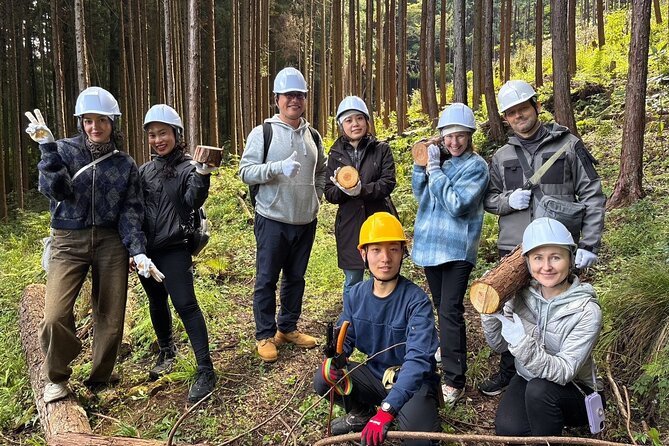
- A private forest normally closed to the public: You get access to a working woodland in Hanno, not simply a public park.
- A 300-year forestry story: Learn how local families manage old trees and use thinning to keep the forest healthy.
- Hands-on log cutting: You use a saw yourself, so expect real effort rather than a staged demonstration.
- Quiet forest bathing: Time beneath the canopy gives the visit a slower, more reflective pace.
- Edo Castle woodcraft: A pyrography pen lets you create a kanji smartphone stand to take home.
- Small group, short journey: The group is capped at eight, with transport from Higashi-Agano Station to the site.
Why Nishikawa timber matters in Hanno
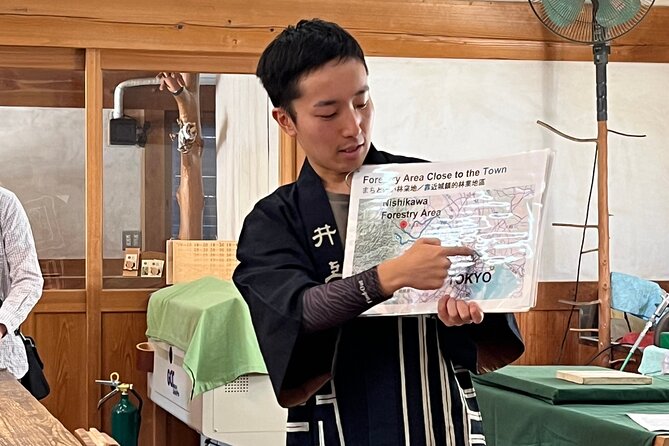
The experience begins with wood, but it is really about the relationship between a city and the forests west of it. Nishikawa timber takes its name from its origin west of Tokyo. For centuries, wood from this area moved toward the capital for buildings and other practical uses.
That link gives the tour more substance than a simple forest walk. You are not only looking at trees. You are learning how a regional material helped shape Tokyo, and why careful forestry still matters to the communities that produce it.
The local foresters are described as mountain artists. It is a fitting idea. Their work is not about leaving every tree untouched. It involves choosing which trees to remove, when to thin a section, and how to help the remaining trees receive enough light and space.
That lesson is especially useful if you are used to thinking of conservation as keeping people out. Here, good care includes measured human intervention. Thinning can support a healthier forest, and the removed timber can become a useful material rather than waste.
The forest has international certification, and access is normally restricted. That does not turn the visit into a grand wilderness expedition. It does give you a close look at a working private woodland, with the people who know its trees best explaining what you are seeing.
Other Japan days people book alongside this one:
- Mt Fuji and Hakone 1-Day Bus Tour Return by Bullet Train
★ 5.0 · 26,383 reviews - 1-Day Tokyo Bus Tour
★ 5.0 · 14,250 reviews - PERFECT KYOTO 1-Day Bus Tour
★ 5.0 · 13,518 reviews
Meeting Shun at Higashi-Agano Station
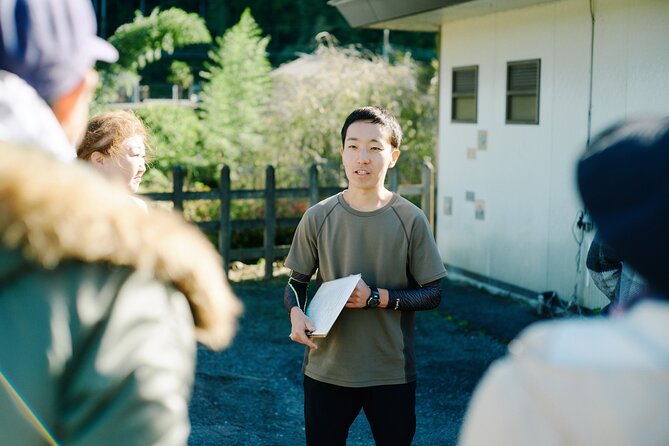
Your meeting point is Higashi-Agano Station in Hanno, Saitama Prefecture. After leaving the ticket gate, look for the guide holding a tour sign. The station is surrounded by wooded hills, so the setting changes quickly from city rail travel to a quieter rural corner.
This meeting arrangement is simple, but you should allow enough time to find the correct station and arrive before the scheduled start. The tour begins and ends here, and the station is the fixed point for the vehicle transfer.
Guide Shun has been described as providing the forest explanation, family story, safety guidance, and hands-on instruction. The experience includes helmets and gloves for the forest work, a sensible touch when you are near logs and cutting tools.
The small maximum of eight participants matters. It allows the guide to keep an eye on the log-cutting activity and answer questions without turning the lesson into a large group presentation. It also means the date may not operate if the minimum number is not reached, so keep that in mind if your schedule is tight.
An air-conditioned vehicle takes you from the station to Kirari, the woodworking studio where the main session takes place. Your transport costs to Higashi-Agano are not included, but the local drive between the station and activity site is included.
Inside Kirari, the woodworking studio
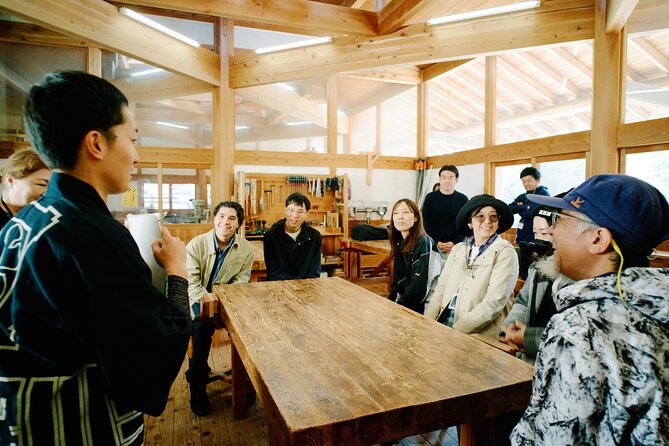
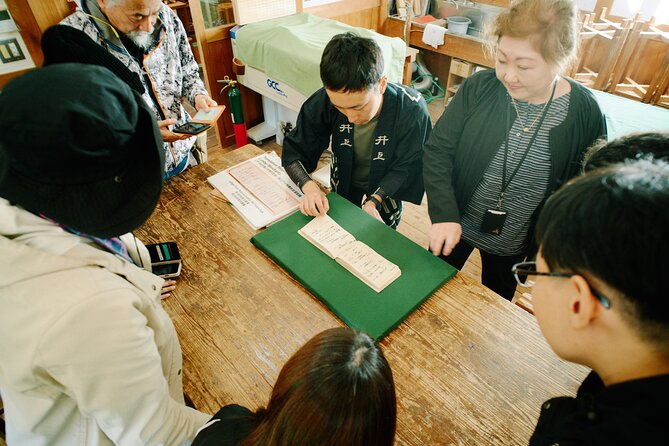
Kirari is the practical center of the experience. Here, you receive an introduction to Nishikawa timber and local forestry from a master connected with the woodworking tradition. One particularly notable detail is the link to the 15th generation head of the Kirari Millwork Shop.
That kind of continuity gives the talk a human scale. You are hearing about a family trade that has passed through many generations, not a general lecture assembled for tourists. The focus stays on wood, forest care, and the way local craft depends on both.
You learn about three types of wood and get to notice their different aromas. This is a small but effective part of the experience. Wood can look similar when it is stacked or shaped, yet its scent and grain tell you that each species behaves differently.
The session also explains thinning, one of the most important ideas in the tour. A forest planted or managed for timber cannot simply be ignored. Removing selected trees can help the rest grow better, while producing material for construction and craft.
I would pay close attention here if you study architecture, design, or traditional Japanese building. The connection between forestry and finished wood is unusually clear. You see how decisions made in the forest affect the material later used in a workshop or city building.
Cutting a log by hand
The log-cutting portion gives the tour some muscle. You do not merely watch a saw move through timber. You try the work yourself and feel how much force and technique it takes to cut wood.
Do not expect the saw to pass through as easily as it might in a demonstration video. The physical resistance is part of the lesson. It helps you understand the energy stored in a piece of timber and the labor behind even a modest wooden object.
This activity is supervised, and the tour provides protective helmets and gloves. Still, you should wear practical clothing and shoes suitable for a forest and workshop setting. The information supplied for the experience says most people can participate, but it does not promise a fully accessible surface or a no-effort activity.
The log-cutting also breaks up the quieter teaching. After learning about forests in an abstract way, you make direct contact with the material. That change from listening to working is one reason the experience feels grounded.
If you have limited strength or dislike tool work, this may be the least appealing section. You can still gain from watching and listening, but the value of the activity comes from trying it rather than treating it as a photo stop.
Same city, a completely different kind of day:
- Tokyo: TOKYO SKYTREE® Admission ticket
★ 4.5 · 11,192 reviews - Tokyo: teamLab Planets TOKYO Digital Art Museum Entry Ticket
★ 4.6 · 9,779 reviews - Mt Fuji & Hakone Cruise, Drum Show Bullet Train 1 Day from Tokyo
★ 4.0 · 7,413 reviews - Tokyo: Sumo Show Experience with Chicken Hot Pot and a Photo
★ 4.8 · 6,678 reviews
Forest bathing beneath the canopy
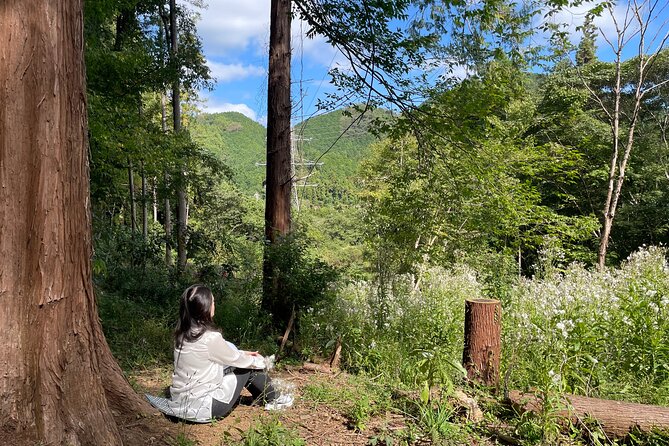
The forest walk is not presented as a demanding trek. It is a guided visit through the private woodland, with time to notice the trees, breathe the air, and choose a tree that speaks to you.
That last part is deliberately unhurried. You can sit or relax beneath the canopy and listen to the quiet. The experience uses the idea of forest bathing, a calm period of contact with the woods rather than a workout or a race to viewpoints.
This is where the tour feels most different from a standard sightseeing outing near Tokyo. There is no list of monuments to check off. Instead, the guide asks you to slow down and notice scent, shade, bark, and the feeling of standing among mature trees.
Cedar and cypress are especially meaningful in Japan because they are familiar building materials, yet many visitors know them mainly as finished wood. Seeing them alive and learning how foresters manage them changes that relationship.
The timing of the forest portion may depend on weather and local conditions. The tour requires good weather, and poor weather can lead to a new date or a full refund. That policy makes sense here because the walk, cutting activity, and quiet time outdoors are central to the experience.
Do not book this expecting dramatic mountain views. The appeal is closer and quieter: a managed woodland, fresh air, tree aromas, and time away from the city’s hard surfaces and noise.
Burning your kanji into an Edo Castle stand
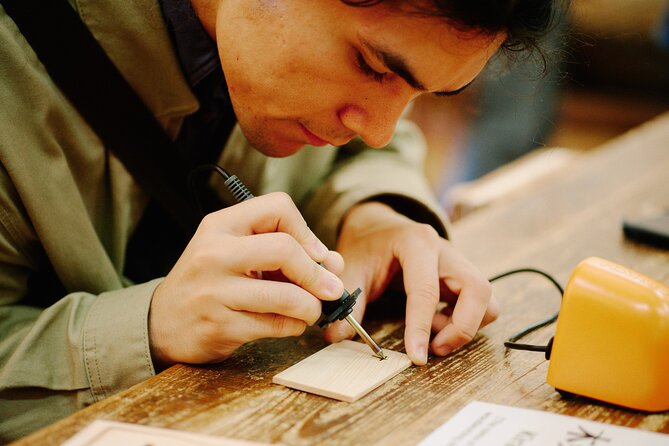
The final craft activity gives you something personal to take home. You use a pyrography pen to burn a kanji of your choice into a wooden piece shaped like Edo Castle.
This is not just a generic souvenir with a place name printed on it. You choose the character, then make the mark yourself. The result serves as a smartphone stand, so it has a purpose beyond sitting in a drawer.
Pyrography requires patience. The pen burns rather than draws, and the mark cannot be erased in the usual way. That makes a simple character worth thinking about before you begin. You might choose a kanji connected with nature, travel, peace, strength, or a personal name, but the tour information leaves the choice to you.
The Edo Castle shape connects your small craft back to Tokyo. The castle itself is no longer standing in its original form, but its name evokes the city that once depended on timber from areas such as Hanno. Your finished object links the forest, the workshop, and the capital in a compact way.
The craft session also suits people who want a gentler finish after the physical work. Several parts of the activity are described as relaxing, and the wood-burning exercise gives you time to concentrate without rushing.
What the $93.93 price really covers
At about $93.93 per person, this is not the cheapest short activity near Tokyo. The price makes more sense if you value personal instruction, access to a normally closed private forest, transport from the station to the site, safety equipment, and a take-home craft.
You are paying for a small group capped at eight, not a large bus tour. You also get several different parts in one visit: a forestry lesson, a forest walk, log cutting, quiet time under the trees, and wood burning.
The price does not include your train fare to Higashi-Agano Station, private transportation to the meeting point, or lunch. That matters because the two-and-a-half-hour activity ends around lunchtime, and you will need to budget for food afterward.
The guide returns you to Higashi-Agano Station. From there, you can continue toward Hanno Station and use one of the guide’s local restaurant suggestions for lunch. The experience can also fit with a wider day in the area, including Chichibu, Kawagoe, or Moomin Valley Park.
I see the strongest value for someone who would otherwise pay separately for a craft class and a nature outing. If you only want a scenic walk, the price may feel high. If you want a local lesson with practical work and a keepsake, it is easier to justify.
Who will enjoy this experience most
I would recommend this to you if you like learning how everyday materials are made. Architecture and design students may find the timber discussion especially useful, since it connects tree species, forestry choices, and wood use in buildings.
It also suits anyone who wants a short break from Tokyo without committing to a full day in the mountains. Hanno is about an hour by train from the city, and the activity itself lasts about two hours and thirty minutes.
Families and mixed-age groups may appreciate the range of activities. The forest walk is calm, the log cutting is physical, and the kanji craft is creative. That gives different members of a group something to enjoy, though younger children should be supervised around tools.
You do not need to be an expert in Japanese culture or forestry. The guide explains the local story through direct examples, and the activities make the ideas easier to grasp.
I would hesitate if you need a fully detailed accessibility guarantee, dislike outdoor weather changes, or want a flexible self-guided visit. The tour has a set meeting point, set length, and weather requirement. You should also be comfortable with a modest amount of walking and manual work.
Practical timing and cancellation advice
The experience is generally booked about six days ahead, so last-minute space may be limited. The mobile ticket and booking confirmation make the reservation easy to carry, but you still need to plan your route to Higashi-Agano Station.
Free cancellation is available if you cancel at least 24 hours before the start time. Changes or cancellations inside that window are not accepted and are not refunded.
If bad weather prevents the activity, you can receive a different date or a full refund. The same applies if the minimum number of participants is not reached and the provider cancels the session.
Because the meeting and ending point are the same, you do not need to arrange a separate return from the forest. The included vehicle transfer handles the local connection, while your train journey and lunch remain your responsibility.
Should you book this Hanno forest tour?
Book it if you want a close look at Japanese forestry rather than a quick nature photo. The strongest reasons are the private forest access, Shun’s personal guidance, the old family connection to local woodcraft, and the chance to work with timber yourself.
The most memorable combination is the contrast between effort and stillness: first you learn how hard a log can be to cut, then you sit beneath the trees and listen. The kanji phone stand adds a useful reminder of the day instead of another mass-produced trinket.
Skip it if you are searching for famous sights, a long hike, or a bargain-priced activity. But for a small, thoughtful escape from Tokyo that connects ecology, local history, and hands-on craft, this is a strong choice. Plan your train route, set aside lunch money, wear practical clothes, and let the forest set the pace.
FAQ
Where does the experience begin?
It begins at Higashi-Agano Station in Hanno, Saitama Prefecture. Meet the guide after exiting the ticket gate and look for the tour placard.
How long does the experience last?
The activity lasts approximately two hours and thirty minutes. The listed schedule includes about ten minutes at the station at the beginning, two hours at Kirari, and about ten minutes for the return to the station.
Is transportation included?
An air-conditioned vehicle takes you from Higashi-Agano Station to the activity site and returns you to the station. Transportation costs to the meeting point are not included.
Is lunch included?
No. Lunch is not included. The experience ends around lunchtime, and you can ask the guide for local restaurant suggestions after returning toward Hanno Station.
What will I make during the craft session?
You will use a pyrography pen to inscribe a kanji of your choice on a wooden piece shaped like Edo Castle. The finished item functions as a smartphone stand.
How many people can join the tour?
The maximum group size is eight participants. The experience also requires a minimum number of participants to operate.
Can I cancel for a full refund?
Yes, if you cancel at least 24 hours before the local start time. Cancellations or changes made less than 24 hours before the start are not refunded. If poor weather or insufficient participation causes the provider to cancel, you will be offered a different date or a full refund.
Just added around Japan
- Private Memorable Tokyo Tour with English Speaking Driver★ 5.0 · 30 reviews
- Private Tokyo Custom Full-Day Tour by Chartered Vehicle★ 5.0 · 16 reviews
- Private Sightseeing to Mt Fuji and Hakone with English Driver★ 5.0 · 51 reviews
- Tokyo Photography Masterclass – Private Photography Lesson★ 5.0 · 25 reviews
- Private Mt. Fuji Day Trip from Tokyo with English-Speaking Driver★ 5.0 · 33 reviews
- 4 Day Tour – Mount. Fuji, Tokyo, Hakone, Kamakura and Yokohama★ 5.0 · 19 reviews
- Private Unforgettable Mt Fuji Tour with English Speaking Driver★ 5.0 · 142 reviews
- Private Tokyo Food Tour – A Journey Through Time Through Food★ 5.0 · 36 reviews